Introduction / Chapter 4
Tree Species
This chapter introduces trees commonly found in Tokyo's forests, where they grow and how to tell them apart. In the Mt. Takao national forest, plantations are 47% cedar and 46% cypress. Natural forests include Japanese blue beech, konara oak, fir and hemlock.[1] On the Izu Islands, Castanopsis and Machilus are the core of the forest.[2]
Identification notes are features found in standard field guides. Field identification tips and photos will be added over time.
Knowing Trees
Which trees were used for what
| Tree Species | Wood properties | Main uses | Examples in Tokyo |
|---|---|---|---|
| Japanese cedar (sugi) | An easily obtained building timber; grows straight and splits thinly along the grain[3] | Posts, boards, ceiling boards, furniture, barrels, geta clogs, disposable chopsticks[4] | Edo-period barrels and tubs[3]; eaves and roof of the National Stadium[5] |
| Japanese cypress (hinoki) | Regarded as the finest building timber; lasts over a thousand years[4] | Temples and shrines, fittings, tubs, lacquerware cores[4] | — |
| Japanese larch (karamatsu) | Used to make deep beams from small and medium-diameter logs[6] | Beams, glulam[6] | Roof trusses of the National Stadium[5] |
| Japanese red pine (akamatsu) | A conifer used for beams and girders[6] | Beams, girders[6] | — |
| Japanese zelkova (keyaki) | A leading hardwood timber; also common as a street tree[4] | Decorative parts of buildings, furniture, mortars, pestles, carving[4] | — |
Blanks under "Examples in Tokyo" are still being researched. Larch is not a major species in Tokyo's forests, but it is listed because it is used in large timber buildings in the city.
Weight, hardness and decay resistance
Wood differs greatly by species in weight, hardness and resistance to decay. Heavier wood tends to be harder and stronger, and air-dry specific gravity (the weight of dry wood relative to water) is a guide to strength.[7] For decay resistance, the Japanese Agricultural Standard (JAS) for sawn timber designates species with highly durable heartwood as "D1."[8]
| Tree Species | Air-dry specific gravity (approx.)[9] | Weight / hardness | Decay resistance (JAS) |
|---|---|---|---|
| Paulownia (kiri) | 0.30 | Very light and soft | — |
| Cedar | 0.38 | Light and soft | D1 (highly durable)[8] |
| Japanese cypress | 0.44 | Medium | D1[8] |
| Fir | 0.44 | Medium | D2[8] |
| Larch | 0.50 | Fairly heavy and hard | D1[8] |
| Hemlock | 0.50 | Fairly heavy and hard | D2[8] |
| Red pine | 0.52 | Fairly heavy and hard | D2[8] |
| Chestnut | 0.60 | Heavy and hard | D1 (hardwood)[8] |
| Beech | 0.65 | Heavy and hard | D2[8] |
| Zelkova | 0.69 | Heavy and hard | D1 (hardwood)[8] |
Under JAS, every species not listed as D1 is D2. Hardwood D1 species include zelkova, chestnut, sawtooth oak and Mongolian oak.[8] The specific gravity figures are the average air-dry densities by species given in the Wood Industry Handbook, 4th revised edition, supervised by the Forestry and Forest Products Research Institute.[9] Values vary widely within a species depending on where it grew and ring width. Paulownia is not in the JAS table, so it is marked "—".
At the Kobayashi House in Hinohara (Chapter 5), chestnut was used for posts and cedar for beams. The table shows both are durable D1 species.
Planted trees
Japanese cedar Cupressaceae
The mainstay of Tama's plantations
Short, sickle-curved needles arranged spirally around the twig. Reddish-brown bark that splits and peels in long vertical strips.
Japanese cypress Cupressaceae
Second to cedar in Tama's plantations
Scale-like leaves pressed close to the twig. White stomatal bands on the underside form a Y shape. The similar sawara cypress shows a shape closer to X, with pointed leaf tips. Reddish-brown bark that peels in thin vertical strips.
Trees of Tama's natural forests
Fir (momi) Pinaceae
A protected stand on Mt. Takao[1]
Flat, linear needles arranged in two rows. On young trees the needle tips are split in two and sharply pointed.
Hemlock (tsuga) Pinaceae
Natural forests along ridges
Needles shorter than fir, with long and short needles mixed. Tips slightly notched.
Japanese blue beech (inubuna) Fagaceae
Montane deciduous broadleaf forests
Dark bark with prominent wart-like lenticels. More lateral leaf veins than Japanese beech.
Konara oak Fagaceae
Coppice woodlands of the hills
Obovate leaves, wider toward the tip, with toothed margins and short stalks. Once the typical tree of woodlands cut for firewood and charcoal.
Island trees
Castanopsis (sudajii) Fagaceae
Evergreen broadleaf forests of the Izu Islands[2]
Evergreen. Leaf undersides look golden brown. Old trees have deeply furrowed bark.
Machilus (tabunoki) Lauraceae
Evergreen broadleaf forests of the Izu Islands[2]
Evergreen. Thick, glossy leaves clustered at the twig tips. Large, round winter buds.
Giant trees and avenues in Tokyo
Japan's Ministry of the Environment defines a "giant tree" as one with a trunk circumference of 300 cm or more at 130 cm above the ground.[10] Tokyo has trees far exceeding that threshold.
| Tree | Location | Girth | Age etc. |
|---|---|---|---|
| Jindai Zelkova of Mitake | Approach to Musashi Mitake Shrine, Ome | 8.2 m | About 600 years (Tokyo Board of Education), also said to be 1,000; 30 m tall; national Natural Monument since 1928[11] |
| Camphor tree ("octopus legs") | Meiji Jingu | 7.03 m | About 100 years[12] |
| Muku tree | Meiji Jingu | 5.75 m | 300+ years[12] |
| Konara oak | Meiji Jingu | 4.74 m | —[12] |
The camphor tree at Meiji Jingu passed 7 m in girth only about 100 years after planting. Even a man-made forest can grow giant trees in a century.[12]
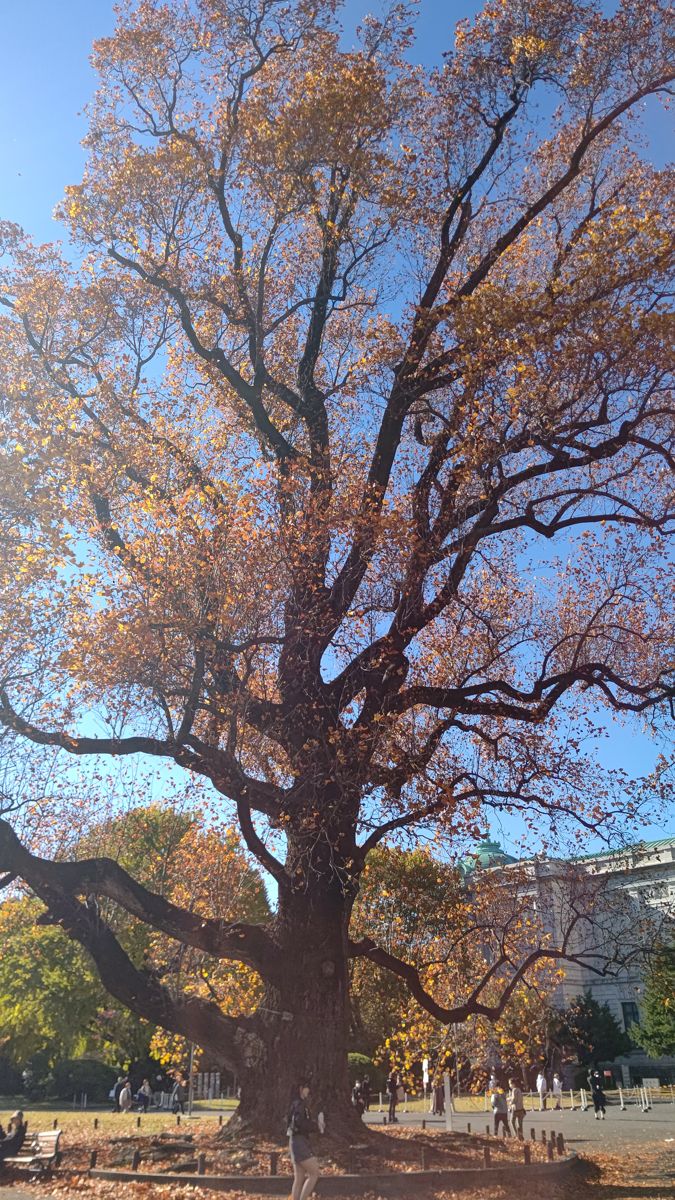
In front of the Honkan of the Tokyo National Museum in Ueno stands a large tulip tree (Liriodendron). Native to North America, one of the seedlings grown from 30 seeds that arrived in the early Meiji era was planted at the museum in 1881 and is said to survive today.[13] In late autumn it draws the eye not with the tulip-shaped flowers that give it its name, but with its large yellowed leaves.
Kitayama cedars at the Musashi Imperial Graveyard
The Musashi Imperial Graveyard in Hachioji contains the Tama Mausoleum of Emperor Taisho (built 1927) and the Musashino Mausoleum of Emperor Showa, among others. Along both sides of the roughly 400 m approach from the main gate, about 150 Kitayama cedars brought from Kyoto are said to be planted. One account says they were about twice a person's height when planted and now exceed 20 m.[14]
The number and origin of the Kitayama cedars come from an encyclopedia-style website and have not yet been confirmed in official sources such as the Imperial Household Agency. The planting year is also unconfirmed.
Tokyo's official tree
Ginkgo Ginkgoaceae
Designated Tokyo's tree on 14 November 1966[15]
Fan-shaped leaves; hard to mistake for anything else. A tree of streets, temples and shrines rather than forests.
More about the ginkgo
Tokyo's official tree is one of the most visible trees in the city. Among street trees, ginkgo numbers 58,858, second by species (as of 1 April 2023).[16] In the front garden of the National Diet Building, a great ginkgo that predates the building still stands.[17]
A fire-resistant tree
When exposed to heat, trees release water from their leaves as vapor, keeping leaf temperature down. Overlapping leaves keep heat from penetrating the crown, and a tree that keeps its shape without burning can act as a "wall" shielding what is behind it.[18] Osaka Prefecture lists ginkgo among species suited to places exposed to radiant heat, because it releases little flammable gas, takes long to ignite and has high moisture content.[18]
After the Great Kanto Earthquake, ginkgo trees were planted on Nihon-Odori in Yokohama over three years from 1927.[19] The story that "ginkgo trees stopped the spread of fire in the earthquake" is often told, but this research found no official source naming a specific place.
Ginkgo nuts: what to know before eating
Ginkgo nuts (ginnan) are an autumn delicacy, but eating too many causes poisoning. The cause is a substance called 4'-O-methylpyridoxine, which blocks vitamin B6 and over-excites the central nervous system. Cooking does not remove it. Symptoms include vomiting, convulsions and dizziness.[20]
There are cases of children aged five or under having convulsions after eating six or seven nuts, and the Japan Poison Information Center advises against giving them to small children. No safe amount for adults has been set. Inquiries peak from October to December. If symptoms appear, always see a doctor, as convulsions may recur.[20]
Ginkgo nuts have long been said to soothe coughs and the like, but this site has not found sources supporting such benefits, so it does not describe them.
The right tree for the right site
Every tree has places where it grows well and places where it does not. Trees planted on suitable sites grow well; on unsuitable sites they grow poorly and are more vulnerable to pests and disease. Choosing species that suit the planting site is called tekichi tekiboku, "the right tree for the right site."[21]
| Soil moisture | Example of suitable trees |
|---|---|
| Moderately moist brown forest soil | Cedar |
| Slightly wet brown forest soil | Cedar (cypress also somewhat suitable) |
| Dry to slightly dry brown forest soil | Red pine |
Example of species selection from Shimane Prefecture's Guide to Reforestation (revised 2020)[21]. In practice, the decision uses two steps: site productivity (site index) and soil type.
The national government, too, is concentrating management on "sites suited to forestry": productive land close to roads and villages. By the end of FY2024, 1.09 million hectares had been designated in municipal plans as "areas where especially efficient forestry is possible." Meanwhile, on harsh sites, plantations are being converted to mixed forests with broadleaf trees through strip and group cutting.[22] It is a fundamental idea for thinking about the future of Tama's plantations (Chapter 2), planted in large numbers after the war on terrain where steep slopes make work difficult.
Tree Diseases, Pests—and Pollen
Matsukui-mushi: Pine Wilt Disease
The real culprit behind the damage known as "matsukui-mushi" ("pine-eating bugs") is the pine wood nematode, a roundworm less than 1 mm long. The Japanese pine sawyer carries this nematode from tree to tree, and a pine infected by it can no longer draw up water and dies.[23] Nationwide damage peaked in FY1979 (Shōwa 54) and by FY2022 (Reiwa 4) had fallen to about one-tenth of that level, 249,000 cubic meters.[24] From FY2023, however, it began rising again, and in FY2025 it surged to about 630,000 cubic meters, 163% of the previous year.[23]
Control measures include spraying insecticide when the sawyers emerge, injecting chemicals into the trunks of healthy pines, and felling dead trees and fumigating, chipping or burning them to wipe out the larvae inside.[23] Some 590 varieties of nematode-resistant pine have also been developed, and in FY2022 they accounted for 80% of pine seedlings.[24] Coastal pine forests protect people's lives from wind, salt spray and tsunamis.[23]
Japanese Oak Wilt: Konara Oaks Dying in Tokyo's Metropolitan Parks
Japanese oak wilt is a disease caused by the Raffaelea quercivora fungus, which is carried by the oak ambrosia beetle (Platypus quercivorus), an insect about 5 mm long. The beetles use an aggregation pheromone to call in others, bore into the trunk en masse and lay their eggs. As the fungus they bring in spreads, it clogs the tree's water-conducting pathways, and between late July and mid-August the leaves discolor and the tree dies.[25] In FY2022, damage was confirmed in 41 prefectures,[24] and nationwide damage in FY2025 amounted to about 212,000 cubic meters.[25]
In Tokyo, in August 2019 (Reiwa 1), large numbers of konara oaks died in several metropolitan parks, including Kinuta Park, and the cause was identified as Japanese oak wilt. In Kinuta Park and Hikarigaoka Park, at least 269 trees of the beech family (Fagaceae) were felled because of oak wilt over five years, about 74% of them konara oaks. Large-diameter trees made up 88.3% of the trees felled in Kinuta Park and 76.5% in Hikarigaoka Park.[26] Most of the trees cut down were ones that had grown big and thick.
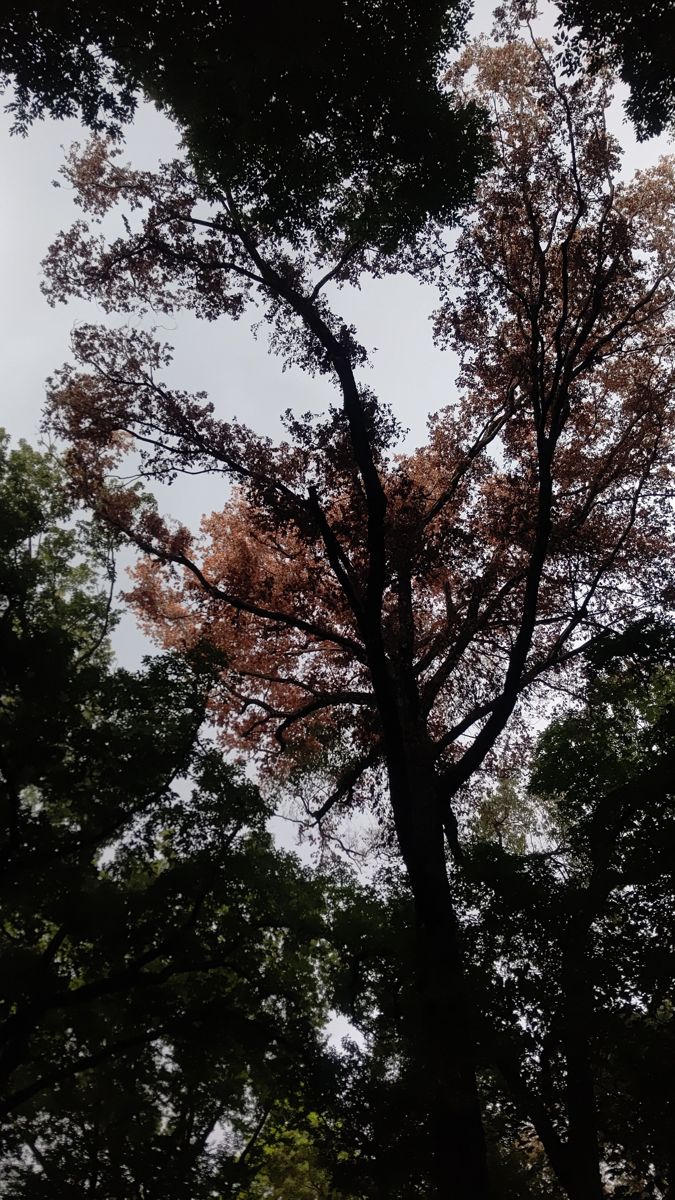
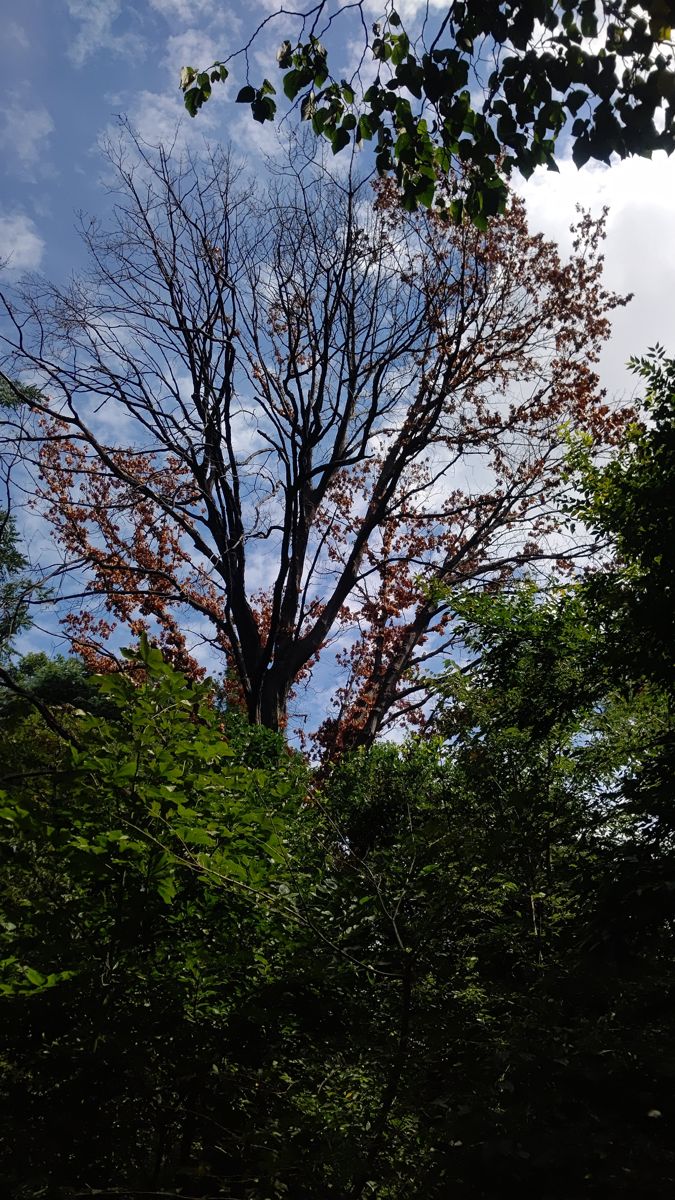
The oak wilt in these photos was identified on site by the author, who took them. The tree species was not recorded.
Other Threats: An Invasive Longhorn Beetle on Cherry Trees, and Deer
The red-necked longhorn beetle (Aromia bungii) is an invasive longhorn beetle that bores into trees of the rose family such as cherry, Japanese apricot (ume) and peach; its larvae feed inside the trunk and kill the tree. A telltale sign is large amounts of "frass," a mix of wood shavings and droppings, coming out of holes in the trunk. In Nerima Ward, adult beetles have been confirmed since July 2026 (Reiwa 8) at sites including Hikarigaoka Park.[27] Tokyo's street trees include about 43,000 cherry trees (Chapter 8), so if the beetle spreads, the impact will be considerable.
In the mountains of Tama, sika deer are increasing. Protection has allowed their numbers to recover, but they have come to eat planted trees and undergrowth, and in 2004 (Heisei 16) severe damage was recorded in Okutama Town, where almost all the topsoil was washed away. The Tokyo Metropolitan Government's managed culling reached 487 deer in FY2020, the highest number on record.[28]
Pollen Allergies and Trees: Not Just Sugi and Hinoki
About 50 plant species have been reported as causes of pollen allergy. The most common is sugi (Japanese cedar); hinoki (Japanese cypress) pollen shares properties with sugi pollen and so also causes sugi pollen allergy. Other trees include Japanese white birch, Japanese alder, Alnus sieboldiana (ōbayashabushi), Japanese zelkova, konara oak and sawtooth oak (kunugi).[29] Tokyo's street trees include about 29,000 zelkovas (Chapter 8), and konara and sawtooth oaks are trees of coppice woodlands. Urban greenery, too, is a source of pollen.
Black locust (Robinia pseudoacacia; harienju) is a tree native to North America, and records show it was introduced to Japan in 1875 (Meiji 8). It has been used for erosion control, greening of barren land and as a street tree, and also to bring back forest on land devastated by smoke pollution from the Ashio Copper Mine. In beekeeping it is regarded as the single most important nectar source.[30] On the other hand, because it can grow rapidly, form dense stands and crowd out native vegetation, it is on the Ministry of the Environment's list of alien species.[30][31] As for pollen allergy, it is not among the main causal trees listed in the Ministry of the Environment's manual.[29] Its flowers are visited by bees for nectar, a different mechanism from sugi, which releases huge amounts of pollen on the wind.[31] Symptoms in early summer may also be caused by grasses, which release pollen from spring to early autumn.[29]
This site has not been able to confirm whether there are no reports at all of symptoms caused by black locust pollen.
Low-Pollen Sugi and Pollen-Free Sugi
The Tokyo Metropolitan Government is running a program to fell sugi and replant with low-pollen varieties (Chapter 2). The varieties planted are of two types.[32]
| Type | Varieties | Characteristics |
|---|---|---|
| Low-pollen sugi cedar | Nishitama No. 2 and Nishitama No. 3 (Tokyo), Naka No. 4 (Kanagawa Prefecture) | Produces few flowers. Varieties suited to the Tama environment have already been developed and are being widely adopted[32] |
| Pollen-free sugi cedar (male-sterile) | Kokorobare Funen No. 1–4 (developed by Tokyo) | Produces no pollen at all. Planted in a test forest in Hinode Town in 2013; new individuals were also planted in 2021–2023 for verification[32] |
There are also sugi cedars called "hybrids." Tottori Prefecture, for example, is artificially crossing sugi carrying the pollen-free gene with sugi that grow well and resist snow and pests, to develop varieties that release no pollen and are also suited to forestry.[33] Unless eliminating pollen goes hand in hand with trees that grow well and sell, replanting will not move forward.
The only example of a "hybrid" this site could confirm is Tottori Prefecture's pollen-free sugi bred by crossing. Tokyo Metropolitan Government documents use the terms "low-pollen sugi" and "pollen-free sugi."
Sources
- 林野庁関東森林管理局「多摩森林計画区の概要」 PDF
- 環境省 富士箱根伊豆国立公園 指定書等資料 PDF
- 東京都 木育関連リーフレット(令和5年度) PDF
- 林野庁掲載 活木活木森ネットワーク「木づかい普及啓発テキスト」 PDF
- 日本スポーツ振興センター「国立競技場について」 PDF
- 長野県林業総合センター 研究トピックス(接着重ね梁) PDF
- 林業試験場研究報告 第319号(1982年、国産主要35樹種の強度試験) PDF
- 農林水産省「製材の日本農林規格」改正告示(耐久性区分D1の樹種) PDF
- 北海道「樹種別の気乾密度の値の例」(森林総合研究所監修『木材工業ハンドブック』改訂4版による) PDF
- 環境省「巨樹・巨木林データベース」リニューアル(2018年3月1日) Link
- ニッポン旅マガジン「御岳の神代ケヤキ」 Link/観光庁 多言語解説文 Link
- 環境省 巨樹・巨木林データベース 観察コースガイド「明治神宮」 PDF
- 中部大学 太田明徳「ユリノキ(ハンテンボク、蓮華木、チューリップツリー)」 PDF
- 「武蔵陵墓地」(百科事典系サイト) Link
- 東京都「東京都の紋章・花・木・鳥」 Link
- 東京都建設局「東京の街路樹 総括表」(令和5年4月1日現在) PDF
- 参議院「国会議事堂を見る」 Link
- 大阪府「樹木の防火機能」 Link
- 横浜市「街路樹の歴史」 Link
- 日本中毒情報センター「ギンナンの食べ過ぎに注意しましょう」(2022年9月30日更新) PDF
- 島根県『新たな再造林の手引き』(令和2年4月改訂) PDF
- 林野庁『令和7年度 森林・林業白書』特集 Link
- 林野庁「松くい虫被害」 Link
- 林野庁『令和5年度 森林・林業白書』第1章(森林の病虫獣害) Link
- 林野庁「ナラ枯れ被害」 Link
- 東京都公園協会「ナラ枯れによって都立公園の樹林はどのように変化したのか ~砧公園・光が丘公園~」 PDF
- 練馬区「クビアカツヤカミキリ」 Link
- 東京都環境局 ニホンジカ管理に関する資料 PDF
- 環境省『花粉症環境保健マニュアル』第2章 PDF
- 環境省 生態系被害防止外来種リスト 参考資料(ハリエンジュ) PDF
- 北海道立総合研究機構 林業試験場「ニセアカシアの分布、生態、管理に関する解説書」 PDF
- 東京都農林水産振興財団 スギ花粉症対策品種に関する資料 PDF
- 鳥取県林業試験場 業務報告(ハイブリッド無花粉スギの開発) PDF