Introduction / Chapter 6
Processing & Civil Works
Logs cannot be used as they are. They must be split, sawn or laminated. This chapter follows how wood has been processed from the Edo period to today, and how it has been used in civil works such as utility poles and land reclamation.
Working the wood
Splitting: older than the saw
Cedar grows straight and splits easily along the grain. It can be split as thin as about 5 mm and was used for barrels and tubs.[1] Old Japanese saws were crosscut tools, poorly suited to sawing wood lengthwise.[2] That is why easily split wood was so valued.
Sawing: the oga and the maebiki-oga
The oga, a saw for ripping wood lengthwise, came from China in the 14th–15th centuries (mid-Muromachi period). Its blade, about 2 m long and 5 cm wide, was stretched in a frame and worked by two people.[2] It made it easy to cut wide, thin boards, transforming board making and woodworking.[2]
In the early Edo period the one-person maebiki-oga appeared and spread.[2] Craftsmen who sawed logs into boards and squared timber were called kobiki, sawyers.
| Method | Period | What it does |
|---|---|---|
| Splitting | Since ancient times | Splitting straight logs lengthwise; staves for barrels and tubs[1] |
| Oga (two-person) | Introduced 14th–15th c. | Rip-sawing wide, thin boards[2] |
| Maebiki-oga (one-person) | Spread in early Edo | A sawyer rips alone[2] |
| Glulam / CLT | Today | Small pieces laminated into large columns, beams and walls[3] |
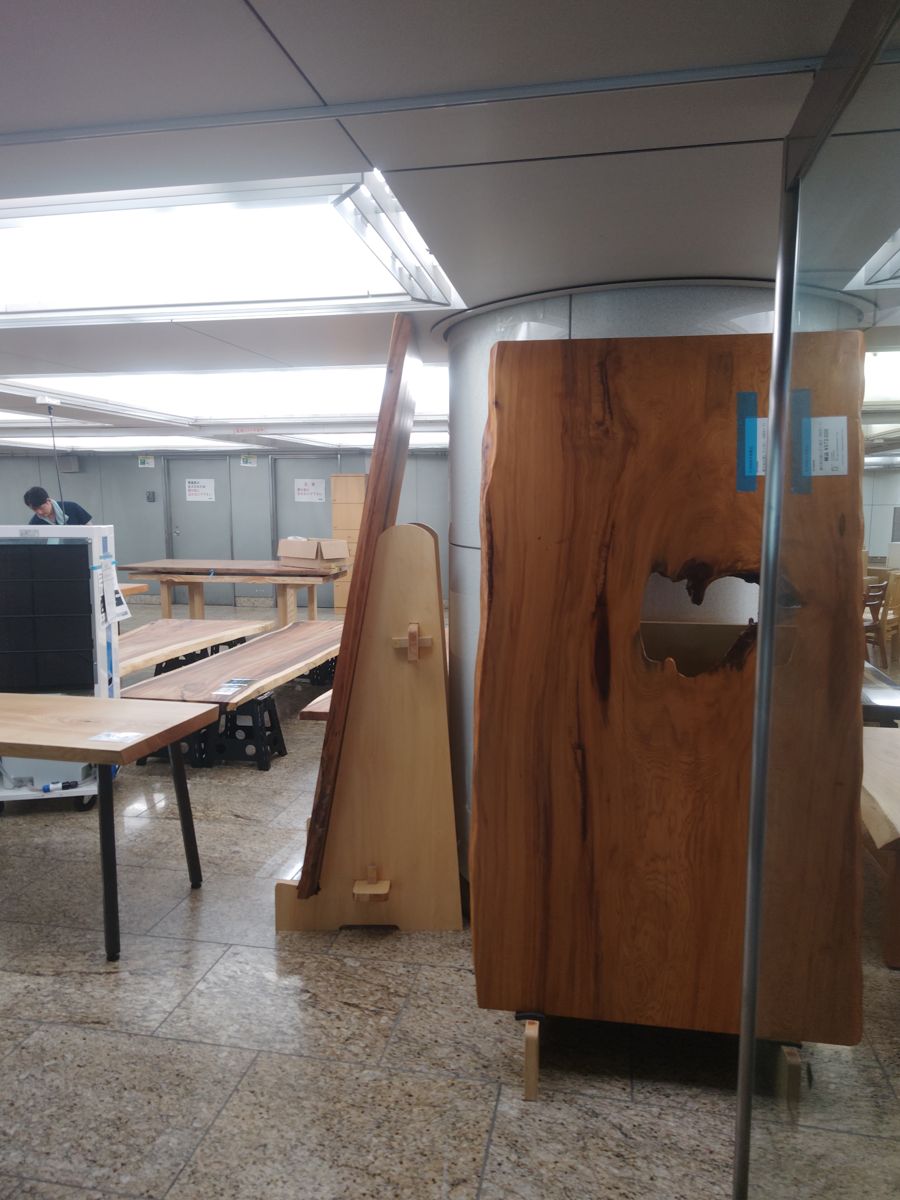
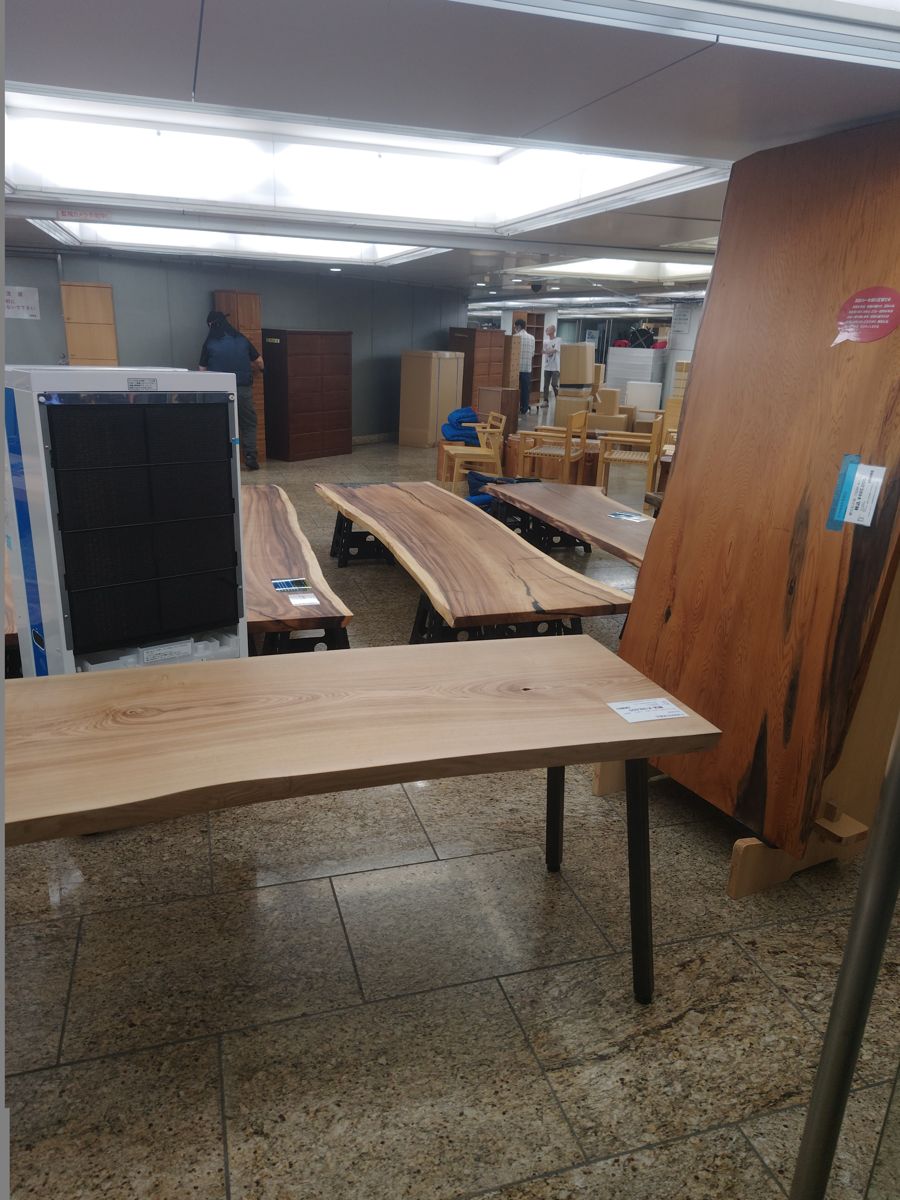
Single-piece slabs sawn from large trees remain popular. In July 2026, a slab sale was held in the event space beneath JR Shinjuku Station, with boards still bearing their bark-side edges (live edges) and boards with holes where knots had fallen out lined up as tabletops.
Laminating: glulam and CLT
Today's timber buildings are supported by laminated materials. The National Stadium's roof frame uses glulam of larch and cedar, and athletes' facilities use domestic CLT (panels of boards layered crosswise).[3] In Nagano Prefecture, a "glued stacked beam" made from small and medium larch logs under 30 cm in diameter has received ministerial certification.[4] Being able to turn slender trees into structural members for large buildings is what made timber buildings in central Tokyo possible (Chapter 5).
Showing it off: furniture that makes use of cracks and rot
Cracks, rot holes and edges with bark left on are the parts usually cut away in ordinary sawmilling. Set in clear resin, they become furniture that shows those shapes as they are.
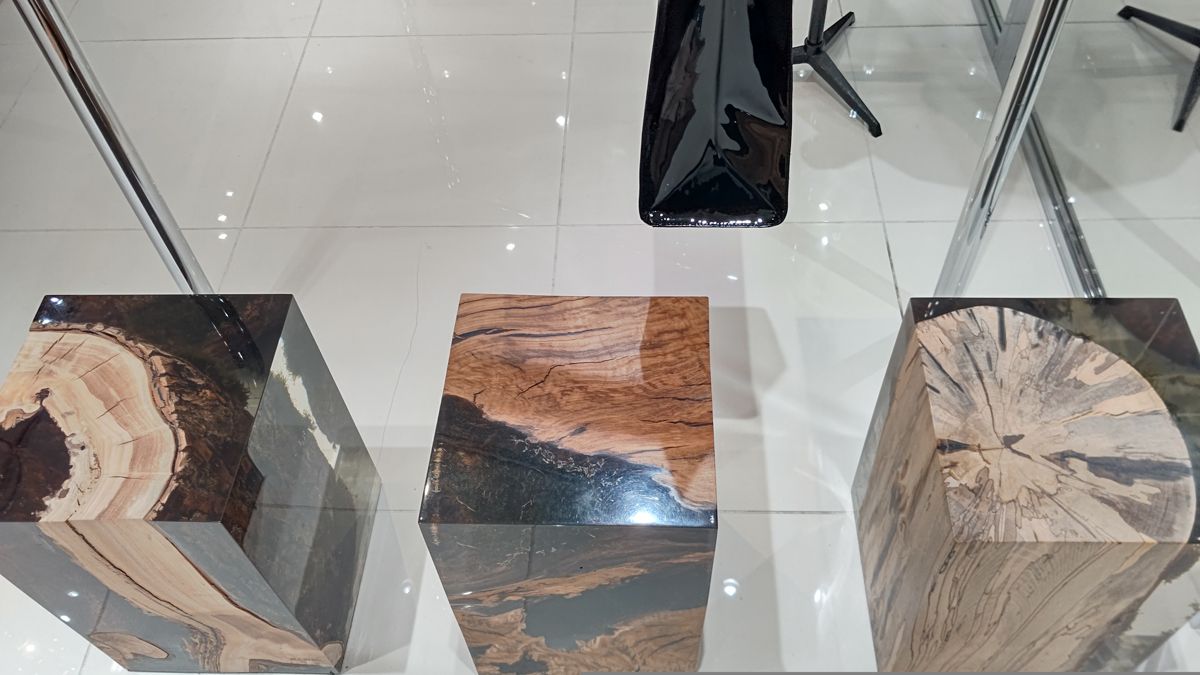
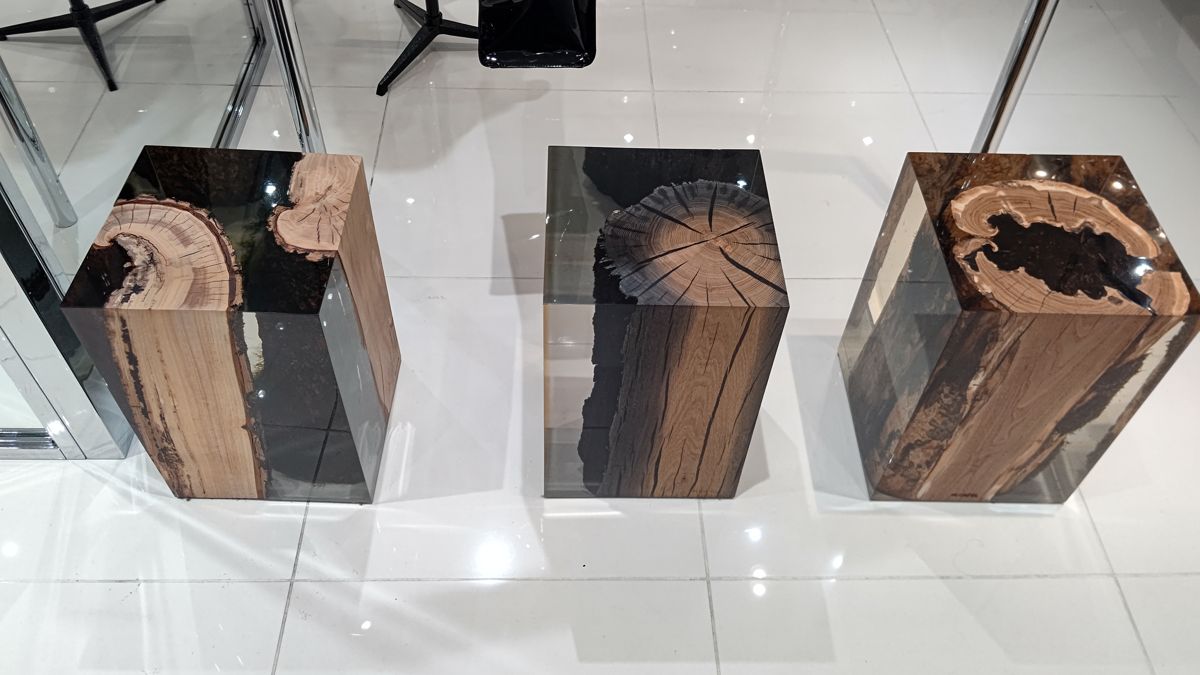
There were also solid-wood stools carved from blocks of log, without resin. The cracks running from the heart of the growth rings and the marks of the cutting tools are left as they are.
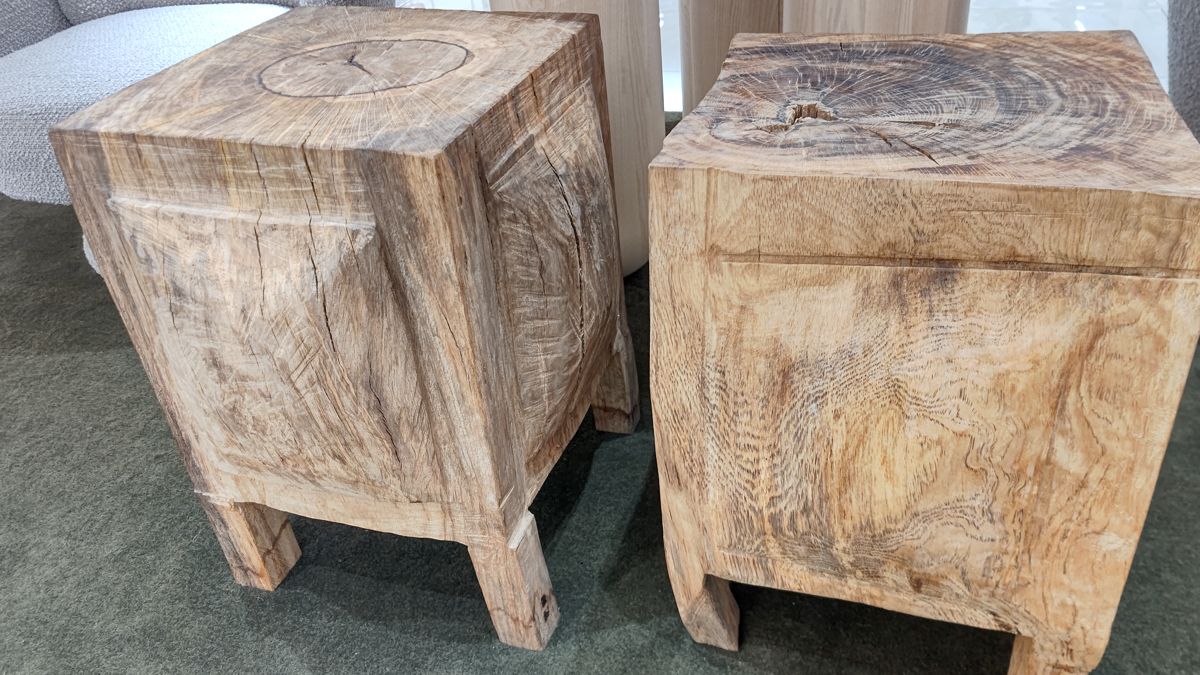
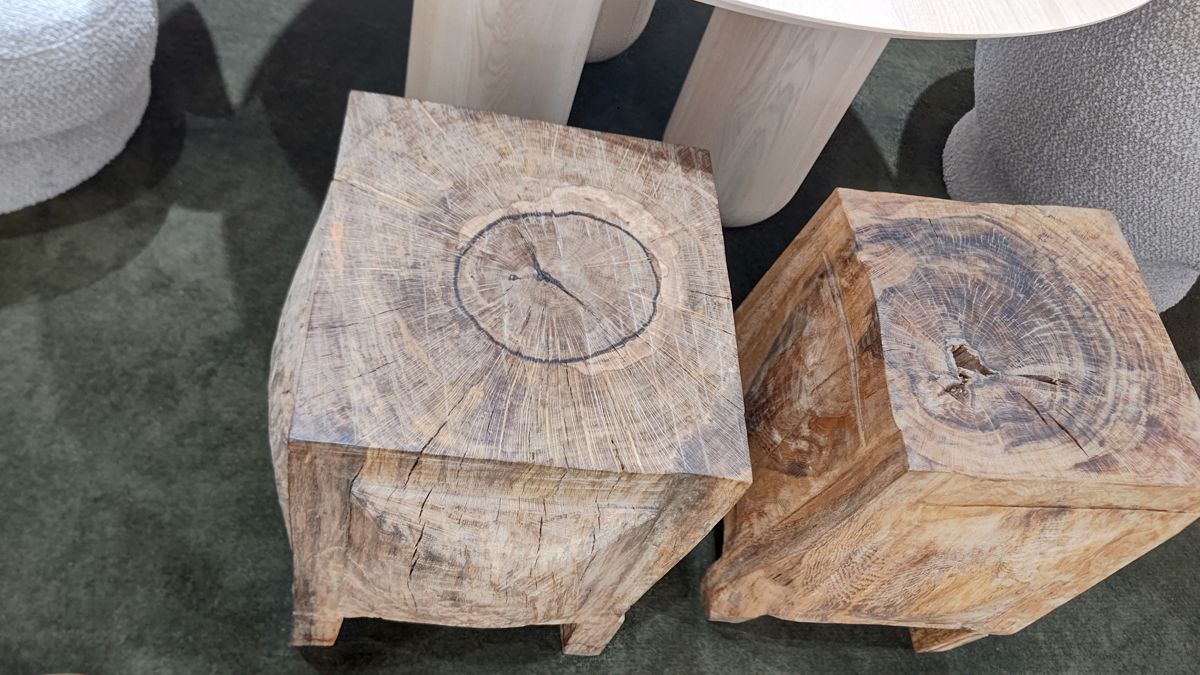
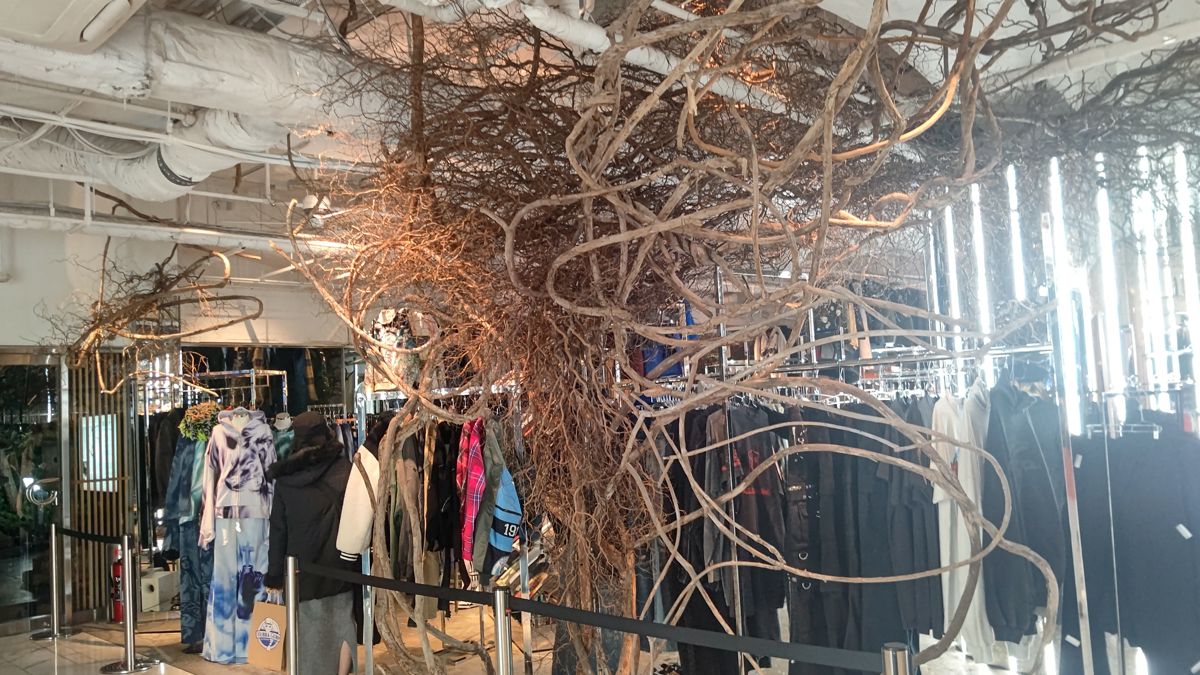
Even without making furniture, the shapes of branches and roots themselves can be put on show. In a clothing store in Shibuya, a huge tangle of dried branches and vines hung from the ceiling, spreading over the sales floor.
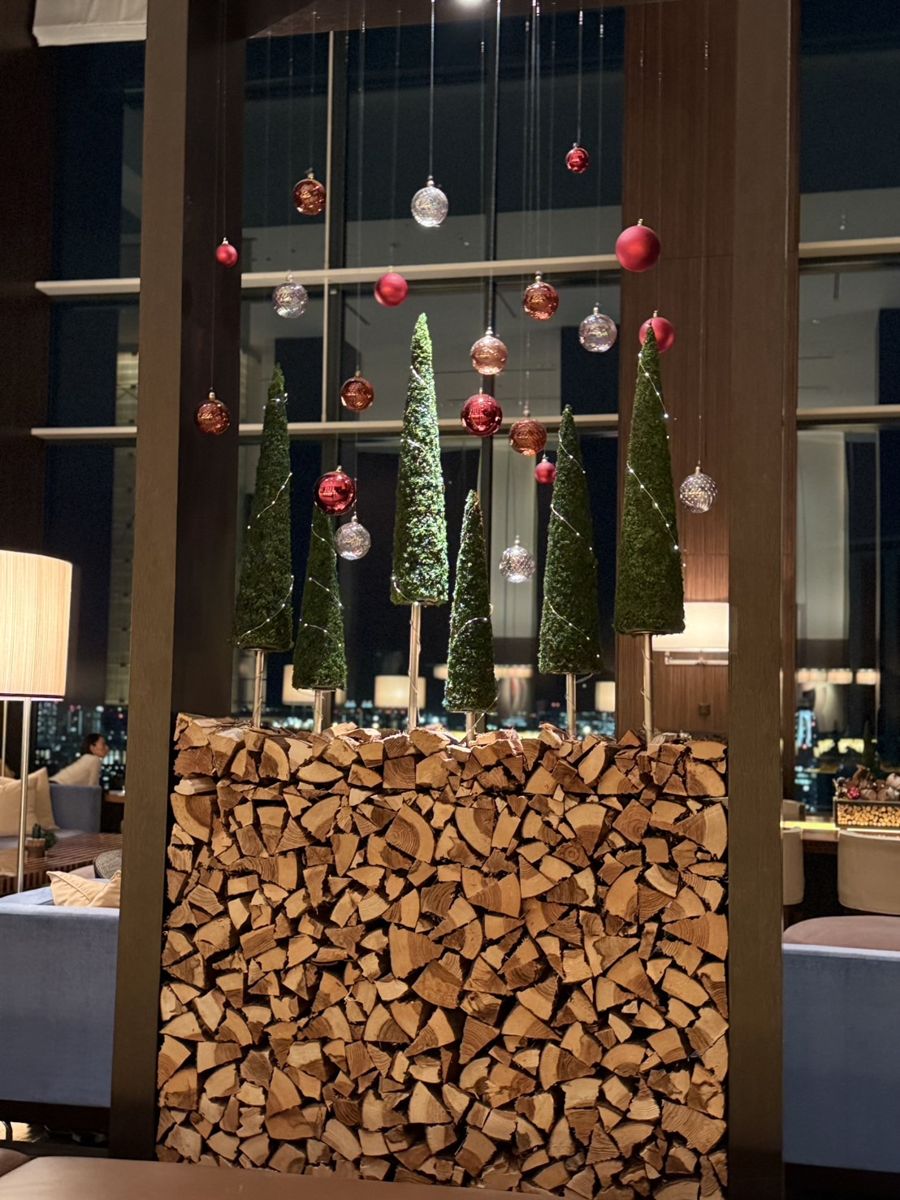
Split firewood, once stacked, becomes decoration in itself. In the lounge of the Conrad Tokyo in Shiodome, small conifer ornaments were lined up on a partition of firewood stacked like a wall.
The resin blocks and solid-wood stools were photographed on the sales floor of a department store in Tokyo with the store's permission. I did not record what kinds of wood and resin were used.
The city's foundations, and where felled trees go
Wooden utility poles
Japan's first utility poles were erected in 1869 to carry an official telegraph line between the Yokohama lighthouse office and the court. From early Meiji to the Taisho era, poles were made of wood.[5]
Wooden poles rot from where they meet the ground. A Hokkaido study describes poles pressure-treated with creosote oil, mainly of Yezo spruce and Sakhalin fir, with larch used for small poles. Poles erected in 1958 had lost their preservative 22 years later and were badly decayed, especially at ground level.[6] The report, from 1981, notes that concrete poles were already common in urban areas.[6]
When and how Tokyo's wooden poles were replaced by concrete is still being researched. The species and treatment above are examples from Hokkaido.
Reclaiming Tokyo Bay
Much of Tokyo's land was made by filling in the sea. Soon after entering Edo, Tokugawa Ieyasu began filling in the Hibiya Inlet, turning it into land between 1593 and 1614. He also cut down Kanda Hill and used its soil to fill the area from Nihonbashi-Hamacho to Shinbashi. The center of Edo's port was placed at Nihonbashi.[7]
East of the Sumida River, reclamation began in 1596. Between 1615 and 1629 reclaimed land increased rapidly in today's eastern Chuo ward, including Reiganjima. Each piece of land was surrounded by canals and became a kashi, a landing for boats.[7]
Timber storage overlaps with this history of reclamation. Genroku-era Kiba was built by timber wholesalers who filled in the Fukagawa marshes themselves (Chapter 1). Shin-Kiba, where it moved in the Showa era, also stands on reclaimed land in Tokyo Bay.
Where felled wood goes
Tama has long been known as the "Ome forestry district," producing mainly posts and scaffolding poles.[8] Today, besides building timber, its wood also goes into plywood (Chapter 7) and fuel. Here we look separately at wood cut in the mountains and wood cut in the city.
Mountain wood as fuel: Hinohara Village
Hinohara Village continues to turn its own wood into heat.[9][10]
| Year | Facility | Details |
|---|---|---|
| 2012 | Kazuma no Yu hot spring center | Two 80 kW firewood boilers installed alongside kerosene boilers; all of the roughly 70 t of firewood used annually comes from the village[9] |
| 2012 | Firewood production | A system to collect wood and make firewood created jobs through the Silver Human Resources Center; firewood is sold stacked on pallets[10] |
| 2017 | Yasuragi no Sato welfare facility | A wood chip boiler replaced fossil fuels[10] |
The village subsidizes felling and hauling so that thinned wood, previously left lying in the mountains, can be brought out.[10] Using wood as fuel gives a use even to the thin and crooked parts of felled trees.
Returning city trees to the city: green recycling
Branches and leaves from pruning parks and street trees can also be used. Since FY1990, Koto City has returned branches and fallen leaves from its greenery back to its own green spaces instead of burning or burying them.[11]
| Form | Use |
|---|---|
| Chips | Cushioning for park paths, mulch for planting beds[11] |
| Compost | Given out at ward events; soil improvement in parks and schools[11] |
| Wood | Tree name plates; craft material for schools and kindergartens[11] |
Tokyo has more than one million street trees (Chapter 8). How to use their prunings is a kind of "urban forestry" challenge.
Laid on park paths: wooden paving of Tama timber
Tama wood is also used underfoot in metropolitan parks. According to a sign by the Tokyo Metropolitan Eastern Park Office that I saw in Ueno Park, the Tokyo government has used Tama timber, including thinnings, for road guard fences, the "Memorial Benches" in metropolitan parks and more, to conserve Tama's deteriorating forests and help prevent global warming. The sign explains that wooden paving will eventually rot and need replacing, but that this keeps thinnings in use and so helps protect the Tama forests.
It is a way of counting rot not as a defect but as a reason to keep using wood. The sign does not say, however, how much wood went into the paving, or whether Tama timber is used again each time it is replaced.
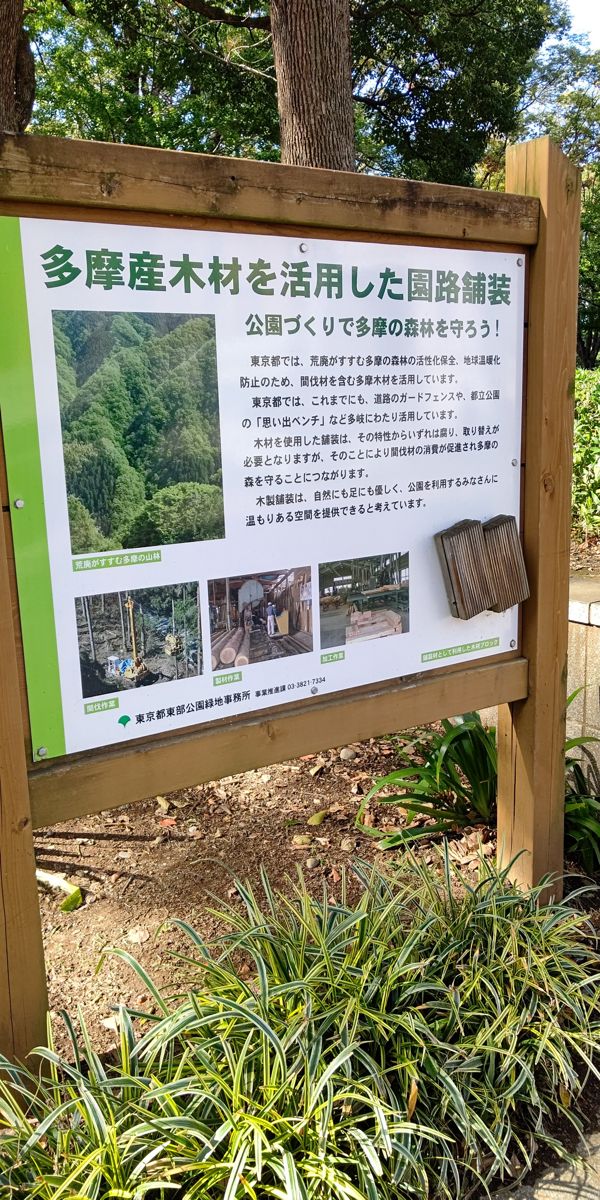
The sign's content is as of October 2021, when the photo was taken. I have not checked the current state of the paving.
Wood crossing the prefectural border: the Otsuki biomass power plant
Felled wood is sometimes carried out of Tokyo. The Otsuki Biomass Power Plant in Otsuki, Yamanashi, has an output of about 14,500 kW, enough electricity for about 30,000 households. It burns about 150,000 tonnes a year of chips made from unused thinnings and pruned branches, mainly from Yamanashi and the wider Kanto region.[12] It began commercial operation in summer 2018.[13]
When the author saw it from a train window in October 2020, logs were piled high in the plant's yard. They were "obstructing trees" (trees felled because they stand in the way of construction) from the building of the Shin-Tomei Expressway (the Second Tomei). Trees cut to build a road were being turned into electricity.
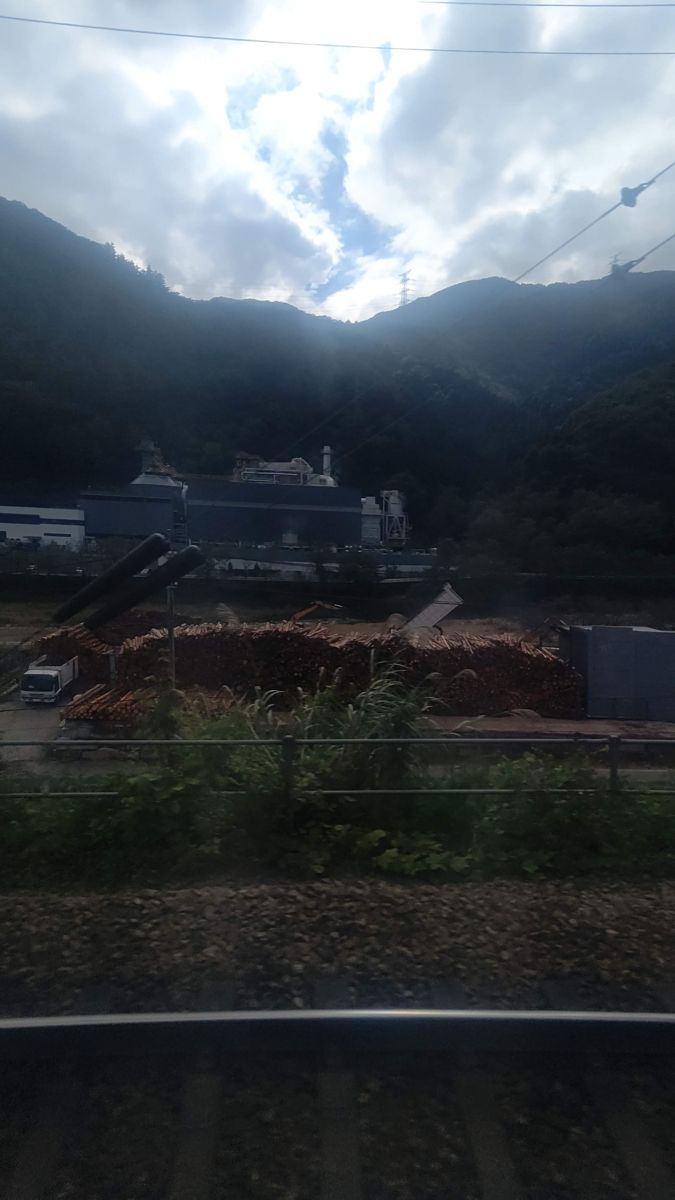
The acceptance of obstructing trees is based on what the author saw and heard on site; it has not been checked against materials from the power plant or the expressway company.
Sources
- 東京都 木育関連リーフレット(令和5年度) PDF
- コトバンク「大鋸」 Link
- 日本スポーツ振興センター「国立競技場について」 PDF
- 長野県林業総合センター 研究トピックス(接着重ね梁) PDF
- 国土交通省 無電柱化に関する資料 PDF
- 北海道立林産試験場『林産試月報』1981年4月号(クレオソート油処理木柱) PDF
- 国土交通省 関東地方整備局 東京港湾事務所「江戸の港」(原典:鈴木理生『江戸の川・東京の川』ほか) PDF
- 東京都「林業・木材産業循環成長対策 変更事業構想」 PDF
- 林野庁『平成28年度 森林・林業白書』事例(檜原村 数馬の湯) Link
- 環境情報センター(EIC)「首長に聞く」檜原村 Link
- 江東区「緑のリサイクル」 Link
- 大林組 ニュースリリース「大月バイオマス発電所の建設に着手」(2016年8月4日) Link
- 大林組 ニュースリリース(2018年6月1日、大月バイオマス発電所の営業運転開始) Link