Introduction / Chapter 2
Tama Forestry
About 70% of Tokyo's forests are in the Tama area in the west of the metropolis, roughly 53,000 hectares.[1] In Tama's privately owned forests, 60% are planted forests of cedar, cypress and similar species, most of them planted between the mid-1950s and the early 1970s.[1]
Tama's forests today
An era of planting, and an era of not planting
Planting exceeded 1,500 hectares a year in 1960. It then fell sharply, to just 6 hectares in 2003.[1] In terms of age classes, the mountains are filled with trees of the same generation, with almost no young forest.
| Fiscal year | Area newly planted | Situation |
|---|---|---|
| 1960 | Over 1,500 ha | Peak of expansion planting |
| 2003 | 6 ha | Lowest point |
| FY2022 | 48 ha | Harvest-and-replant program continues |
Source: Tokyo Metropolitan Government, Plan for Circular Growth of Forestry and Timber Industry (revised)[1]
Why the trees are not cut
A long slump in timber prices and rising labor costs made forestry unprofitable, so harvesting of cedar and cypress over 50 years old, big enough to use, came to a halt.[3] Steep terrain raises operating costs, and Tokyo's forestry businesses are small with thin margins.[1]
Reaching the city as pollen
Unharvested cedar affects city life too. A 2017 survey estimated the prevalence of cedar pollen allergy in Tokyo at 48.8%, up from 28.2% in the FY2006 survey.[3] The Tokyo Development Foundation for Agriculture, Forestry and Fisheries runs a program to fell cedar and replant low-pollen varieties. From FY2006 to FY2020 the program shipped a cumulative 257,000 cubic meters of timber.[3]
Natural forests and national forests
In the Mt. Takao national forest in Hachioji, a natural fir forest is designated as a protected plant community. The area lies on the boundary between cool-temperate and warm-temperate zones, and its natural forests include Japanese blue beech (inubuna), konara oak, fir and hemlock.[4]
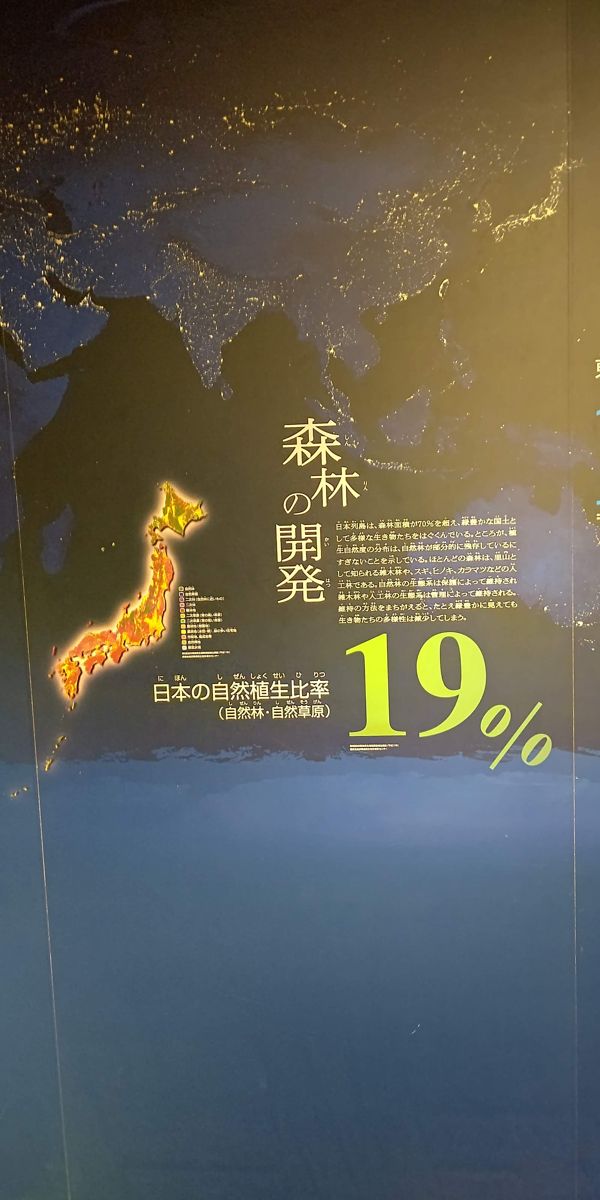
Across Japan as a whole, vegetation left in its natural state is not common. An exhibit panel I saw at a museum in Ueno Park showed that while forests cover more than 70% of Japan, most of them are satoyama coppice woodland or plantations of sugi, hinoki, larch and the like, and that "natural vegetation"—natural forest and natural grassland combined—makes up 19%. The panel cites the Ministry of the Environment's National Survey on the Natural Environment as its source.
Forestry workers and money
Forestry workers: 44,000 nationwide
The number of people working in forestry nationwide (forestry workers) has declined for decades, reaching about 44,000 in 2020. The share aged 65 and over (the aging rate) is 25%, above the 15% for all industries. Meanwhile, the share under 35 (the youth rate) has risen since 1990 and now stands at 17%.[5]
Before the national "Green Employment" program began, an average of about 2,000 people a year entered forestry; after it began, the number rose to about 3,200 a year.[5] A system that lets newcomers start working while receiving on-the-job training is bringing more people into the field.
Forestry on the ground in Tokyo
In a Tokyo Metropolitan Government survey of forestry businesses in Tokyo (54 businesses responded), the average age of field workers was 45.7, and about 27% were 34 or younger. In FY2024, 21 people joined and 19 left, a one-year retention rate of 91.8%. Workers with 15 years of experience or less make up 57.3%.[6]
The most common pay band was "¥4 million to under ¥4.5 million," at 26.2%, and about 46% earned under ¥4 million. About three-quarters of the businesses surveyed had raised wages from the previous year.[6]
Danger and working conditions
Forestry is still dangerous work. The number of workers killed or injured per 1,000 workers per year (the injury rate per 1,000 workers per year) was 23.5 in forestry in 2022, against 2.3 for all industries, about 10 times higher. Average annual pay was ¥3.61 million in forestry and ¥4.58 million across all industries.[7]
Ways of working are changing. The share of workers employed 210 days or more a year has risen from 9% in FY1985 to about 70%, and the share paid a monthly salary from 2% to about 30%.[7] Employment is moving toward a stable, year-round form.
Mechanization: high-performance forestry machines
Felling, delimbing, cutting to set lengths, hauling out. Work once done by hand with chainsaws and wire ropes is now taken on by specialized machines. Nationwide there were 16,431 high-performance forestry machines in FY2024, up 1,365 from the previous year and about 2.3 times the 7,089 of ten years earlier (FY2014).[8]
| Machine | What it does | Units (FY2024) |
|---|---|---|
| Forwarder | Loads cut logs onto its bed and hauls them out | 5,186[8] |
| Processor | Delimbs felled trees and cuts them to set lengths | 2,348[8] |
| Harvester | Fells standing trees, then delimbs and cross-cuts them | 2,272[8] |
| Swing yarder | Uses wire ropes to pull logs up or down slopes | 1,151[8] |
Descriptions of what the machines do are general. Unit counts are national totals; figures for Tokyo have not been confirmed.
Does forestry pay?
According to a Forestry Agency estimate, harvesting 1 hectare of 50-year-old sugi (Japanese cedar) plantation yields ¥3.98 million in log sales. But after subtracting the cost of felling and transport, the forest owner's share (the stumpage price) is just ¥1.37 million. The cost of then planting seedlings and starting to raise them is ¥2.75 million, more than that share. Simply harvesting and replanting puts the owner in the red.[9]
The Forestry Agency estimates that "new forestry," combining mechanization with labor-saving planting, could turn a profit of ¥710,000 with measures available today, and ¥1.13 million with new technologies.[9] How much the forest owner's share has fallen compared with the past is summarized under "Timber prices in the past" in the Appendix.
Per-hectare amounts are Forestry Agency estimates for Japan as a whole, not figures for Tokyo's forests alone.
How to secure the workforce
The pillars of securing workers are employment support with training, such as the national "Green Employment" program, and better conditions such as higher wages and year-round employment.[5][7] In Tokyo, most businesses have raised wages, and the number of new entrants and leavers is roughly in balance.[6] Information on finding forestry jobs in Tokyo, and contacts for volunteering in forest care, are collected in the links in the Appendix.
Sources
- 東京都産業労働局「林業・木材産業循環成長対策 変更事業構想」 PDF
- 東京都「森づくり推進プラン」表1-1(原典:令和2年版 東京の森林・林業) PDF
- 公益財団法人東京都農林水産振興財団 説明資料 PDF
- 林野庁関東森林管理局「多摩森林計画区の概要」 PDF
- 林野庁「林業労働力の動向」 Link
- 東京都森林事務所『林業関係労働力実態分析報告書』(令和7年度、令和8年3月) PDF
- 林野庁「一目でわかる林業労働(データ編)」 PDF
- 林野庁「高性能林業機械の保有状況」 Link
- 林野庁『令和5年度 森林・林業白書』第2章(林業経営の効率化) Link