Einführung / Kapitel 6
Verarbeitung & Tiefbau
Rundholz lässt sich nicht so verwenden, wie es ist. Es muss gespalten, gesägt oder verleimt werden. Dieses Kapitel verfolgt, wie Holz von der Edo-Zeit bis heute verarbeitet wurde und wie es im Tiefbau eingesetzt wurde, etwa für Strommasten und die Landgewinnung.
Holz bearbeiten
Spalten: älter als die Säge
Zedernholz wächst gerade und lässt sich leicht entlang der Faser spalten. Es kann bis auf etwa 5 mm Dicke gespalten werden und wurde für Fässer und Bottiche verwendet.[1] Alte japanische Sägen waren Quersägen und eigneten sich schlecht zum Längssägen von Holz.[2] Deshalb war leicht spaltbares Holz so geschätzt.
Sägen: oga und maebiki-oga
Die oga, eine Säge zum Längstrennen von Holz, kam im 14.–15. Jahrhundert (mittlere Muromachi-Zeit) aus China. Ihr etwa 2 m langes und 5 cm breites Blatt war in einen Rahmen gespannt und wurde von zwei Personen geführt.[2] Sie erleichterte das Schneiden breiter, dünner Bretter und veränderte Brettherstellung und Holzbearbeitung grundlegend.[2]
In der frühen Edo-Zeit kam die von einer Person geführte maebiki-oga auf und verbreitete sich.[2] Handwerker, die Stämme zu Brettern und Kanthölzern sägten, hießen kobiki, Brettschneider.
| Methode | Zeit | Funktion |
|---|---|---|
| Spalten | Seit alters her | Längsspalten gerader Stämme; Dauben für Fässer und Bottiche[1] |
| Oga (zwei Personen) | Eingeführt 14.–15. Jh. | Längssägen breiter, dünner Bretter[2] |
| Maebiki-oga (eine Person) | Verbreitet in der frühen Edo-Zeit | Ein Brettschneider sägt allein der Länge nach[2] |
| Brettschichtholz / CLT | Heute | Kleine Teile zu großen Stützen, Trägern und Wänden verleimt[3] |
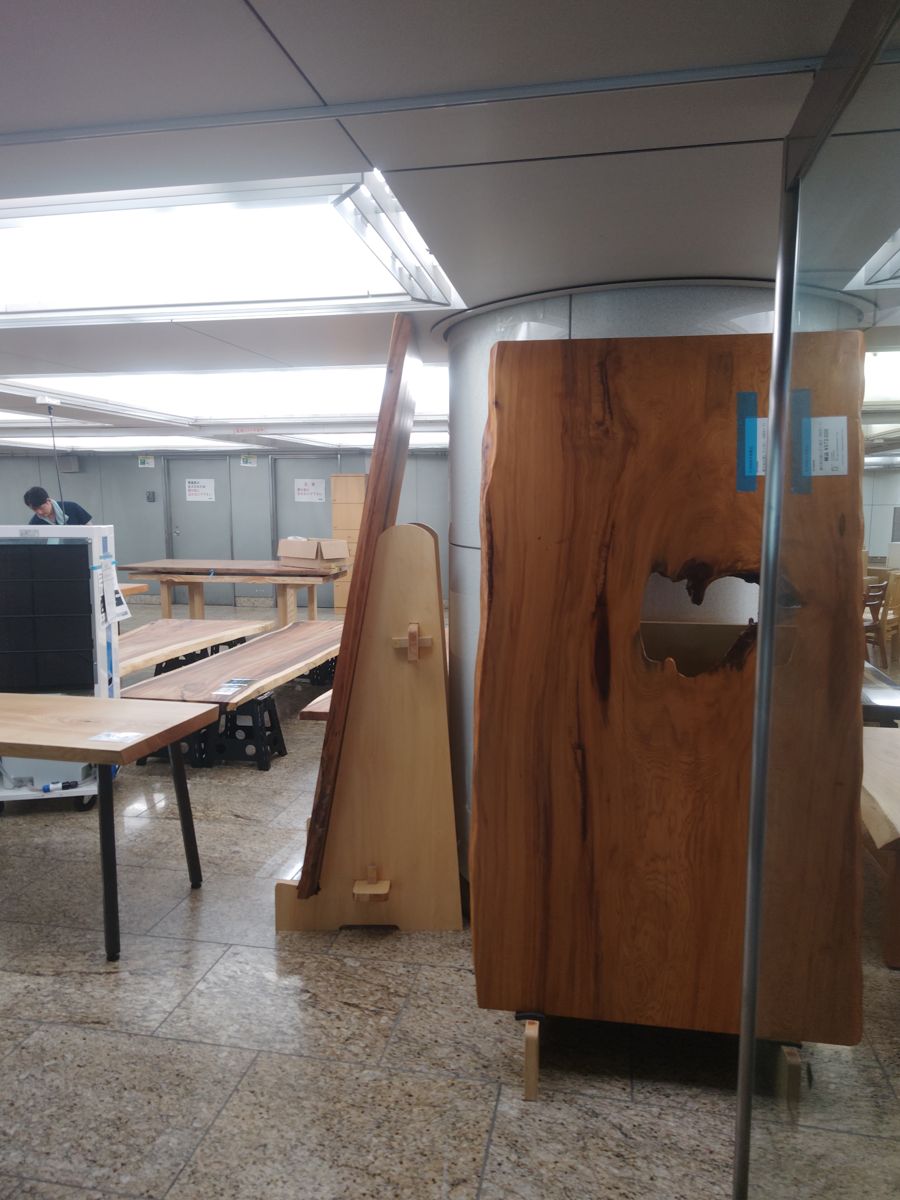
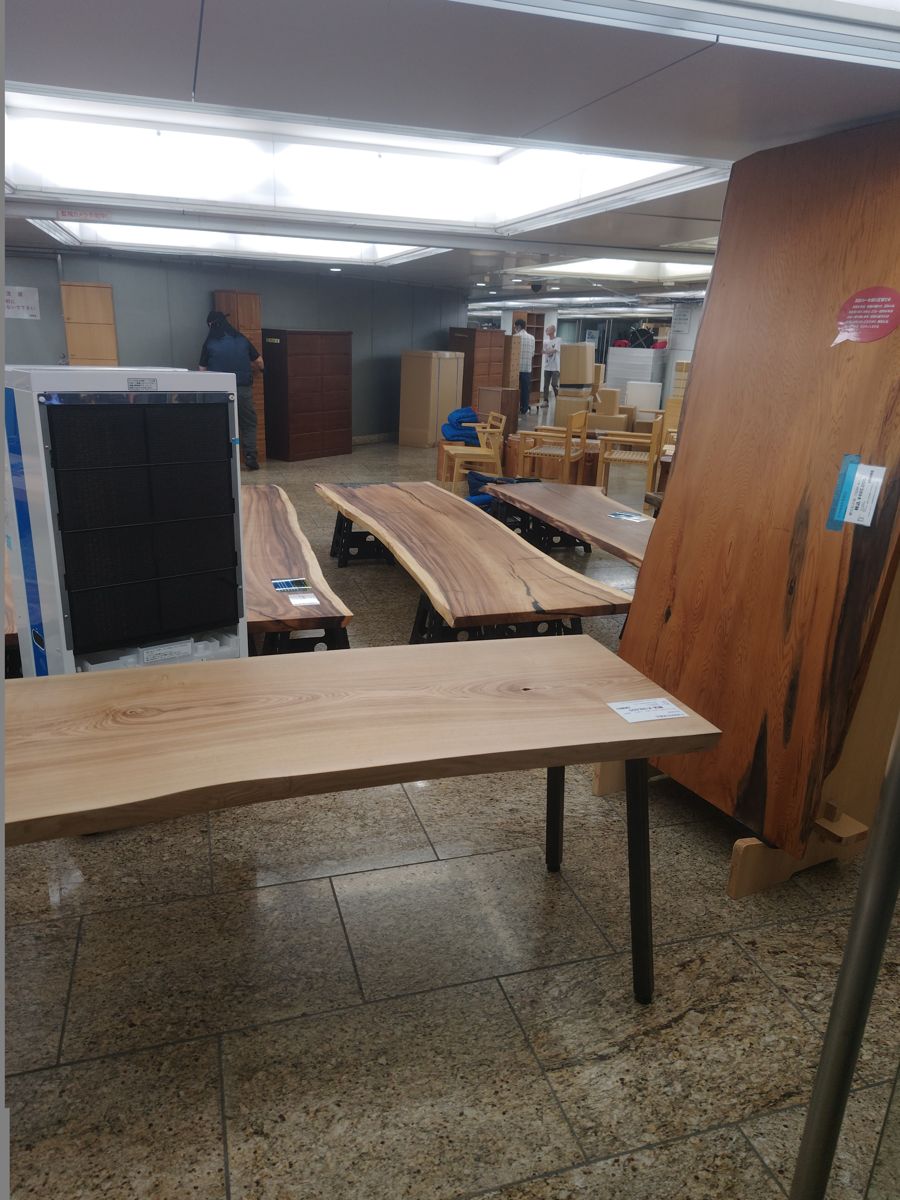
Single-piece slabs sawn from large trees remain popular. In July 2026, a slab sale was held in the event space beneath JR Shinjuku Station, with boards still bearing their bark-side edges (live edges) and boards with holes where knots had fallen out lined up as tabletops.
Verleimen: Brettschichtholz und CLT
Heutige Holzbauten werden von verleimten Werkstoffen getragen. Das Dachtragwerk des Nationalstadions besteht aus Brettschichtholz aus Lärche und Zeder, und in den Einrichtungen für die Athleten wurde inländisches CLT (kreuzweise geschichtete Brettlagen) verwendet.[3] In der Präfektur Nagano hat ein „verleimter Stapelbalken“ aus Lärchenstammholz kleiner und mittlerer Durchmesser unter 30 cm eine ministerielle Zulassung erhalten.[4] Dass sich schlanke Bäume in Tragelemente für große Gebäude verwandeln lassen, hat Holzbauten im Zentrum Tokios erst möglich gemacht (Kapitel 5).
Showing it off: furniture that makes use of cracks and rot
Cracks, rot holes and edges with bark left on are the parts usually cut away in ordinary sawmilling. Set in clear resin, they become furniture that shows those shapes as they are.
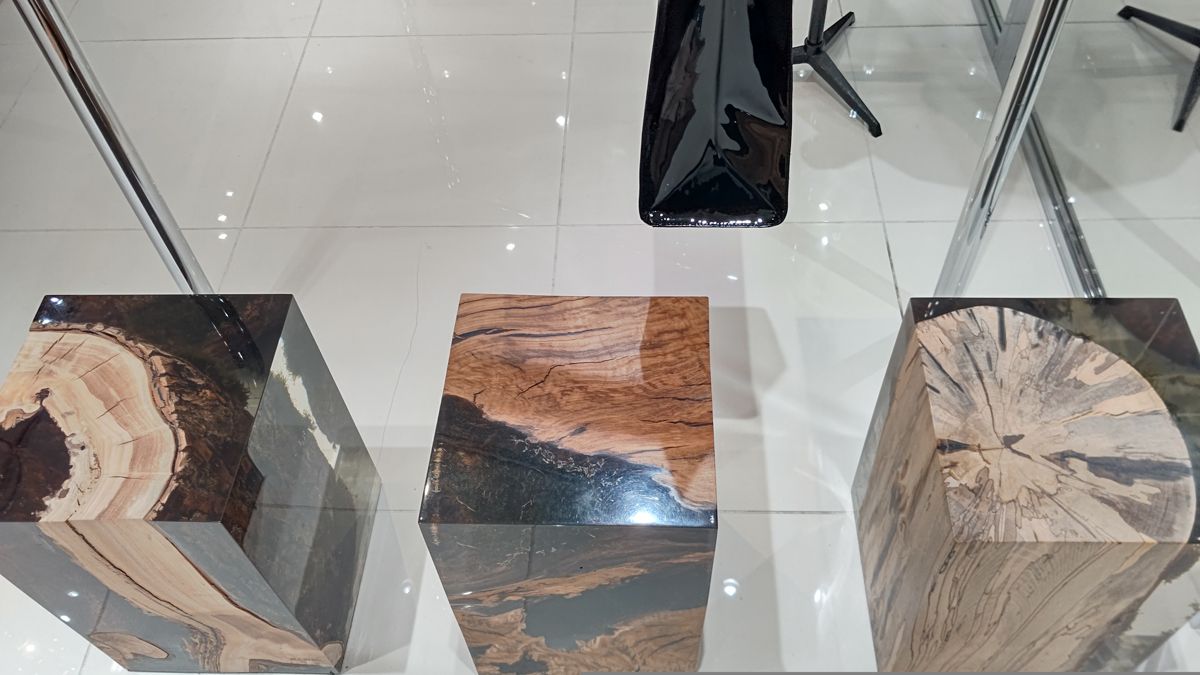
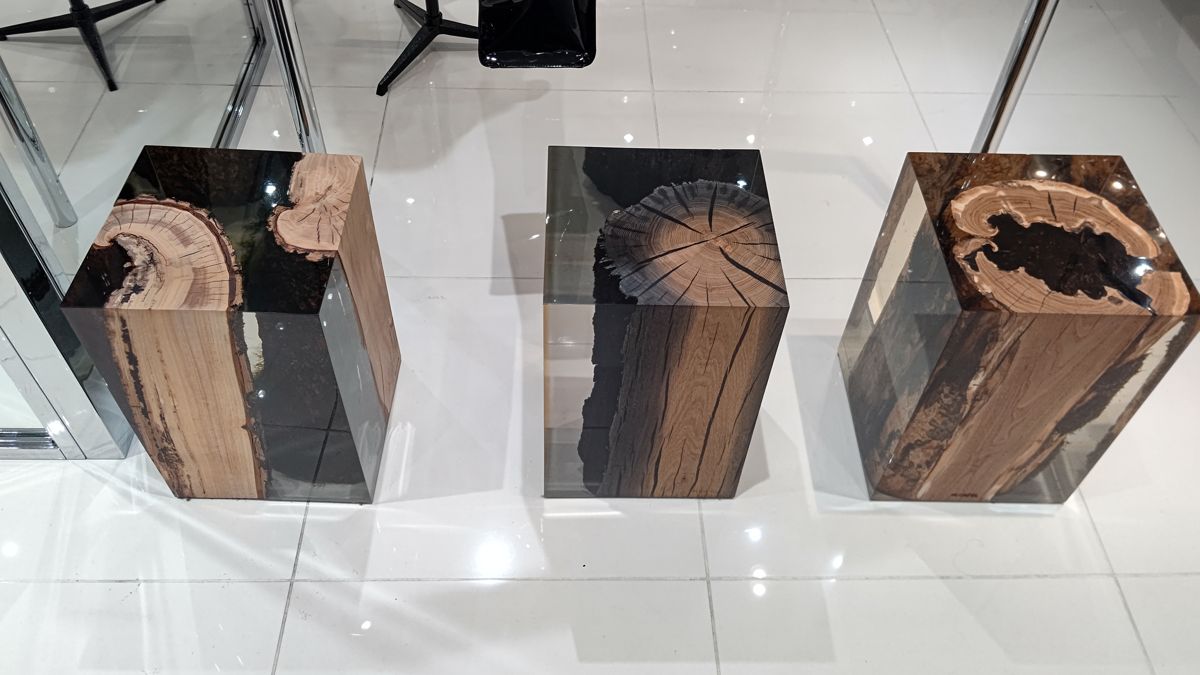
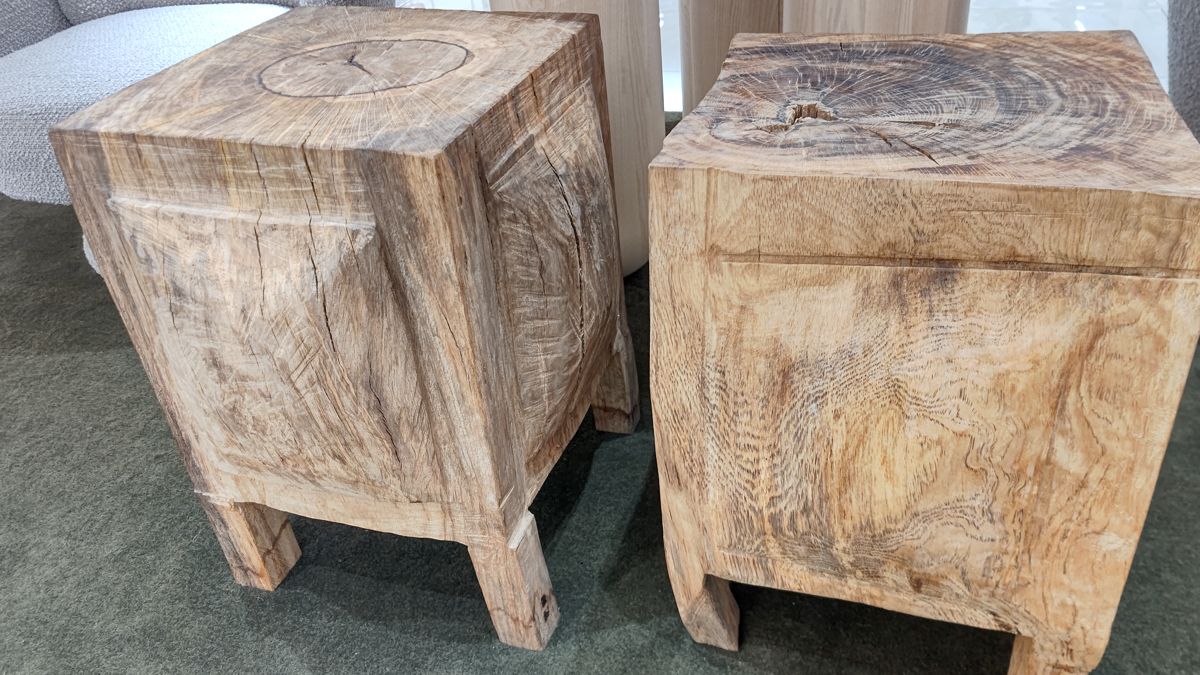
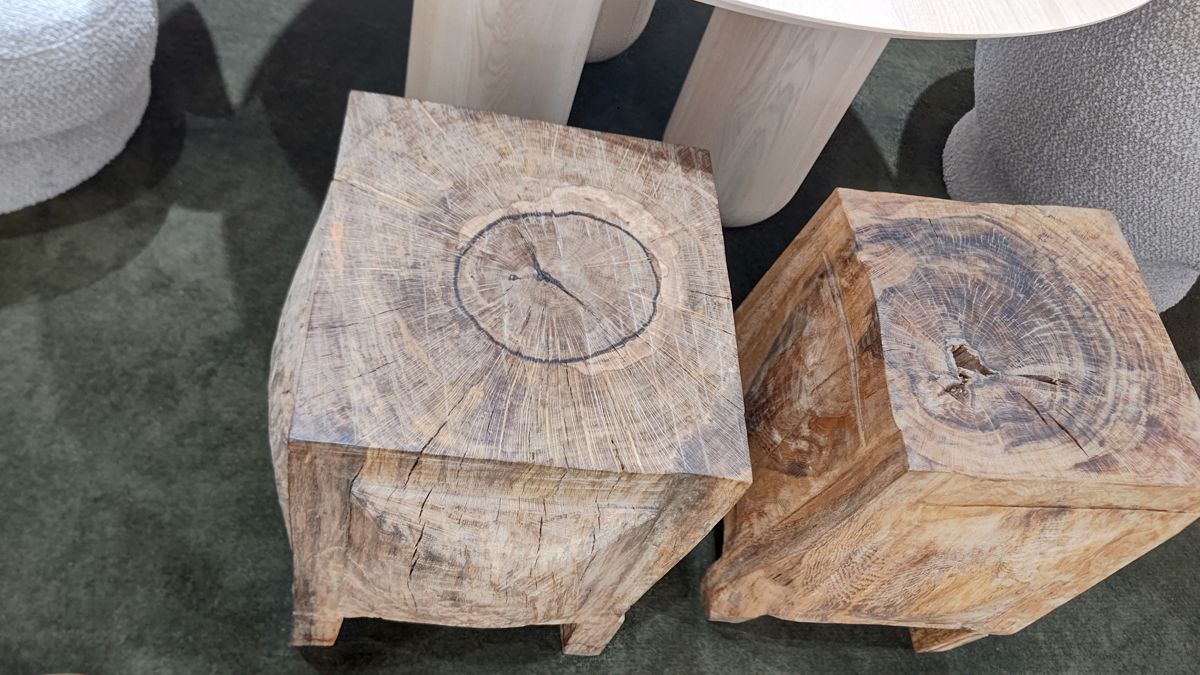
There were also solid-wood stools carved from blocks of log, without resin. The cracks running from the heart of the growth rings and the marks of the cutting tools are left as they are.
Even without making furniture, the shapes of branches and roots themselves can be put on show. In a clothing store in Shibuya, a huge tangle of dried branches and vines hung from the ceiling, spreading over the sales floor.

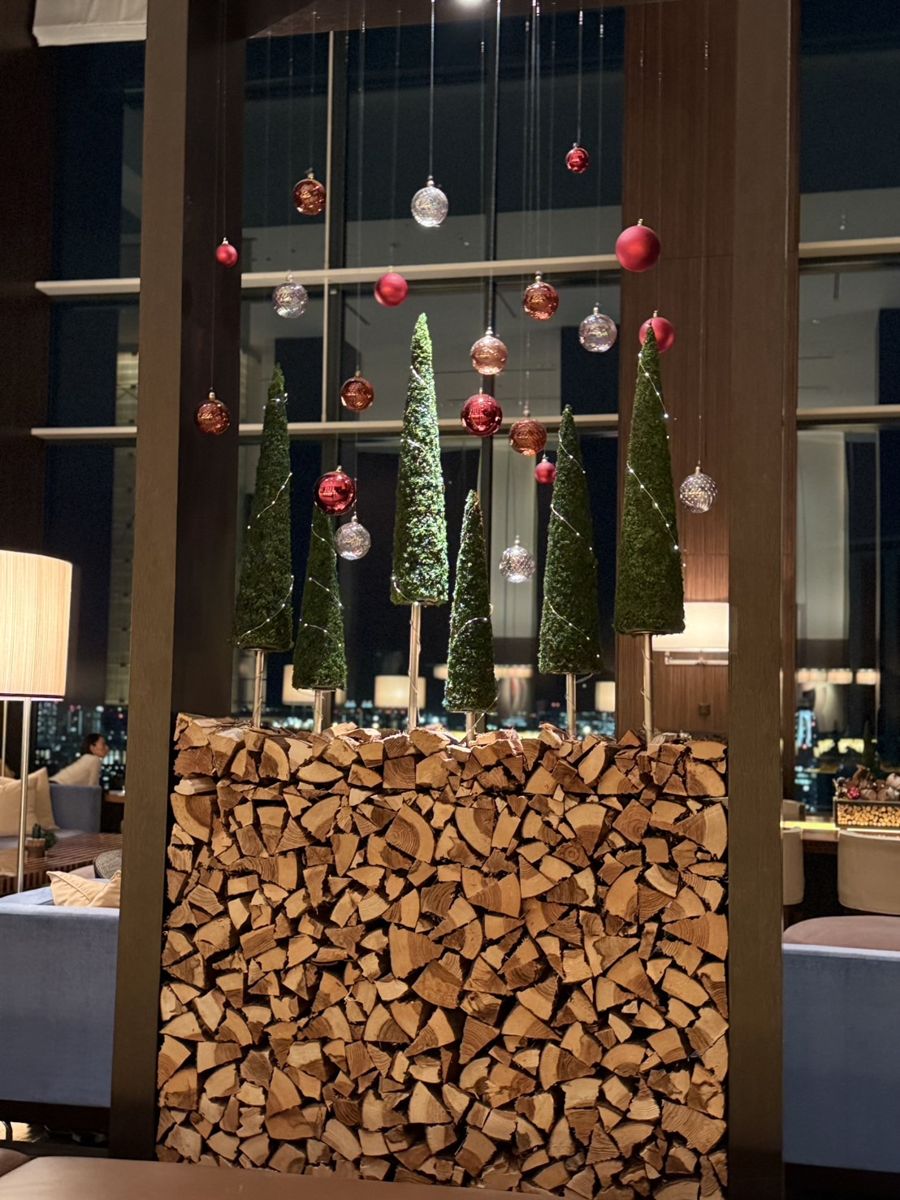
Split firewood, once stacked, becomes decoration in itself. In the lounge of the Conrad Tokyo in Shiodome, small conifer ornaments were lined up on a partition of firewood stacked like a wall.
The resin blocks and solid-wood stools were photographed on the sales floor of a department store in Tokyo with the store's permission. I did not record what kinds of wood and resin were used.
Das Fundament der Stadt und der Verbleib gefällter Bäume
Holzmasten
Japans erste Leitungsmasten wurden 1869 für eine amtliche Telegrafenleitung zwischen dem Leuchtturmamt in Yokohama und dem Gericht errichtet. Von der frühen Meiji- bis zur Taisho-Zeit bestanden die Masten aus Holz.[5]
Holzmasten verrotten an der Stelle, wo sie in den Boden treten. Eine Studie aus Hokkaido beschreibt mit Kreosotöl kesseldruckimprägnierte Masten, hauptsächlich aus Ajan-Fichte und Sachalin-Tanne, wobei für kleine Masten Lärche verwendet wurde. 1958 aufgestellte Masten hatten 22 Jahre später ihr Schutzmittel verloren und waren stark verrottet, besonders auf Bodenhöhe.[6] Der Bericht von 1981 hält fest, dass in Stadtgebieten bereits Betonmasten üblich waren.[6]
Wann und wie die Holzmasten in Tokio durch Beton ersetzt wurden, ist noch in Recherche. Holzarten und Behandlung oben sind Beispiele aus Hokkaido.
Landgewinnung in der Bucht von Tokio
Ein großer Teil des Bodens von Tokio entstand durch Aufschüttung des Meeres. Bald nach seinem Einzug in Edo ließ Tokugawa Ieyasu die Hibiya-Bucht auffüllen und zwischen 1593 und 1614 in Land verwandeln. Außerdem ließ er den Kanda-Hügel abtragen und mit dessen Erde das Gebiet von Nihonbashi-Hamacho bis Shinbashi aufschütten. Das Zentrum des Hafens von Edo wurde nach Nihonbashi gelegt.[7]
Östlich des Sumida begann die Landgewinnung 1596. Zwischen 1615 und 1629 nahm das aufgeschüttete Land im heutigen östlichen Bezirk Chuo, einschließlich Reiganjima, rasch zu. Jede Fläche war von Kanälen umgeben und wurde zu einem kashi, einer Anlegestelle für Boote.[7]
Die Holzlagerung ist eng mit dieser Geschichte der Landgewinnung verknüpft. Das Kiba der Genroku-Ära wurde von Holzgroßhändlern errichtet, die die Sümpfe von Fukagawa selbst aufschütteten (Kapitel 1). Auch Shin-Kiba, wohin es in der Showa-Zeit umzog, steht auf Neuland in der Bucht von Tokio.
Wohin gefälltes Holz geht
Tama ist seit Langem als „Forstbezirk Ome“ bekannt, der vor allem Pfosten und Gerüststangen erzeugte.[8] Heute geht sein Holz neben Bauholz auch in Sperrholz (Kapitel 7) und Brennstoff. Hier betrachten wir Holz aus den Bergen und Holz aus der Stadt getrennt.
Bergholz als Brennstoff: Dorf Hinohara
Das Dorf Hinohara verwandelt sein eigenes Holz weiterhin in Wärme.[9][10]
| Jahr | Einrichtung | Einzelheiten |
|---|---|---|
| 2012 | Thermalbad Kazuma no Yu | Zwei Scheitholzkessel mit je 80 kW neben Kerosinkesseln installiert; die gesamten rund 70 t Brennholz pro Jahr stammen aus dem Dorf[9] |
| 2012 | Brennholzerzeugung | Ein System zum Sammeln von Holz und zur Brennholzherstellung schuf über das Silver Human Resources Center Arbeitsplätze; das Brennholz wird auf Paletten gestapelt verkauft[10] |
| 2017 | Sozialeinrichtung Yasuragi no Sato | Ein Hackschnitzelkessel ersetzte fossile Brennstoffe[10] |
Das Dorf fördert Fällen und Rücken, damit Durchforstungsholz, das bisher im Wald liegen blieb, herausgebracht werden kann.[10] Die Nutzung als Brennstoff gibt selbst den dünnen und krummen Teilen gefällter Bäume eine Verwendung.
Stadtbäume zurück in die Stadt: Grünschnittverwertung
Auch Äste und Laub aus dem Schnitt von Park- und Straßenbäumen lassen sich nutzen. Seit dem HJ 1990 führt der Stadtbezirk Koto Äste und Falllaub aus seinen Grünanlagen in die eigenen Grünflächen zurück, statt sie zu verbrennen oder zu deponieren.[11]
| Form | Verwendung |
|---|---|
| Hackschnitzel | Polsterung für Parkwege, Mulch für Pflanzbeete[11] |
| Kompost | Bei Bezirksveranstaltungen verteilt; Bodenverbesserung in Parks und Schulen[11] |
| Holz | Baumnamensschilder; Bastelmaterial für Schulen und Kindergärten[11] |
Tokio hat mehr als eine Million Straßenbäume (Kapitel 8). Wie man ihren Schnitt verwertet, ist eine Art Aufgabe der „urbanen Forstwirtschaft“.
Laid on park paths: wooden paving of Tama timber
Tama wood is also used underfoot in metropolitan parks. According to a sign by the Tokyo Metropolitan Eastern Park Office that I saw in Ueno Park, the Tokyo government has used Tama timber, including thinnings, for road guard fences, the "Memorial Benches" in metropolitan parks and more, to conserve Tama's deteriorating forests and help prevent global warming. The sign explains that wooden paving will eventually rot and need replacing, but that this keeps thinnings in use and so helps protect the Tama forests.
It is a way of counting rot not as a defect but as a reason to keep using wood. The sign does not say, however, how much wood went into the paving, or whether Tama timber is used again each time it is replaced.
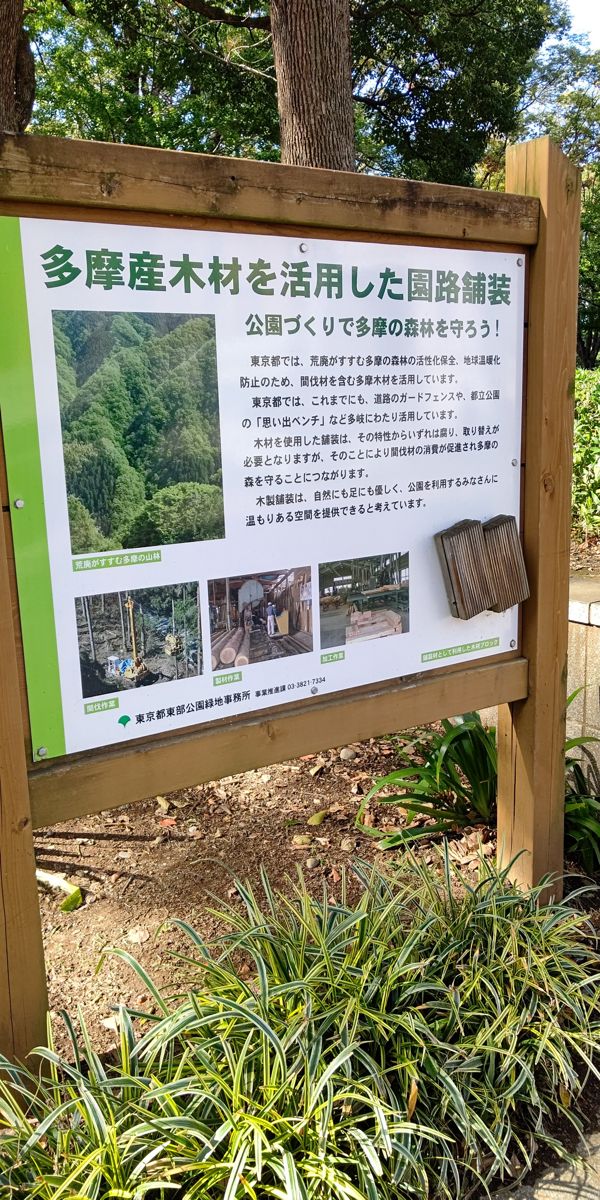
The sign's content is as of October 2021, when the photo was taken. I have not checked the current state of the paving.
Wood crossing the prefectural border: the Otsuki biomass power plant
Felled wood is sometimes carried out of Tokyo. The Otsuki Biomass Power Plant in Otsuki, Yamanashi, has an output of about 14,500 kW, enough electricity for about 30,000 households. It burns about 150,000 tonnes a year of chips made from unused thinnings and pruned branches, mainly from Yamanashi and the wider Kanto region.[12] It began commercial operation in summer 2018.[13]
When the author saw it from a train window in October 2020, logs were piled high in the plant's yard. They were "obstructing trees" (trees felled because they stand in the way of construction) from the building of the Shin-Tomei Expressway (the Second Tomei). Trees cut to build a road were being turned into electricity.
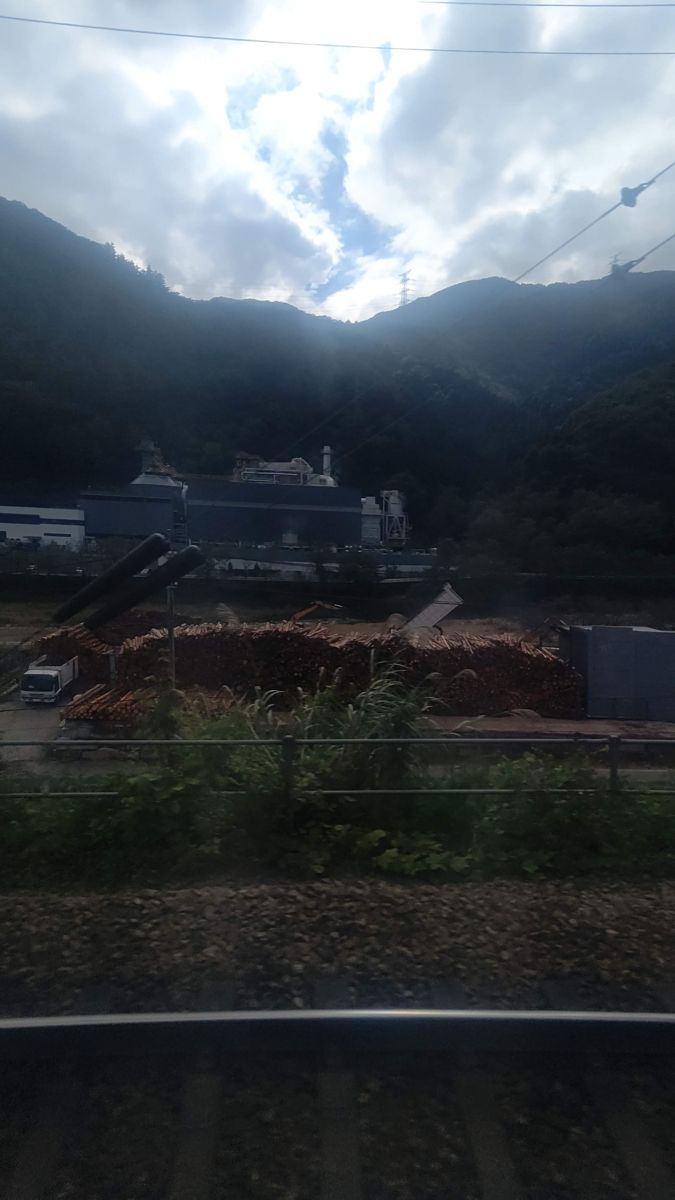
The acceptance of obstructing trees is based on what the author saw and heard on site; it has not been checked against materials from the power plant or the expressway company.
Quellen
- 東京都 木育関連リーフレット(令和5年度) PDF
- コトバンク「大鋸」 Link
- 日本スポーツ振興センター「国立競技場について」 PDF
- 長野県林業総合センター 研究トピックス(接着重ね梁) PDF
- 国土交通省 無電柱化に関する資料 PDF
- 北海道立林産試験場『林産試月報』1981年4月号(クレオソート油処理木柱) PDF
- 国土交通省 関東地方整備局 東京港湾事務所「江戸の港」(原典:鈴木理生『江戸の川・東京の川』ほか) PDF
- 東京都「林業・木材産業循環成長対策 変更事業構想」 PDF
- 林野庁『平成28年度 森林・林業白書』事例(檜原村 数馬の湯) Link
- 環境情報センター(EIC)「首長に聞く」檜原村 Link
- 江東区「緑のリサイクル」 Link
- 大林組 ニュースリリース「大月バイオマス発電所の建設に着手」(2016年8月4日) Link
- 大林組 ニュースリリース(2018年6月1日、大月バイオマス発電所の営業運転開始) Link