Introducción / Capítulo 8
Espacios verdes
Cada espacio verde de Tokio tiene un origen distinto: una residencia de daimio, un terreno militar, un embalse para controlar inundaciones. Conocer la historia del lugar ayuda a entender por qué hay allí ciertos árboles.
Este capítulo se divide en tres partes: bosques y jardines emblemáticos, el verde de las calles y árboles de la memoria y de las ceremonias.
Bosques y jardines emblemáticos
Resumen
| Lugar | Superficie | Uso anterior del terreno | Árboles destacados |
|---|---|---|---|
| Monte Takao Hachioji; bosque nacional | — | Bosque nacional tras la guerra; Cuasi Parque Nacional Meiji no Mori Takao desde 1967[1] | Haya, haya azul y abeto en la ladera norte; robles perennes y Castanopsis en la sur. Unas 1.600 especies vegetales[1] |
| Shinjuku Gyoen Shinjuku/Shibuya; jardín nacional | Unas 58,3 ha[2] | Residencia de la familia Naito (dominio de Takato) → Estación experimental Naito Shinjuku desde 1872 → jardín nacional desde 1949[3] | Más de 10.000 árboles[2]; tulíperos y plátanos gigantes[3] |
| Parque Yoyogi Shibuya; parque metropolitano | Unas 54 ha[4] | Campo de maniobras del ejército → viviendas militares de EE. UU. → Villa Olímpica de 1964 → abierto en 1967[5] | Bosque plantado de unos 100.000 árboles, unas 1.000 zelkovas, avenida de 260 ginkgos[5] |
| Parque Mizumoto Katsushika; parque metropolitano | Unas 92 ha[6] | Orillas del embalse Kogo-tame, construido en 1729 para controlar inundaciones[6] | Bosque de 1.800 metasecuoyas, avenida de álamos de 1,2 km, alisos junto al agua[6] |
| Jardines Hama-rikyu Chuo; jardín metropolitano | Unas 25 ha[7] | Coto de cetrería del shogun → villa de playa del dominio de Kofu → residencia del shogun «Hama Goten» → palacio imperial → abierto en 1946[7] | El «Pino de 300 años», plantado en tiempos del sexto shogun, Ienobu[7] |
| Parque Rinshi-no-Mori Shinagawa/Meguro; parque metropolitano | Unas 12 ha[8] | Vivero experimental de Meguro desde 1900 → Estación de Experimentación Forestal → traslado a Tsukuba en 1978 → parque desde 1989[8][9] | Árboles de más de 100 años; un álamo de 35,5 m, una zelkova de 3,82 m de perímetro[8] |
| Instituto de Estudio de la Naturaleza Shirokanedai, Minato (junto a la estación de Meguro) | — | Residencia de un clan medieval → villa del dominio de Takamatsu → polvorín → finca imperial de Shirokane → monumento natural y sitio histórico desde 1949[10] | Bosque mixto de perennes como Castanopsis, robles y pinos con caducifolios; el «Pino del cuento»[10] |
| Parque Komabano Meguro | Unas 3,9 ha[11] | Escuela de Agricultura de Komaba (Meiji) → Facultad de Agricultura de la Universidad de Educación de Tokio → abierto en 1986[11] | Plantaciones separadas de bosque del norte, de Kanto–Kansai y del sur; 19 variedades de cerezo[11] |
| Parque Inokashira Musashino y Mitaka, parque metropolitano | Unas 42,8 ha[12] | Fuente de agua de Edo → bosque imperial en la era Meiji → cedido a la ciudad de Tokio en 1913 → abierto en 1917[12] | Unos 20.000 árboles[12]. El bosque de cedros plantado a principios de Meiji se taló durante la guerra; cerezos tras la guerra[13] |
| Parque Central de Shinjuku Shinjuku, parque del distrito | unas 8,8 ha[14] | Antigua planta potabilizadora de Yodobashi → abierto en 1968 dentro del plan del subcentro de Shinjuku → transferido al distrito en 1975[14][15] | Cerezo Takato Kohigan[15], biotopo[14] |
| Cerezos del río Meguro Meguro y otros distritos | Unos 3,8 km | Avenida ribereña[16] | Unos 800 cerezos Somei-yoshino[16] |
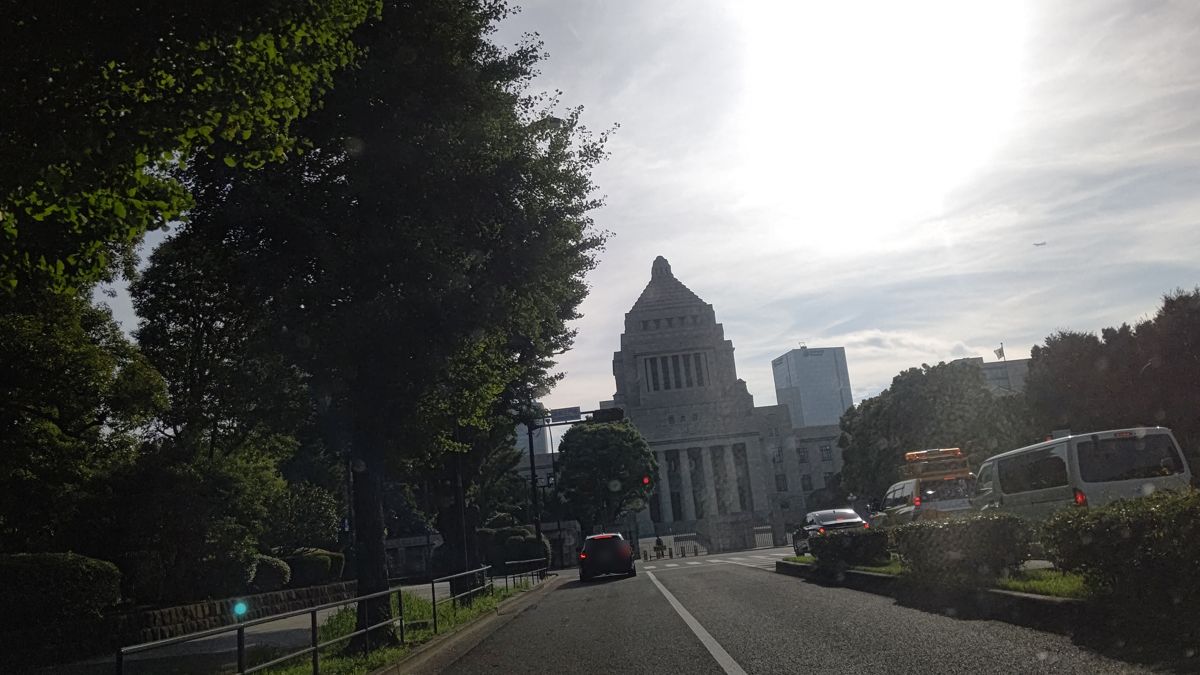
| Jardín delantero de la Dieta Chiyoda | — | Jardín delantero del edificio de la Dieta Nacional[17] | Árboles de todas las prefecturas; un gran ginkgo anterior al edificio[17] |
Mapa
Ubicación de los espacios verdes de los 23 distritos. Las formas municipales se basan en la Información Numérica Territorial Nacional (límites administrativos, MLIT); los ríos son aproximados. El monte Takao está unos 40 km al oeste y aparece en el mapa de la portada (número 5).
Monte Takao: donde se encuentran dos bosques
En el monte Takao se encuentran los bosques templado-fríos y templado-cálidos. En la ladera norte, caducifolios como haya, haya azul y arces se mezclan con abeto y pino rojo. En la sur hay perennifolios como robles perennes, Castanopsis y camelia, con abeto.[1] De unas 4.700 especies vegetales de Japón, unas 1.600 crecerían en el monte Takao. Gestionado como bosque nacional tras la guerra, en 1967 pasó a ser el Cuasi Parque Nacional Meiji no Mori Takao. Recibe más de tres millones de excursionistas al año.[1] La estación Takaosanguchi, a sus pies, aparece en el capítulo 5, y el abetal protegido, en el capítulo 2.
Shinjuku Gyoen: de residencia a estación experimental y parque
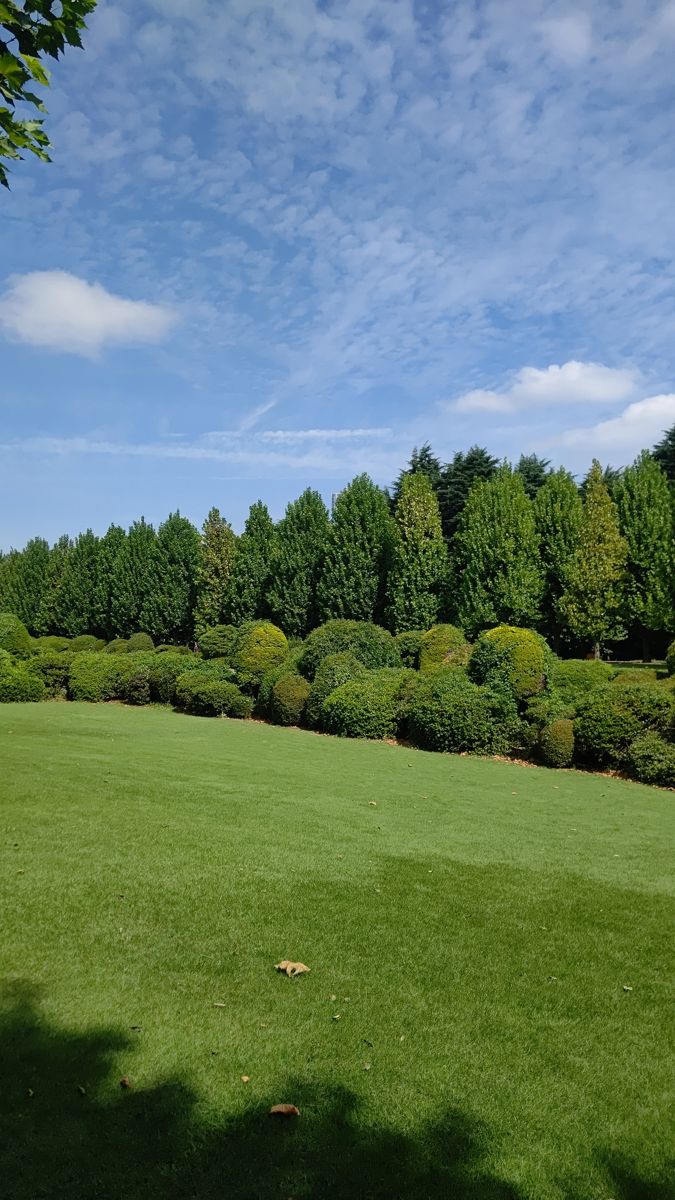
En el período Edo formaba parte de la residencia de la familia Naito, señores de Takato en Shinshu. En 1872 pasó a ser la «Estación experimental Naito Shinjuku» del Ministerio del Interior, para ensayar cultivos y plantas hortícolas. Se abrió al público como jardín nacional en 1949.[3] Tiene unas 58,3 hectáreas y más de 10.000 árboles.[2]
| Árbol gigante | Perímetro | Altura | Edad |
|---|---|---|---|
| Plátano de sombra | 6.30 m | 26 m | Más de 120 años |
| Tulípero (árbol emblema) | 4.91 m | 35 m | Más de 120 años |
| Olmo japonés | 3.83 m | 22 m | Más de 120 años |
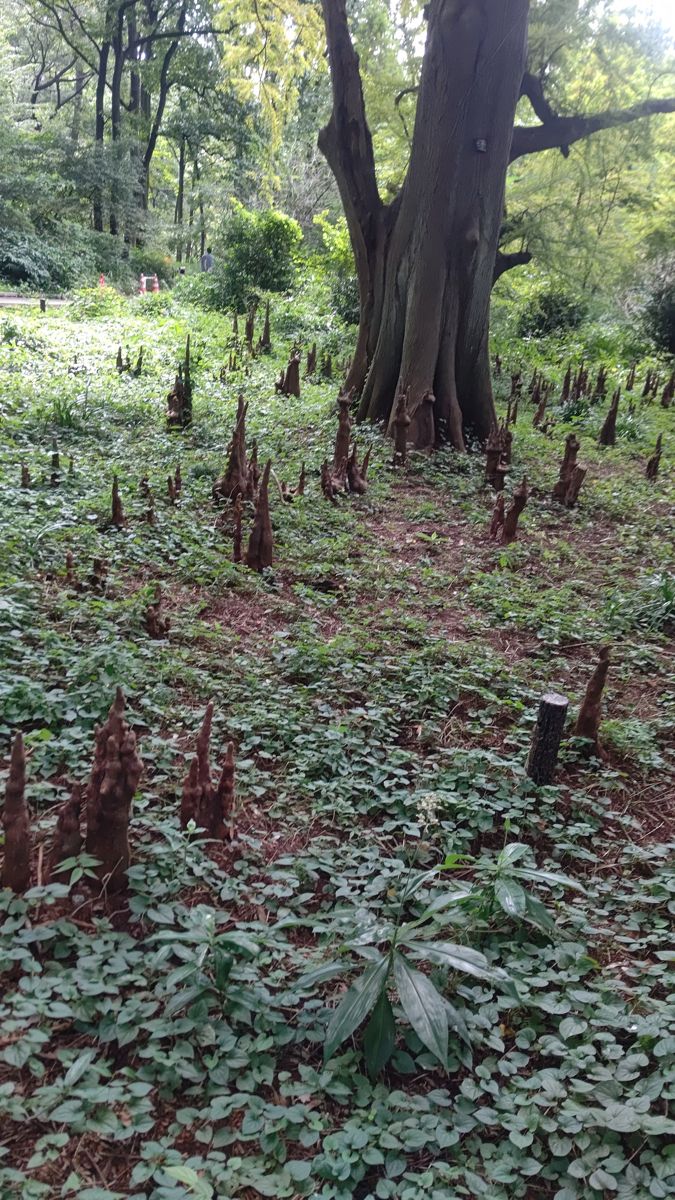
| Ciprés calvo | 3.37 m | 25 m | Más de 120 años |
| Magnolia yulan | 2.38 m | 14 m | Más de 150 años (árbol célebre desde el período Edo) |
Fuente: Ministerio de Medio Ambiente, base de datos de árboles gigantes, guía de observación «Shinjuku Gyoen»[3]
El tulípero, el plátano de sombra y el ciprés calvo vinieron del extranjero. La historia de cultivo de plantas extranjeras en la estación experimental puede leerse en la lista actual de árboles gigantes.
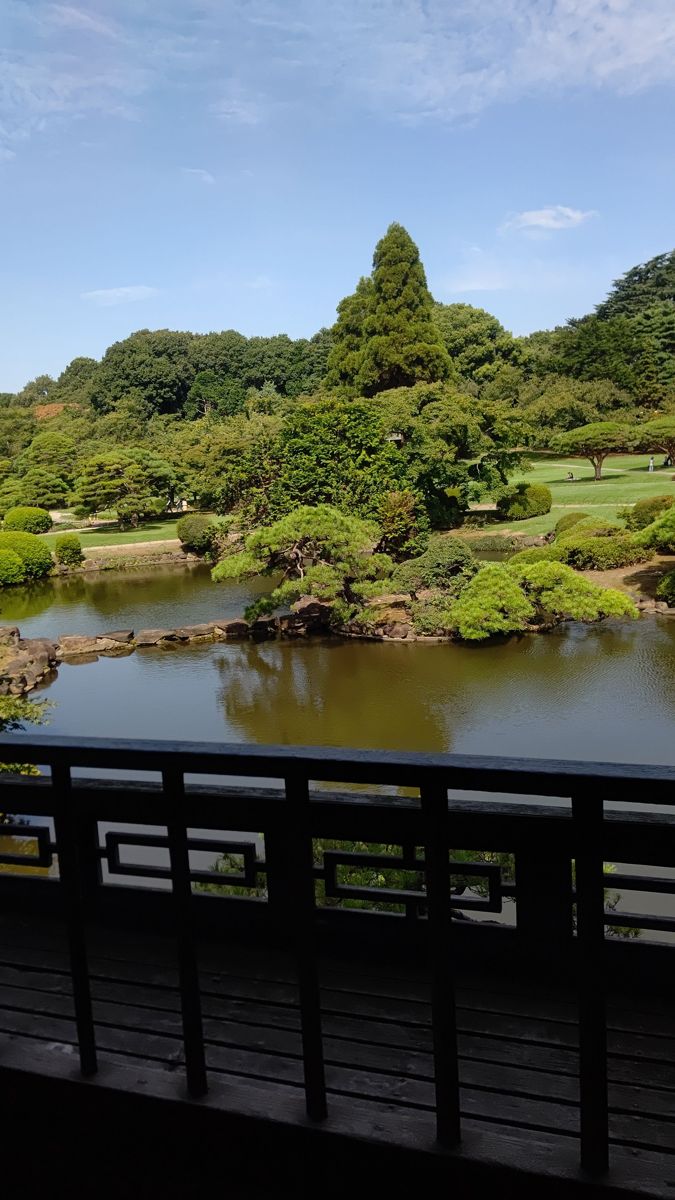
Beside the pond of the Japanese garden stands the Former Goryotei pavilion, known as the "Taiwan Pavilion." Built in 1927, it is a single-story timber building in the Minnan style of southern China, and is a Tokyo Metropolitan selected historic building.[18]
Parque Yoyogi: un bosque nacido de un terreno militar
Antes de la guerra fue campo de entrenamiento del ejército; después, instalación militar de EE. UU.; y en 1964, Villa Olímpica. El parque abrió el 20 de octubre de 1967.[4][5] Es un bosque artificial de unos 100.000 árboles, con unas 1.000 zelkovas contando la avenida, unos 700 cerezos y una avenida de 260 ginkgos.[5] Forma un área verde continua con el bosque vecino del Santuario Meiji (capítulo 5, capítulo 4).
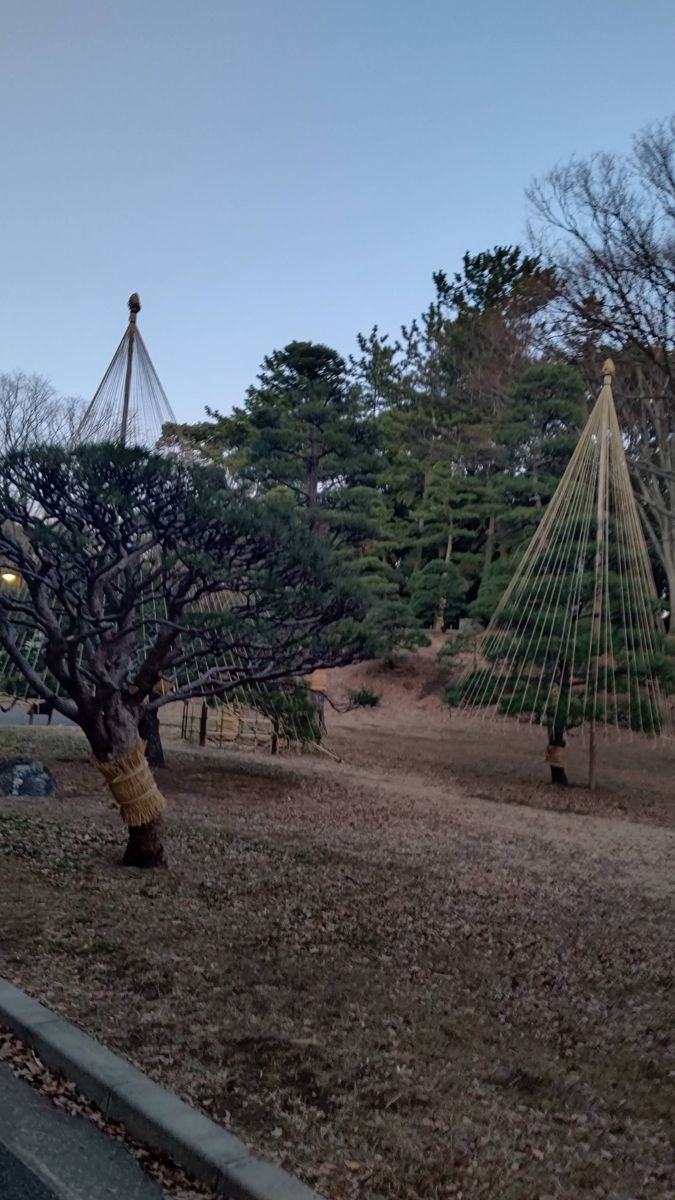
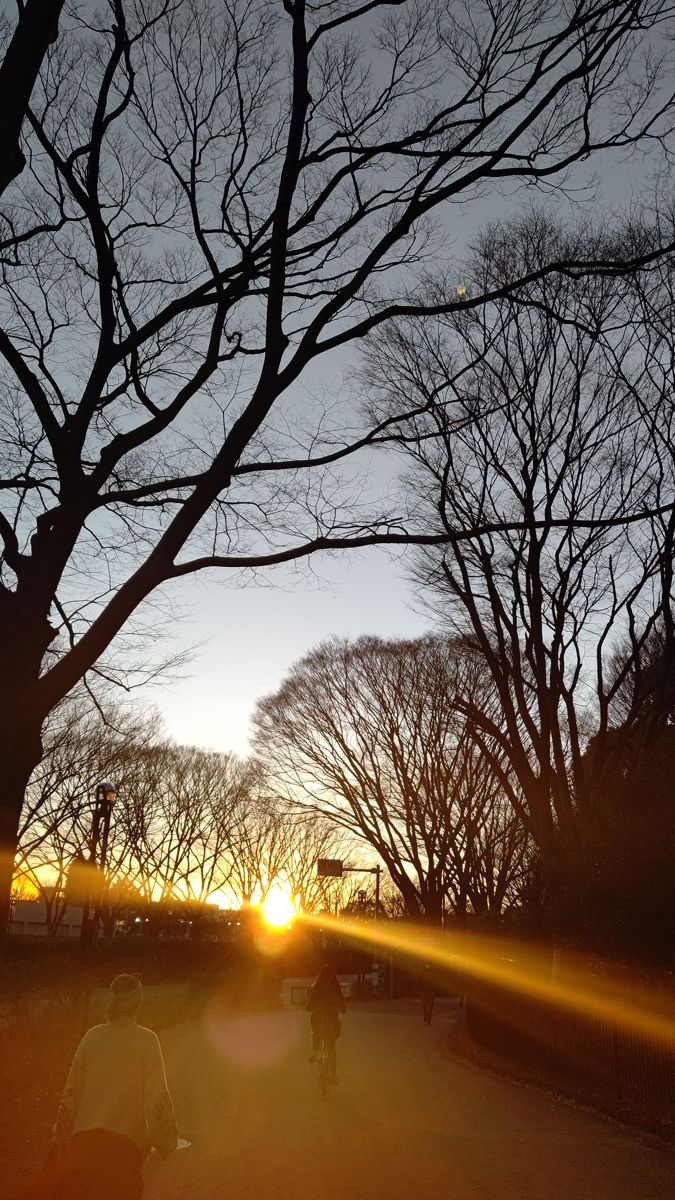
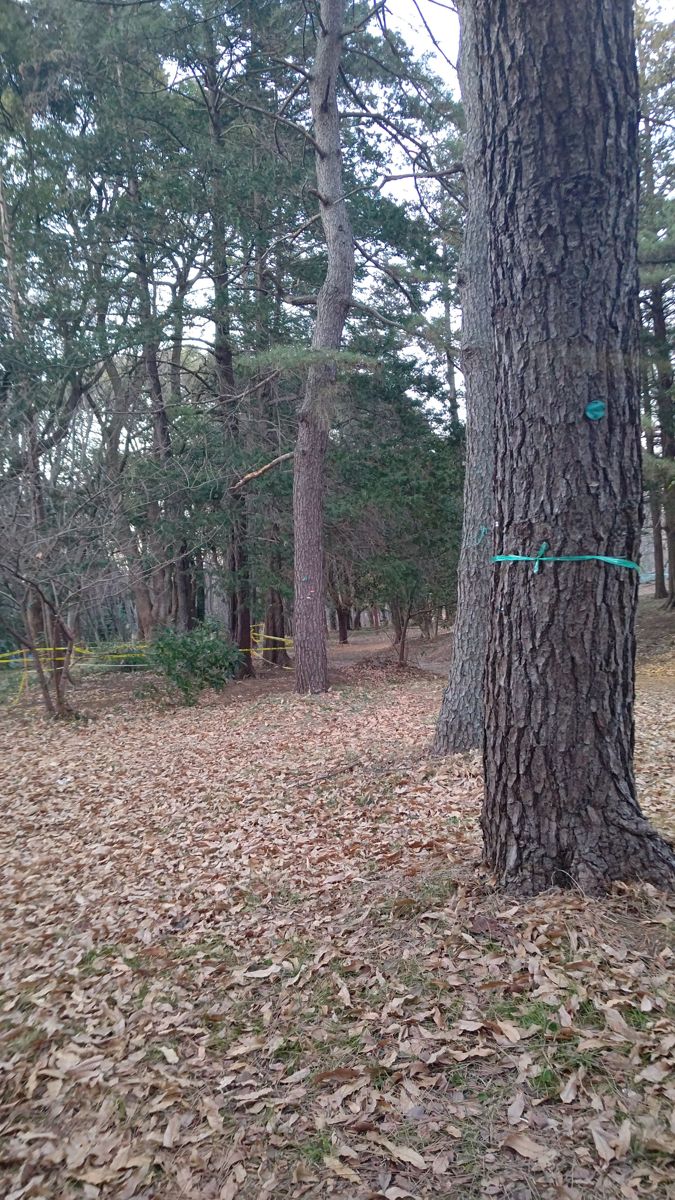
Visiting in winter, the author found the pines fitted with yukitsuri snow supports and komomaki straw wraps, while the deciduous trees had shed their leaves and the setting sun shone through their branches.
Parque Mizumoto: el único paisaje de aldea de agua de Tokio
Parque de unas 92 hectáreas en Katsushika, considerado el único lugar de Tokio con paisaje de suigo (aldea de agua).[6] Bordea el embalse Kogo-tame, construido en 1729 para controlar inundaciones; como era la fuente de agua de los pueblos vecinos, la zona se llamó «Mizumoto», el origen del agua.[6]
Los árboles destacados están junto al agua: un bosque de 1.800 metasecuoyas, una avenida de álamos de 1,2 km y alisos que prosperan en suelo húmedo.[6]
Jardines Hama-rikyu: un jardín de shogun alimentado por el mar
Empezó en 1654 como coto de cetrería del shogun. Matsudaira Tsunashige, señor de Kofu, ganó tierra al mar y construyó una villa, la «Residencia de playa de Kofu». Cuando su hijo Tsunatoyo se convirtió en el sexto shogun, Ienobu, pasó a ser residencia del shogun, «Hama Goten». Los sucesivos shogun la remodelaron, y tomó más o menos su forma actual con el undécimo, Ienari. Tras la Restauración Meiji fue palacio imperial; se cedió a Tokio en noviembre de 1945 y se abrió en abril de 1946. Tiene unas 25 hectáreas y fue declarado Lugar Especial de Belleza Escénica y Sitio Histórico Especial en 1952.[7]
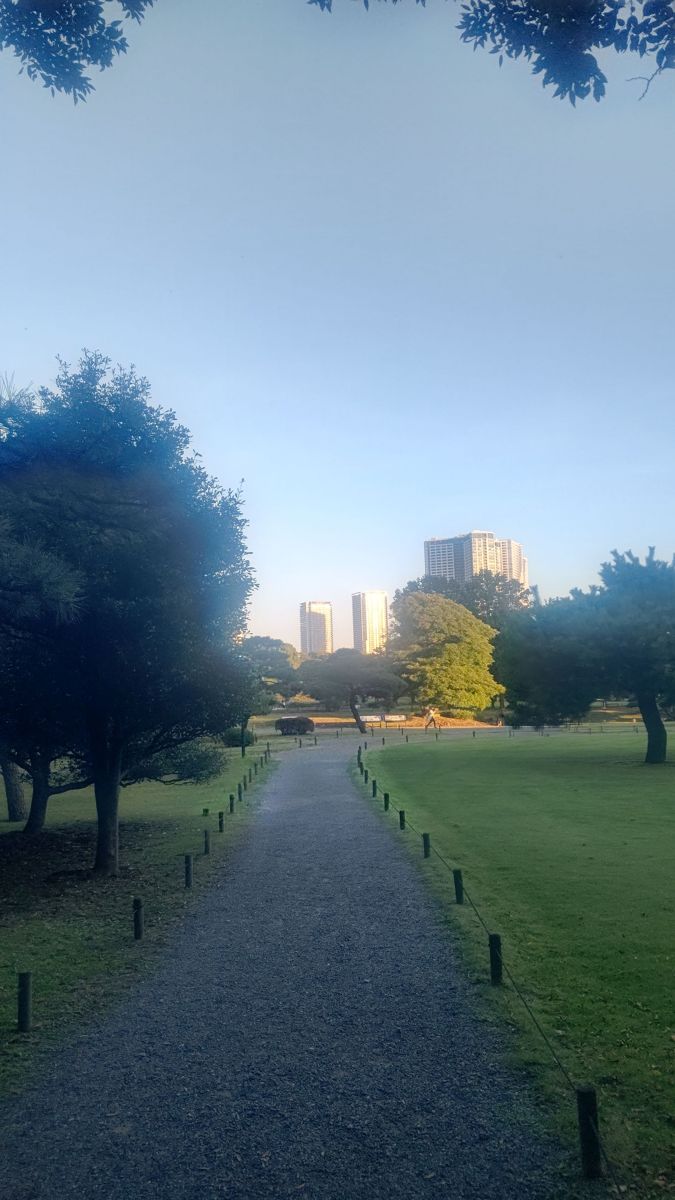
En su centro está el «estanque Shioiri», que toma agua de mar para que el paisaje cambie con las mareas. Las compuertas todavía se abren y cierran según el nivel de la bahía de Tokio. El «Pino de 300 años», junto a la entrada, se habría plantado para honrar la gran reforma de Hama Goten por Ienobu.[7] Un pino que ha vivido 300 años se alza sobre tierra ganada al mar (capítulo 6).
Parque Rinshi-no-Mori: un bosque que fue estación de investigación forestal
Parque de unas 12 hectáreas entre los distritos de Shinagawa y Meguro. Se abrió en 1900 como «Vivero experimental de Meguro» y luego fue la Estación Nacional de Experimentación Forestal (hoy Instituto de Investigación Forestal y de Productos Forestales). Tras el traslado de la estación a Tsukuba en 1978, el terreno se convirtió en parque, abierto en 1989.[8][9]
Los árboles plantados en tiempos de la estación son hoy gigantes. Muchos superan los 100 años, como una zelkova de 3,82 m de perímetro, un álamo de 35,5 m y especies raras como el roble hanagagashi, en peligro.[8] Es un lugar donde pasear por la propia historia forestal de Tokio.
Dos bosques junto a la estación de Meguro
El Instituto de Estudio de la Naturaleza (Shirokanedai, Minato) está a unos siete minutos a pie de la estación de Meguro. Fue residencia de un clan en la Edad Media, villa de la familia Matsudaira del dominio de Takamatsu en el período Edo, polvorín del ejército y la marina en Meiji y finca imperial de Shirokane desde Taisho. Como apenas se entró en él durante mucho tiempo, la naturaleza se conservó; en 1949 fue declarado monumento natural y sitio histórico y se abrió al público. Es un bosque de perennes como Castanopsis, robles y pinos mezclados con caducifolios, y se conservan el «Pino del cuento» y el estanque en forma de calabaza de la época de Takamatsu, así como terraplenes del clan medieval.[10]
El parque Komabano (Komaba, Meguro) ocupa la antigua Escuela de Agricultura de Komaba, fundada en Meiji para modernizar el campo. El arrozal experimental donde el profesor alemán Oskar Kellner, llegado en 1881, estudió suelos y abonos se conserva como «arrozal de Kellner», y estudiantes de secundaria cercanos aún cultivan arroz en él. Tras el traslado de la Facultad de Agricultura de la Universidad de Educación de Tokio a Tsukuba en 1978, el lugar se abrió como parque de unas 3,9 hectáreas en 1986. Tiene plantaciones separadas de bosque del norte, bosque de leña de Kanto y Kansai y bosque del sur.[11]
Tanto Rinshi-no-Mori como Komabano son espacios verdes nacidos en terrenos que dejaron instituciones nacionales de investigación y enseñanza al trasladarse a Tsukuba.
Parque Inokashira: de un bosque de cedros protector del agua a un parque de cerezos
El estanque de Inokashira era conocido desde el período Edo como paraje pintoresco y fuente de agua para Edo, y aparece en las Cien famosas vistas de Edo de Utagawa Hiroshige. En la era Meiji pasó a ser bosque imperial, y en 1913 fue cedido a la ciudad de Tokio. El 1 de mayo de 1917 se abrió como el primer parque de donación imperial y el primer parque suburbano de Japón. Hoy el parque abarca unas 42,8 hectáreas y tiene unos 20.000 árboles.[12]
Antes de la guerra, el estanque estaba rodeado por un denso bosque protector del agua (un bosque que almacena agua) de cedros plantados por la prefectura de Tokio a principios de Meiji. Sin embargo, durante la guerra se talaron muchos de esos cedros para fabricar ataúdes, y después de la guerra se plantaron muchos cerezos.[13] Un bosque de cedros destinado a proteger el agua se perdió con la guerra y se convirtió en un lugar para contemplar los cerezos en flor. El paisaje de Inokashira refleja la historia de la silvicultura y de la guerra.
Parque Central de Shinjuku: un bosque crecido sobre una planta de agua
El Parque Central de Shinjuku se abrió en 1968 en el solar de la planta potabilizadora de Yodobashi, como uno de los proyectos del plan del subcentro de Shinjuku.[15] Abrió como parque metropolitano y pasó al distrito de Shinjuku en 1975. Con unas 8,8 hectáreas, es el mayor parque del distrito.[14] En primavera florecen los cerezos Takato Kohigan de Ina (Nagano), ciudad hermana de Shinjuku.[15] Tiene un biotopo para plantas y animales autóctonos, y en febrero de 2026 abrió el «Flower Forest», con una plaza cubierta de astillas de madera.[14]
En algo más de medio siglo desde su apertura, ha crecido una gruesa capa de árboles al pie de los rascacielos. Desde arriba, el verde parece un solo bosque que cruza las calles.
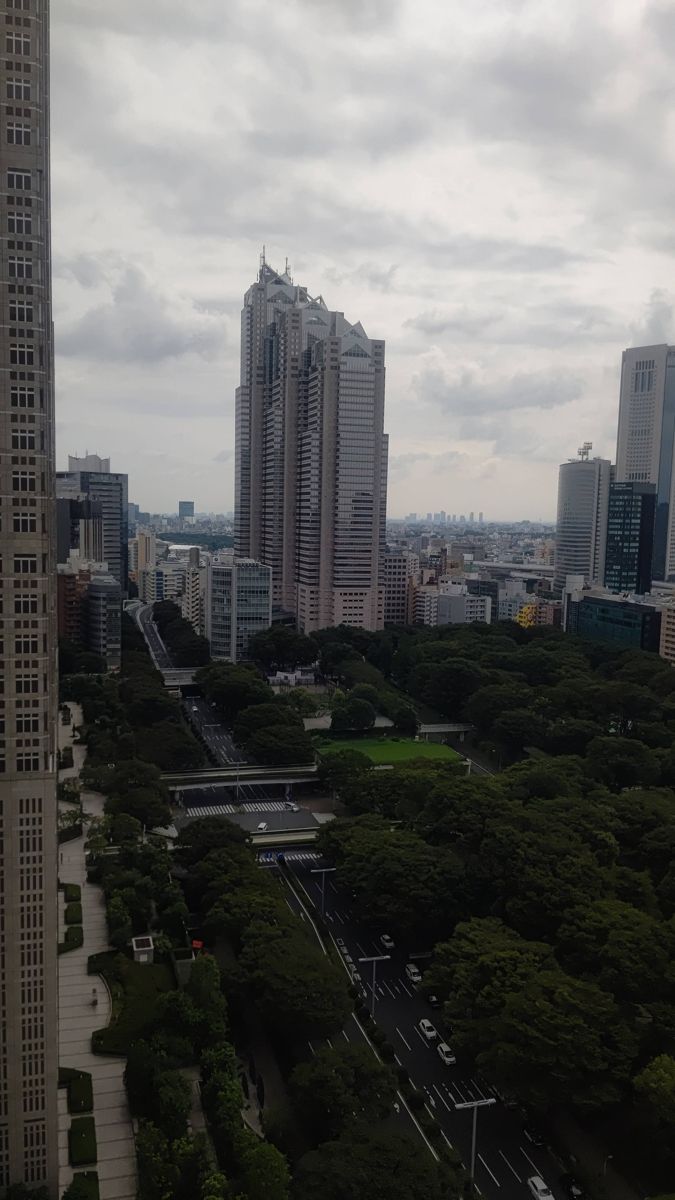
When the author visited in October 2020, renovation work was under way in the park. A forestry machine was working on ground where trees had been cut, and elsewhere newly planted trees were held up by wooden stakes. The park's forest, too, is kept up through a cycle of cutting and replanting.
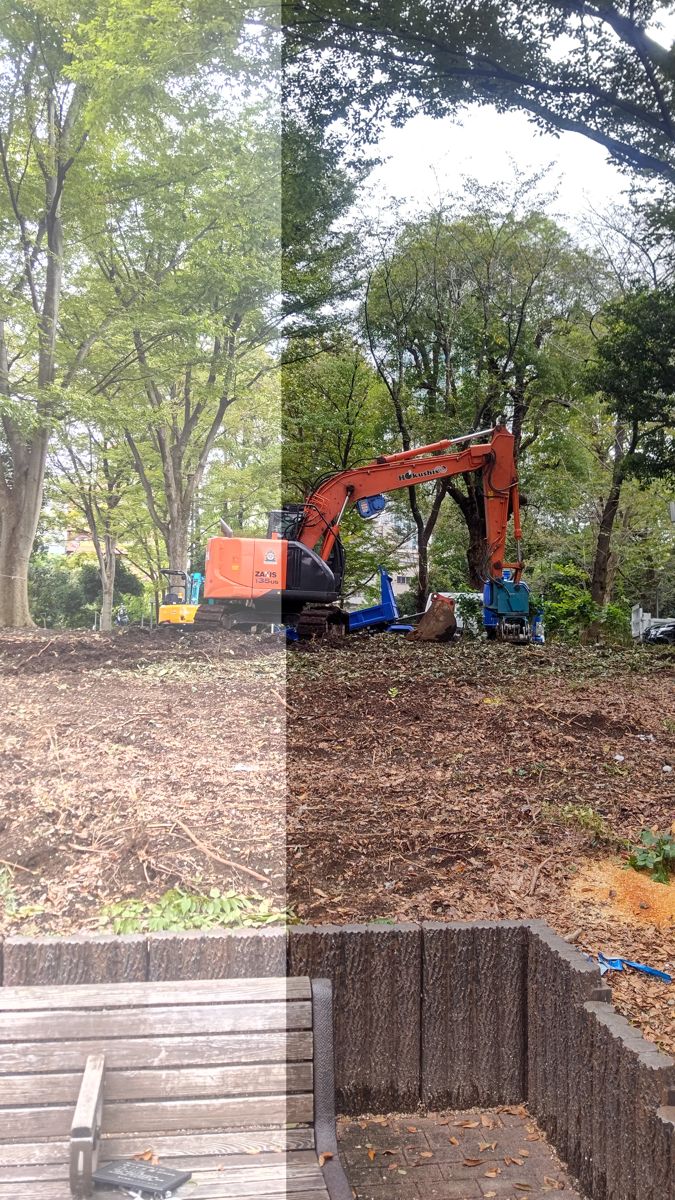
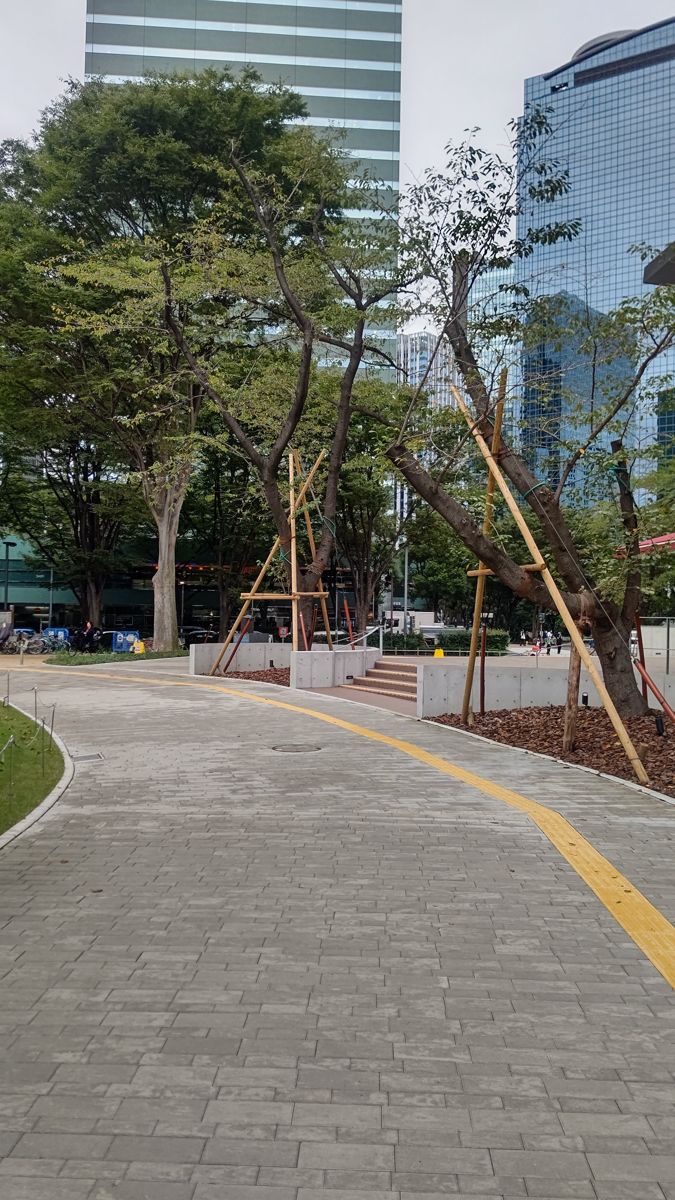
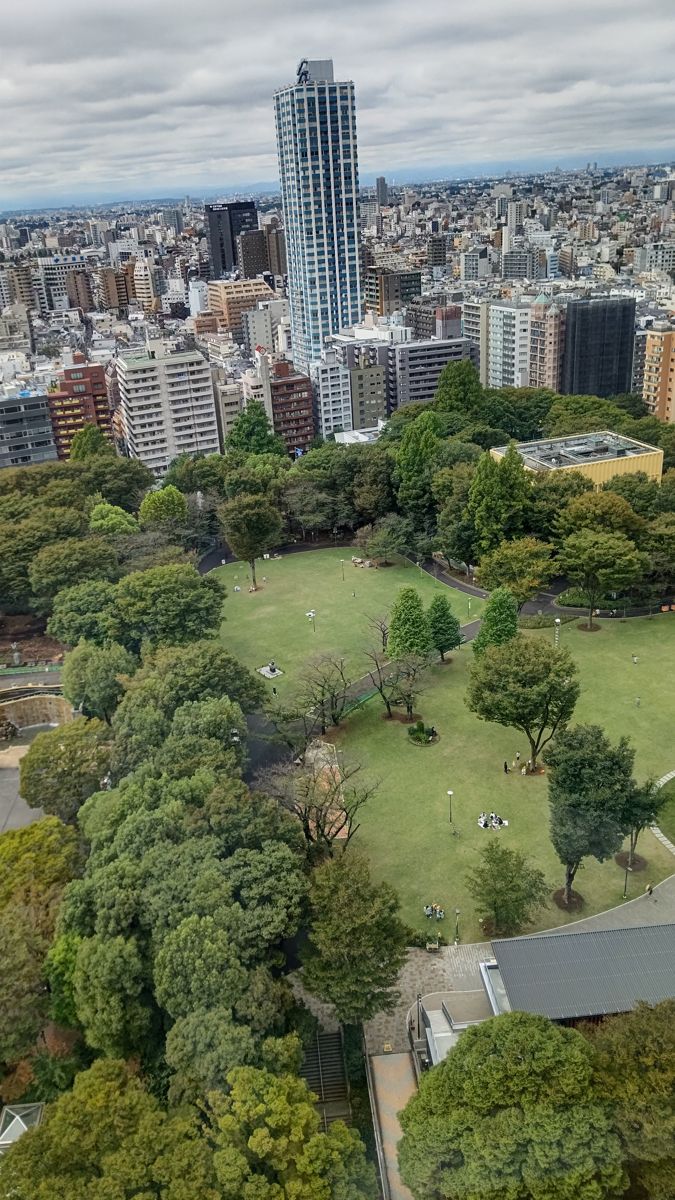
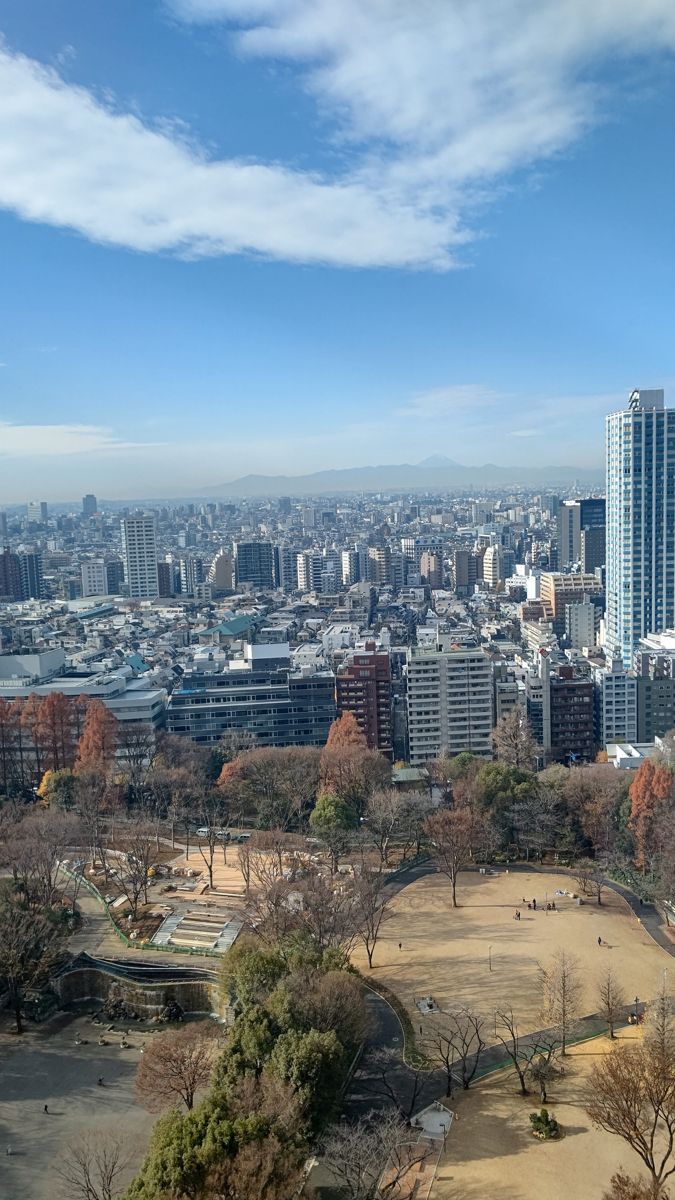
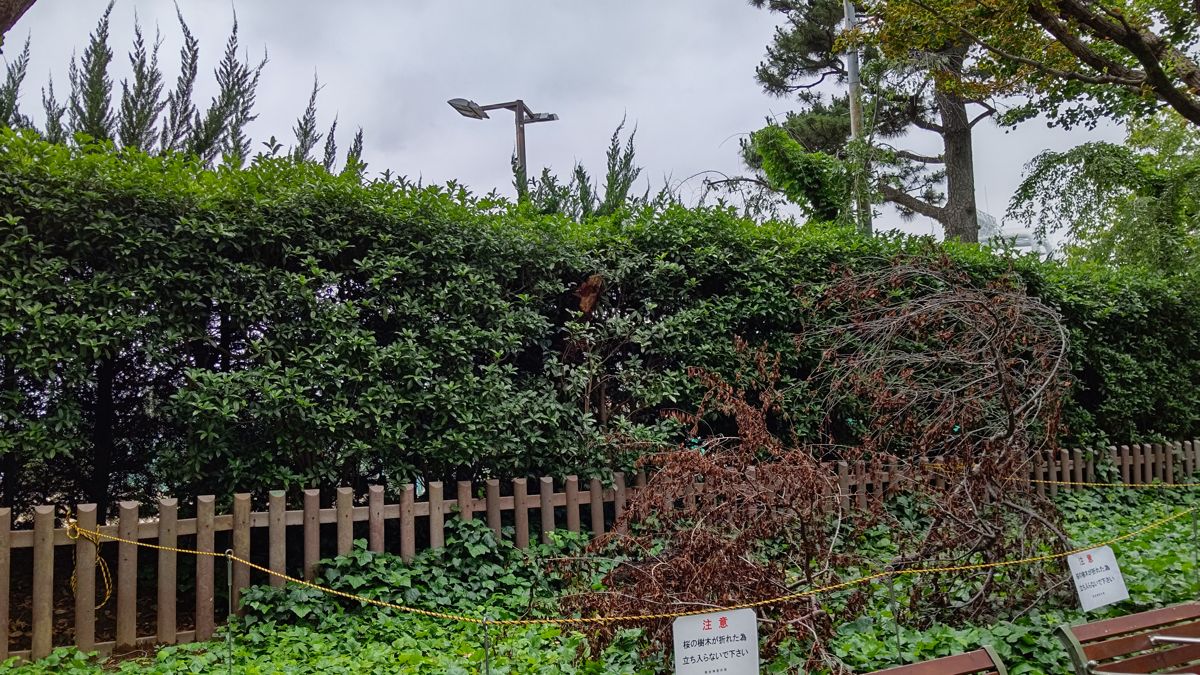
When I visited again in April 2022, many of the park's tall trees had been cut back hard. Tall conifers had been topped and stripped of almost all their side branches, leaving little more than trunks. Broadleaf trees had been cut partway along their thick limbs, with thin shoots sprouting like brooms near the cuts. Some trunks were wrapped in cloth. I have not been able to confirm from ward or park-manager documents why the trees were cut this far at this time.
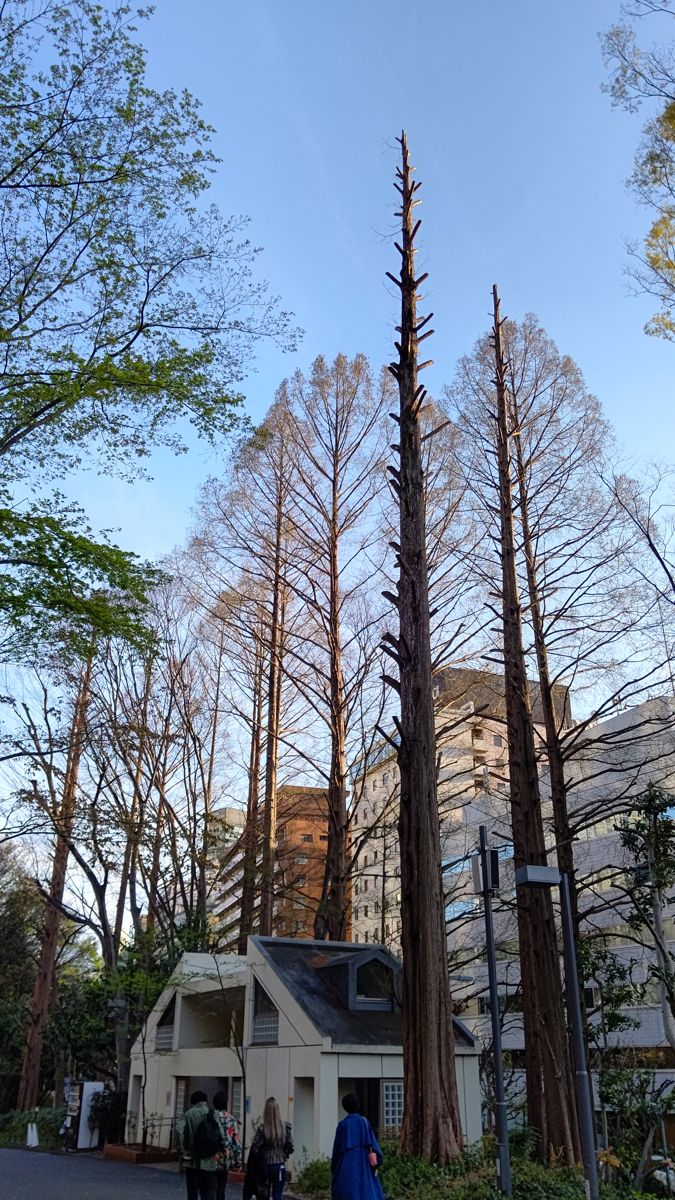
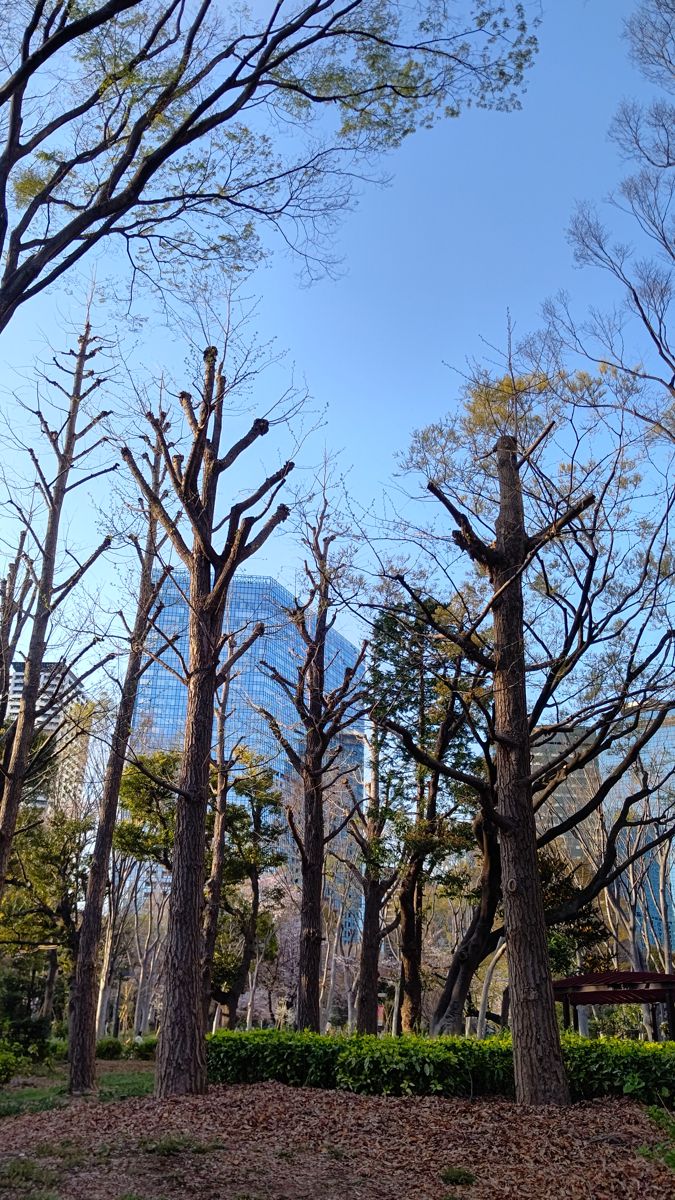
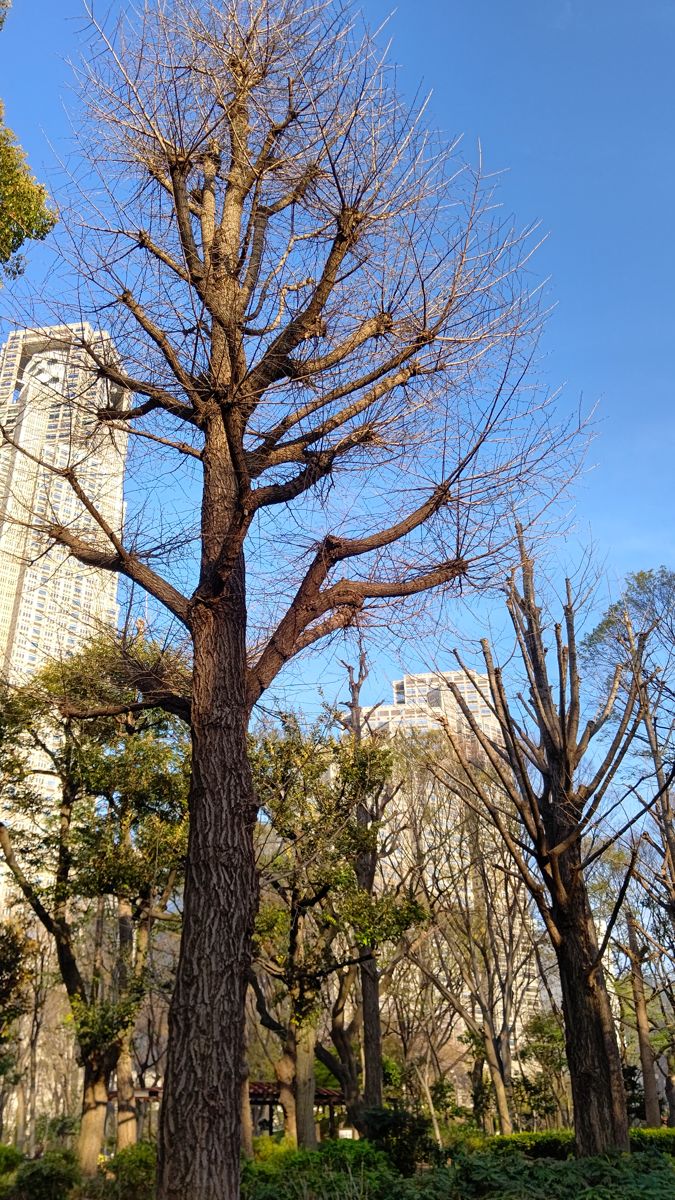
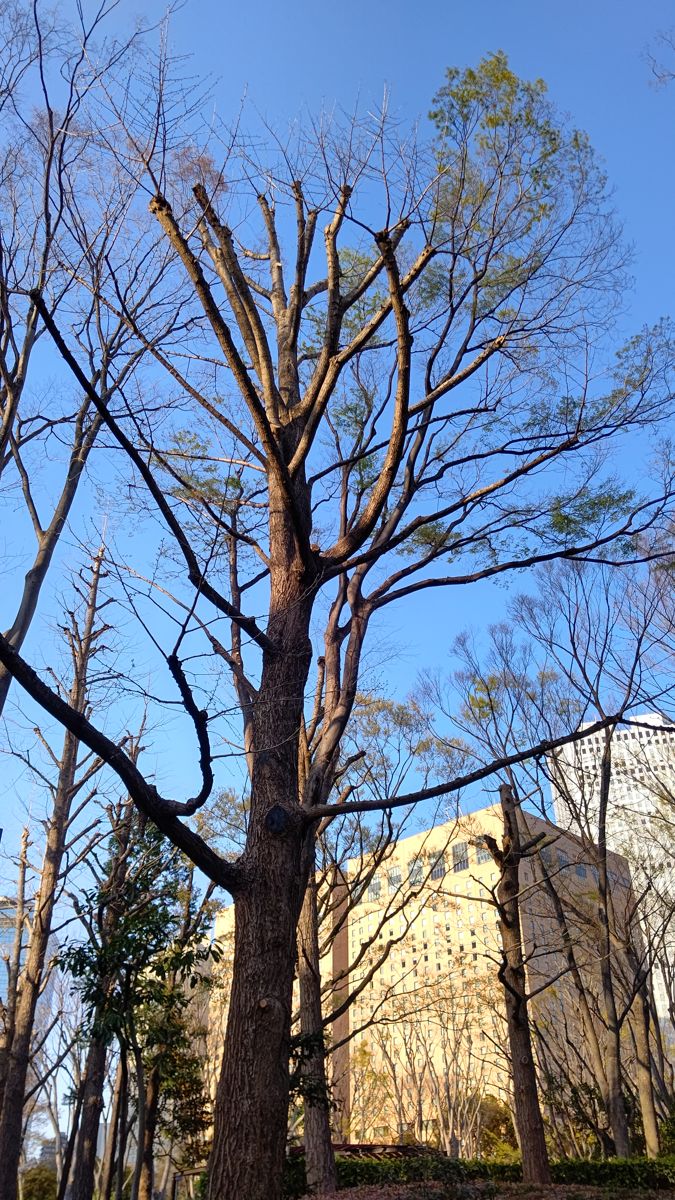
Hard pruning that cuts thick limbs partway has a cost. Research by the National Institute for Land and Infrastructure Management notes that after heavy pruning, masses of sprouts emerge and disorder the crown, and that the large wounds left by cutting big limbs let decay in, so the tree loses its health and its form eventually breaks down.[19] On the other hand, urban parks sometimes cut to reduce the risk of falling branches and toppling trees. Which consideration weighed more in Shinjuku Central Park would need to be confirmed with the park's managers.
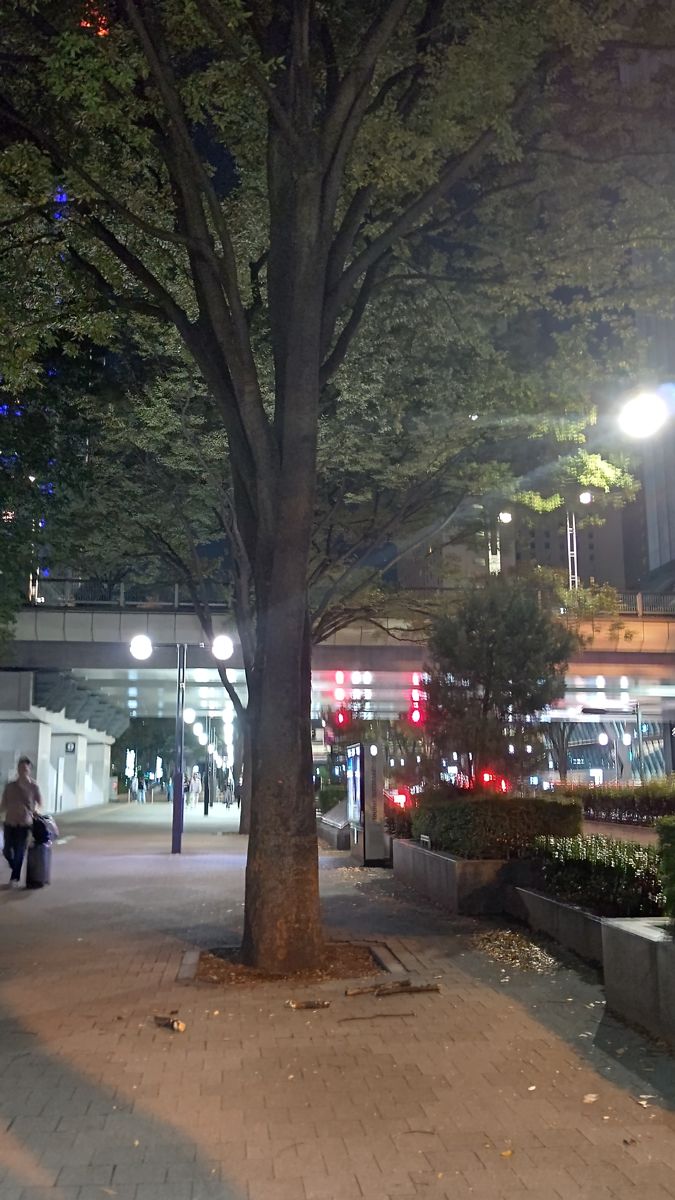
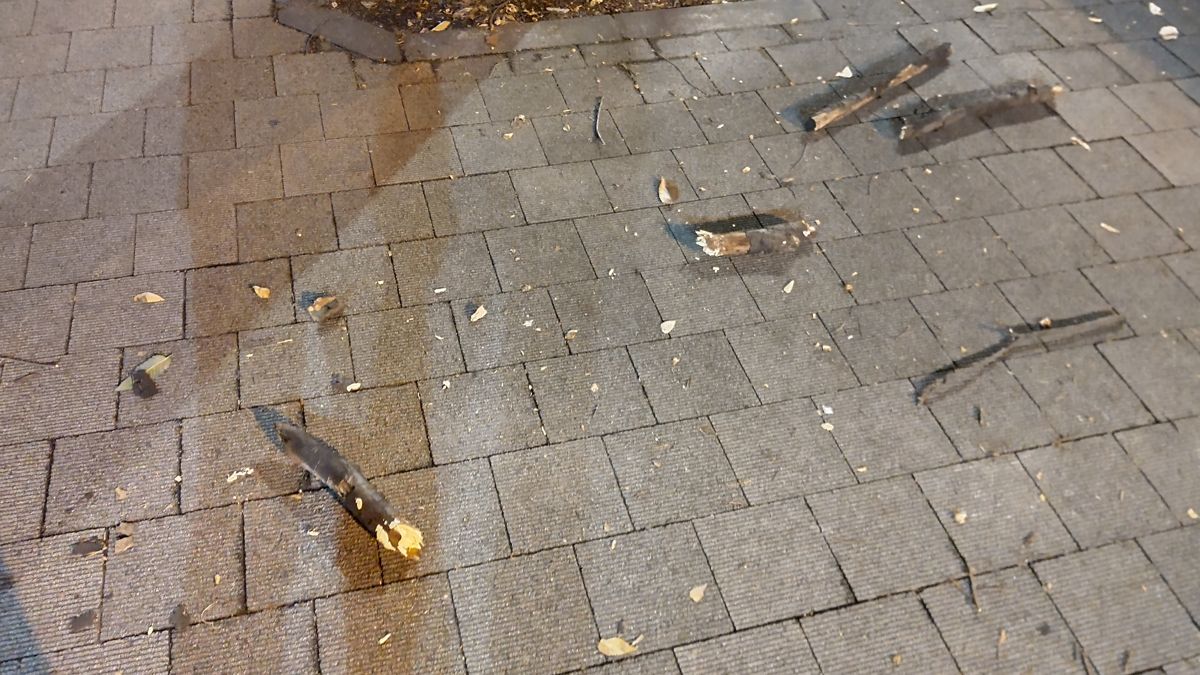
The danger of falling branches is something you can actually see. On a November night in 2024, broken branches lay scattered beneath a street tree on a sidewalk in Nishi-Shinjuku. As long as there are large trees above places where people walk, both cutting and not cutting carry their own risks.
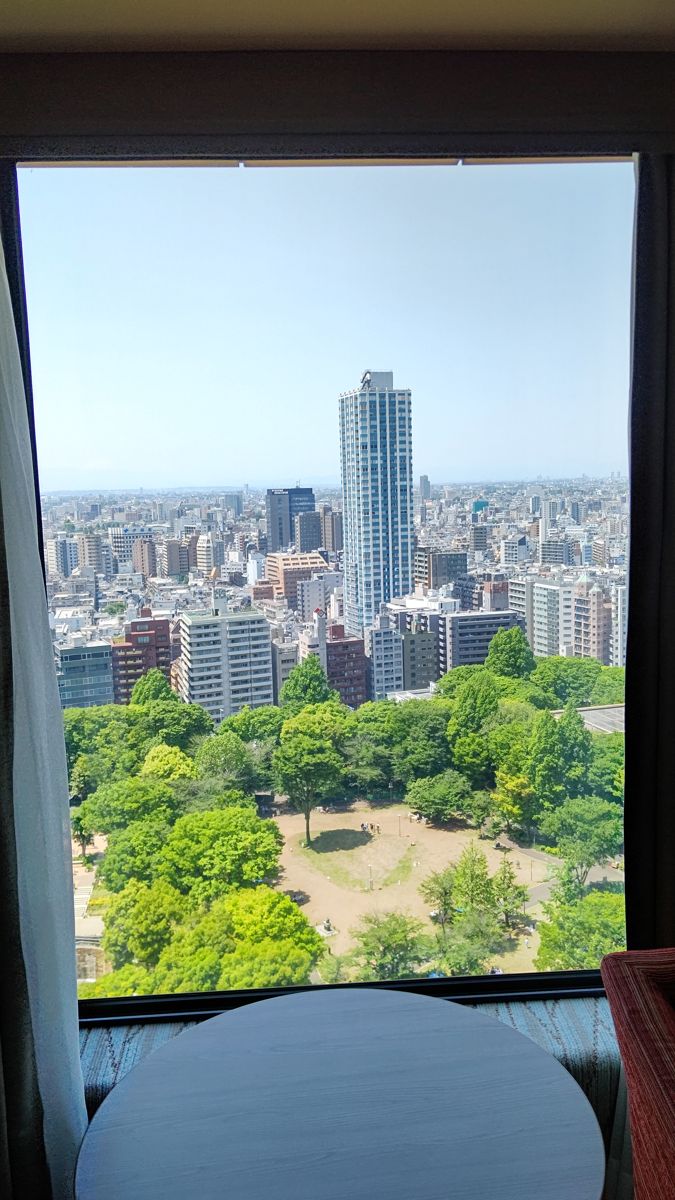
Seen from above a month later, in May 2022, the park was covered in fresh leaves. But the return of the leaves does not mean the hard pruning had no effect. The mass of sprouts that the research above points to shows up precisely as thin shoots and leaves flushing all at once after cutting.
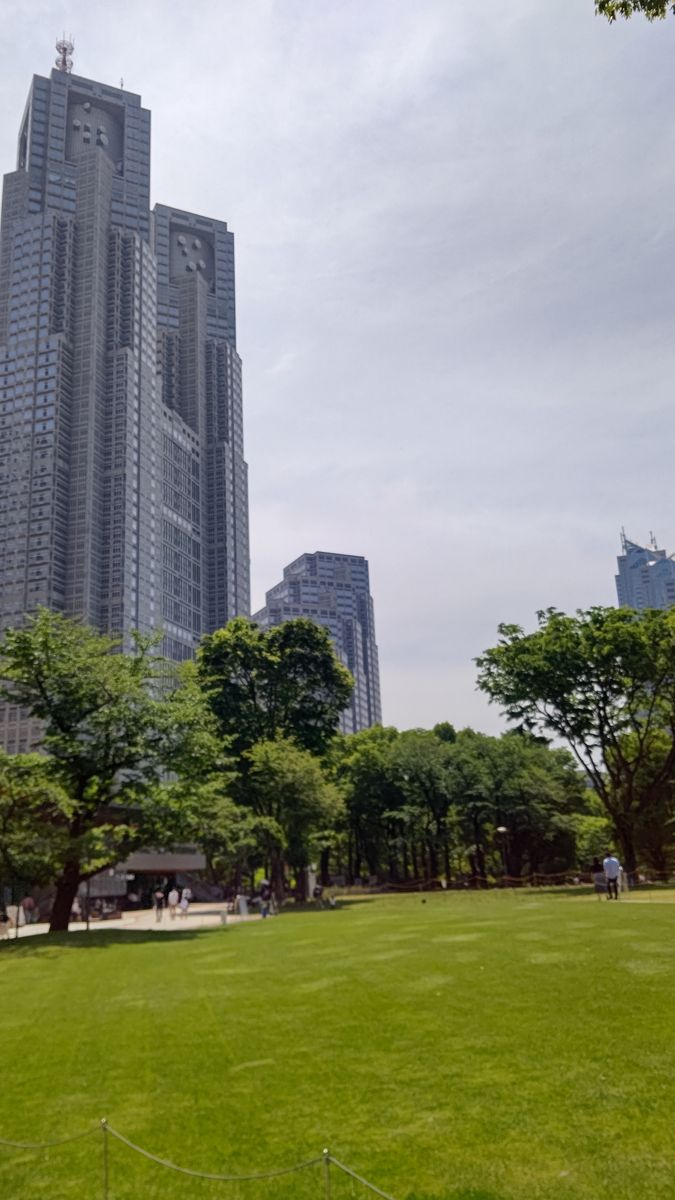
Around the same time, redevelopment work was under way at the park's Chibikko Hiroba (children's plaza). According to notices on site, it was commissioned by the Parks and Greenery Division of Shinjuku Ward's Greenery and Civil Engineering Department. The work ran from mid-November 2021 to mid-October 2022 and included a new play area for infants and the renovation of the large slide. The notices do not show whether the April pruning was connected with this work.
Details of the work are from the notices "Notice of Chibikko Hiroba redevelopment work" and "Notice of partial closure of the play equipment area," photographed by the author on May 5, 2022.
Hibiya Park: a Western-style park on a former parade ground
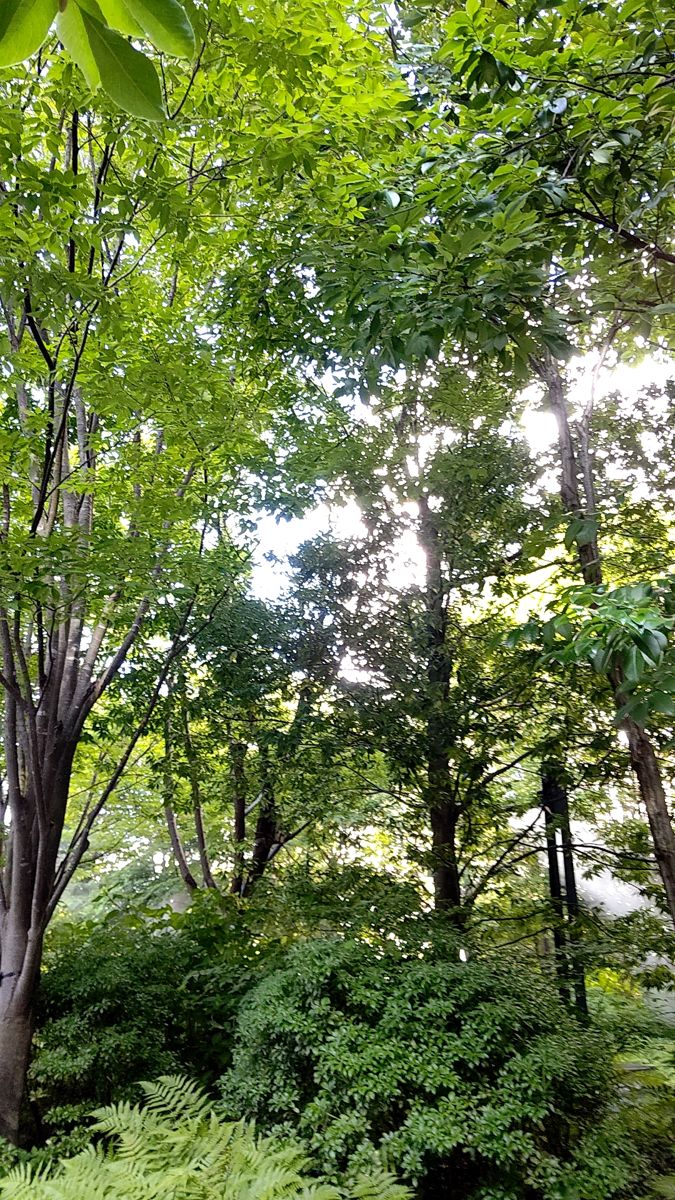
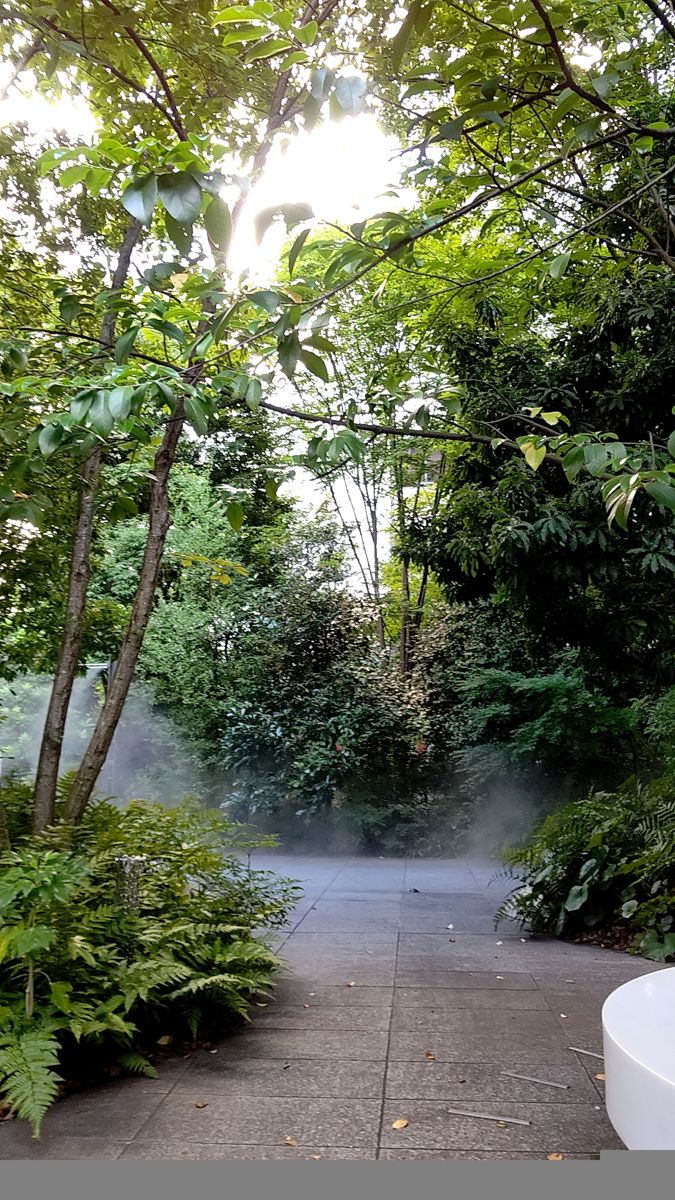
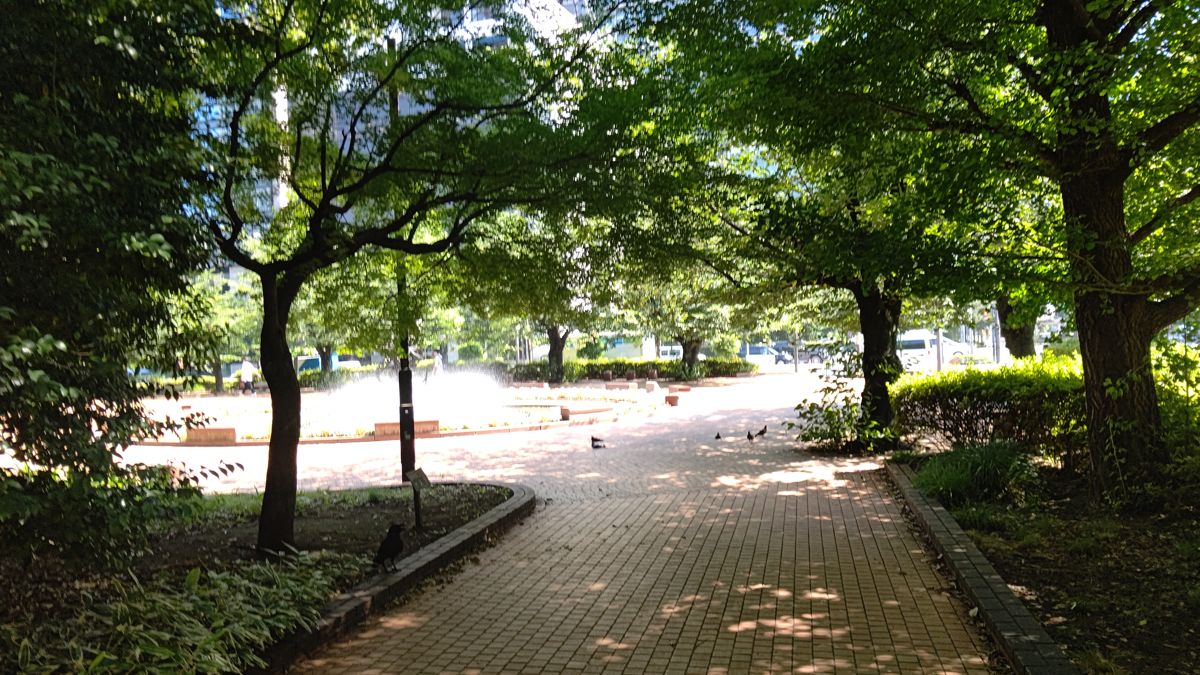
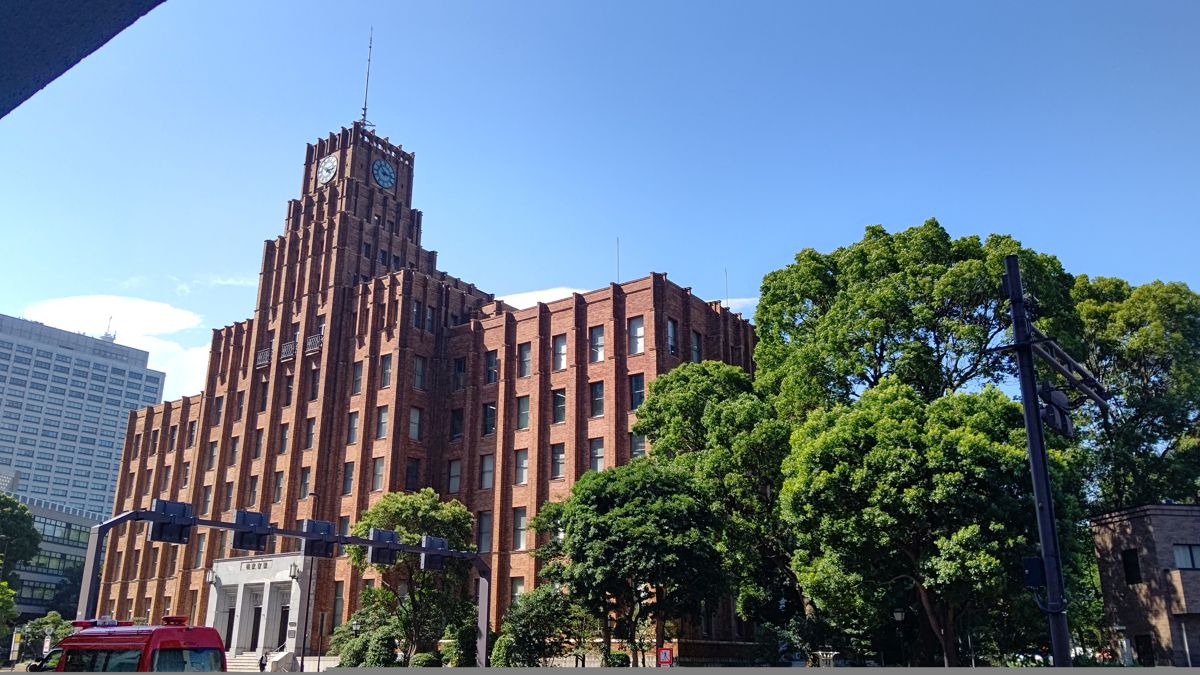
Hibiya Park, opened in 1903 on the site of an army parade ground, was Japan's first modern Western-style park. It covers 16 hectares and is planted with many trees, including the "Kubikake Icho," a ginkgo estimated to be about 500 years old. Since September 2023, renovation work has been under way area by area.[20]
Though surrounded by government offices and the buildings of Ginza and Yurakucho, the park has woodland-like spots where ferns grow thick beneath tall trees.
A garden inside a hotel: the Japanese garden of the New Otani
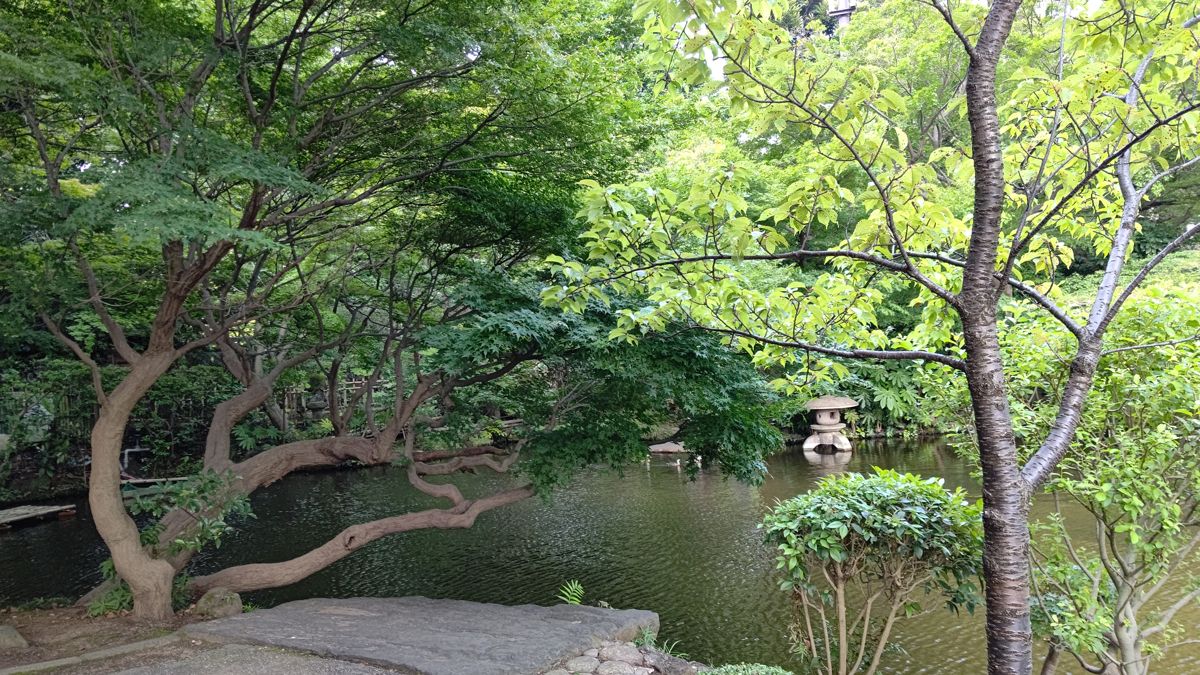
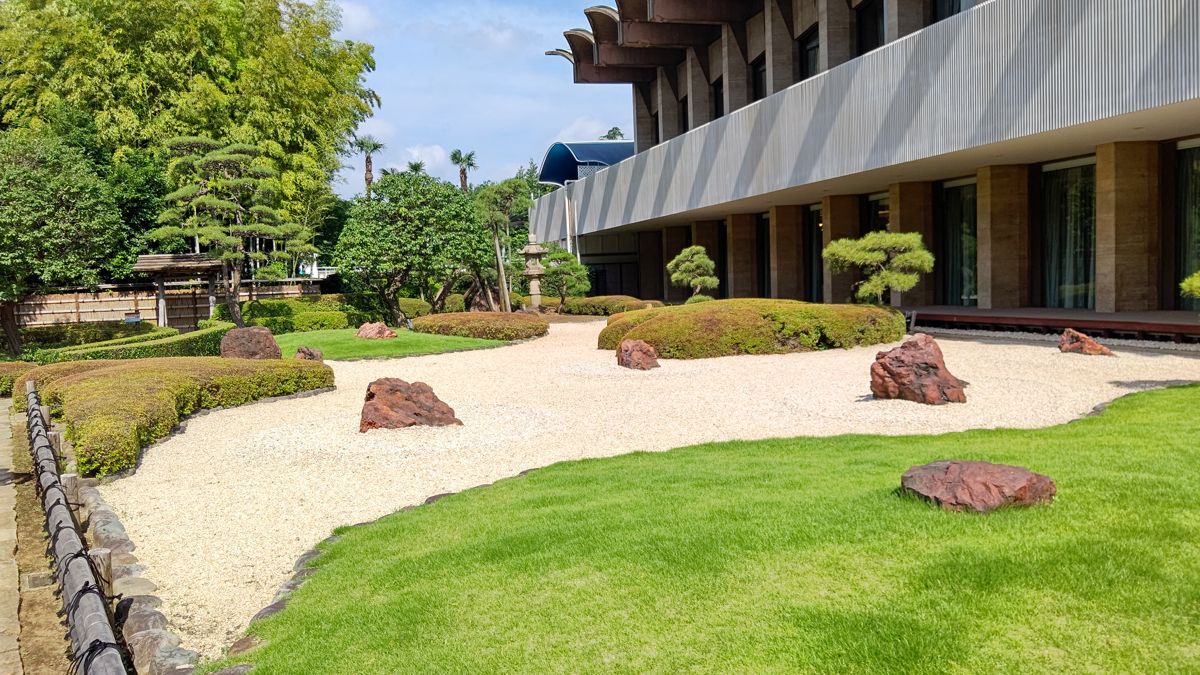
The Hotel New Otani in Kioicho has a Japanese garden of about 10,000 tsubo (roughly 3.3 hectares). In the early Edo period it was the site of a secondary residence of Kato Kiyomasa; after the Kato family was dispossessed it became a residence of the Ii family until the end of the shogunate. It later became the residence of the Fushimi-no-miya family and was known as a beautiful garden wrapped in pines and camphor trees.[21]
El verde de las calles
Árboles de calle: un millón en Tokio
A 1 de abril de 2023, Tokio tenía 1.000.546 árboles de calle de porte alto. De ellos, 645.875 (más del 60 %) están en vías metropolitanas; 206.451 en vías de distrito; 123.986 en vías de ciudades, pueblos y aldeas, y 24.234 en carreteras nacionales.[22]
Unidad: árboles. 10 especies principales. Longitud relativa al cornejo = 100. Fuente: Oficina de Construcción de Tokio, «Tabla resumen de árboles de calle de Tokio»[22]
Incluso las diez primeras especies suman solo cerca del 30 % del total: se usan muchas clases de árboles.[22] La primera, el cornejo florido, es norteamericana, y en el jardín de la Dieta hay cornejos regalados por Estados Unidos en 1915.[23]
Street trees do more than give shade. In central Tokyo in winter, they become the frame for illuminations, with lights wound around their trunks and branches to brighten the street—a way of using trees while they are still standing.
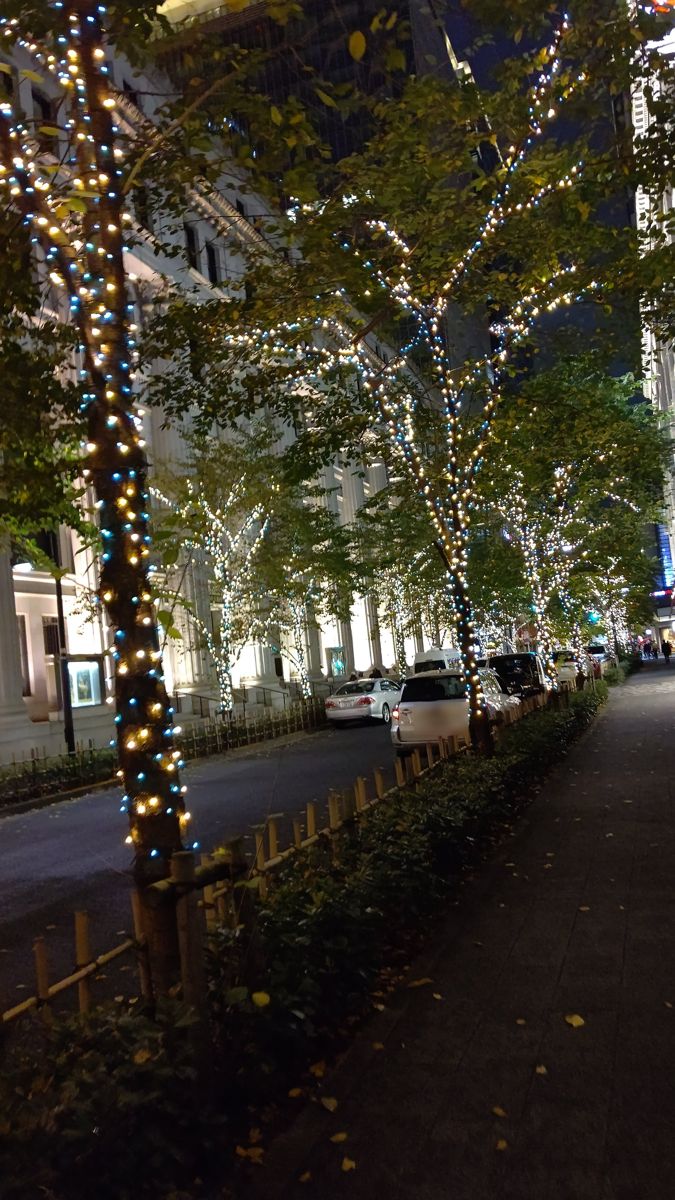
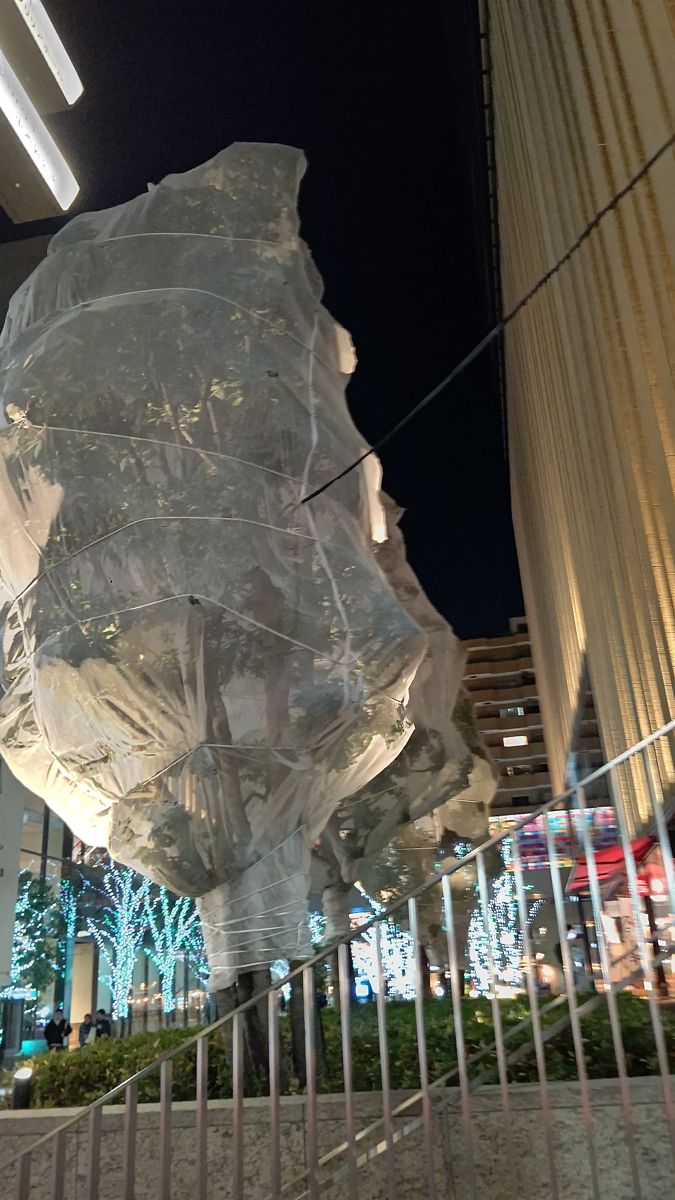
In the same winter streets, you also see trees wrapped whole in white netting. A tree I saw in Ikebukuro had been covered, branches and leaves and all, in netting to see it through the winter, while the street trees beyond it were lit with illuminations.
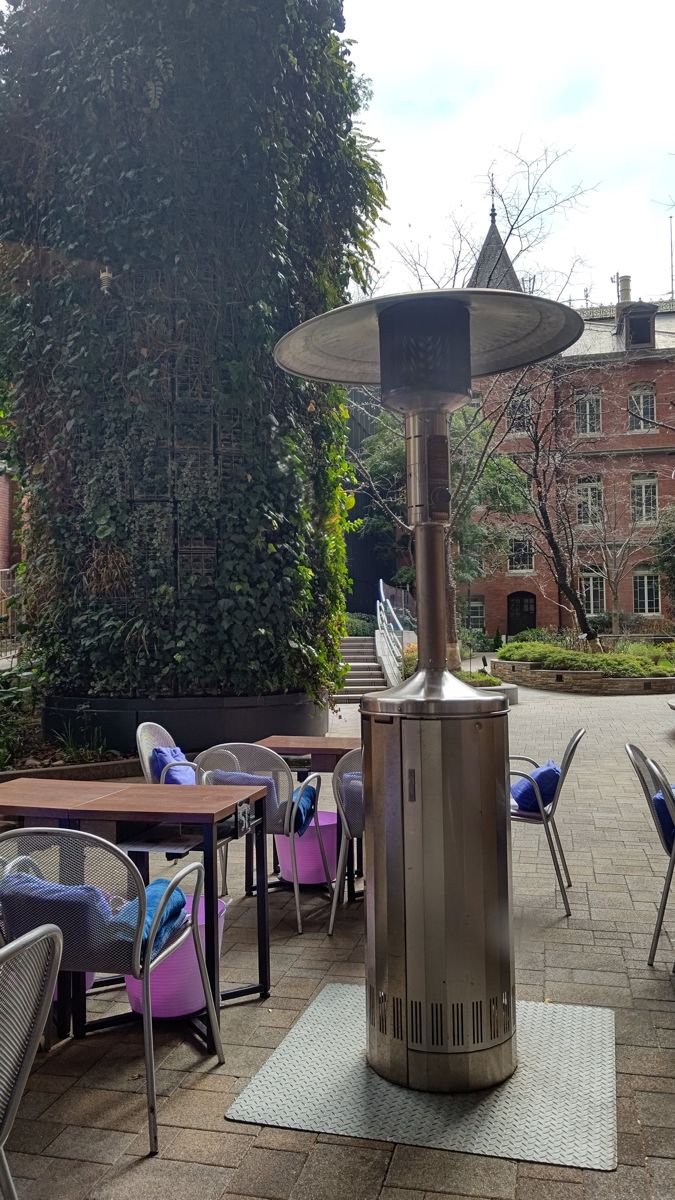
Between office towers, walls and columns themselves are sometimes covered in plants—"green walls." The Mitsubishi Ichigokan Museum in Marunouchi is a reconstruction of the Mitsubishi Ichigokan designed by Josiah Conder in 1894; it opened in 2010, and its courtyard has an English-style garden with about 40 varieties of heritage roses.[24] Its designer is the same as that of the former Iwasaki residence (Chapter 5). Beside the courtyard café stood a thick column covered in climbing plants.
Greenery is found inside buildings too. In the Peak Lounge, in the glass-walled atrium on the 41st floor of the Park Hyatt Tokyo—which occupies floors 39 to 52 of Shinjuku Park Tower—bamboo was planted like a grove.[25]
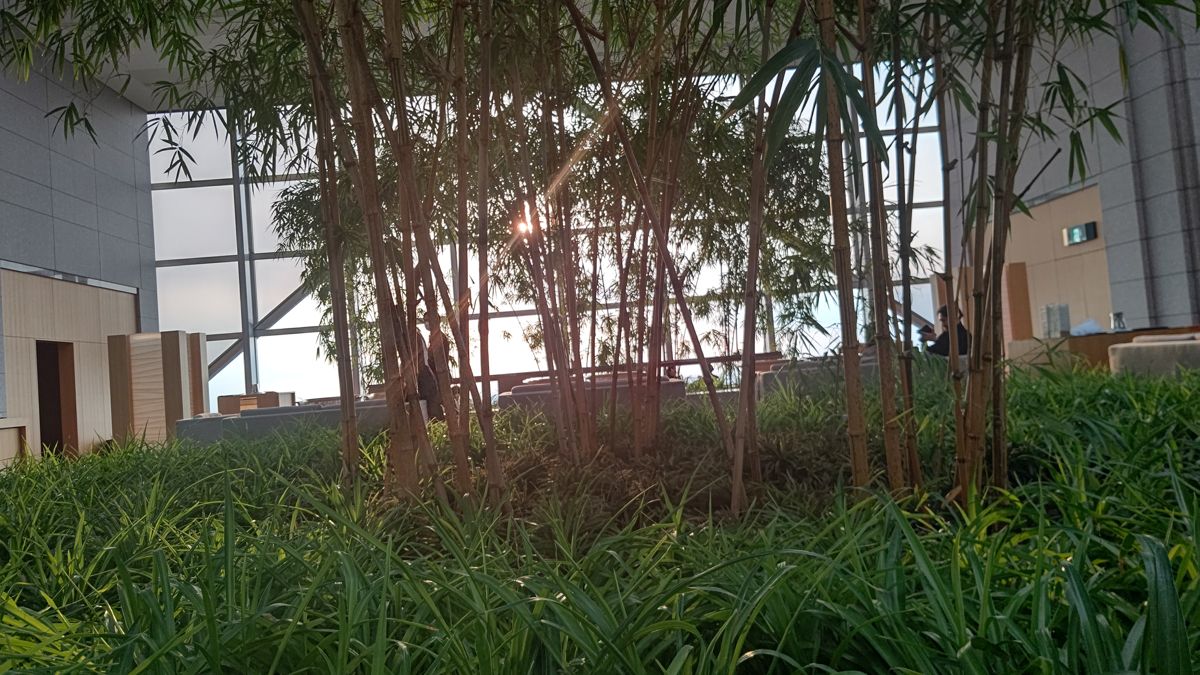
I have not confirmed whether the bamboo is real or how it is grown.
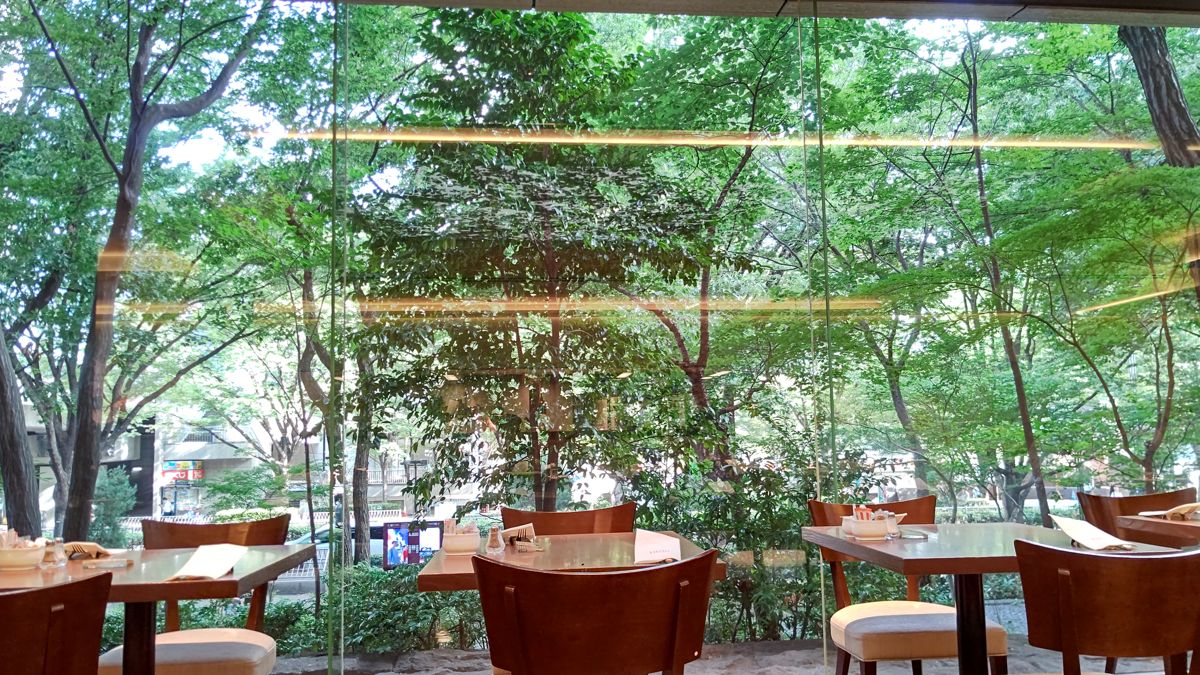
At the Keio Plaza Hotel, also in Nishi-Shinjuku, the green of summer trees filled the restaurant's large windows.
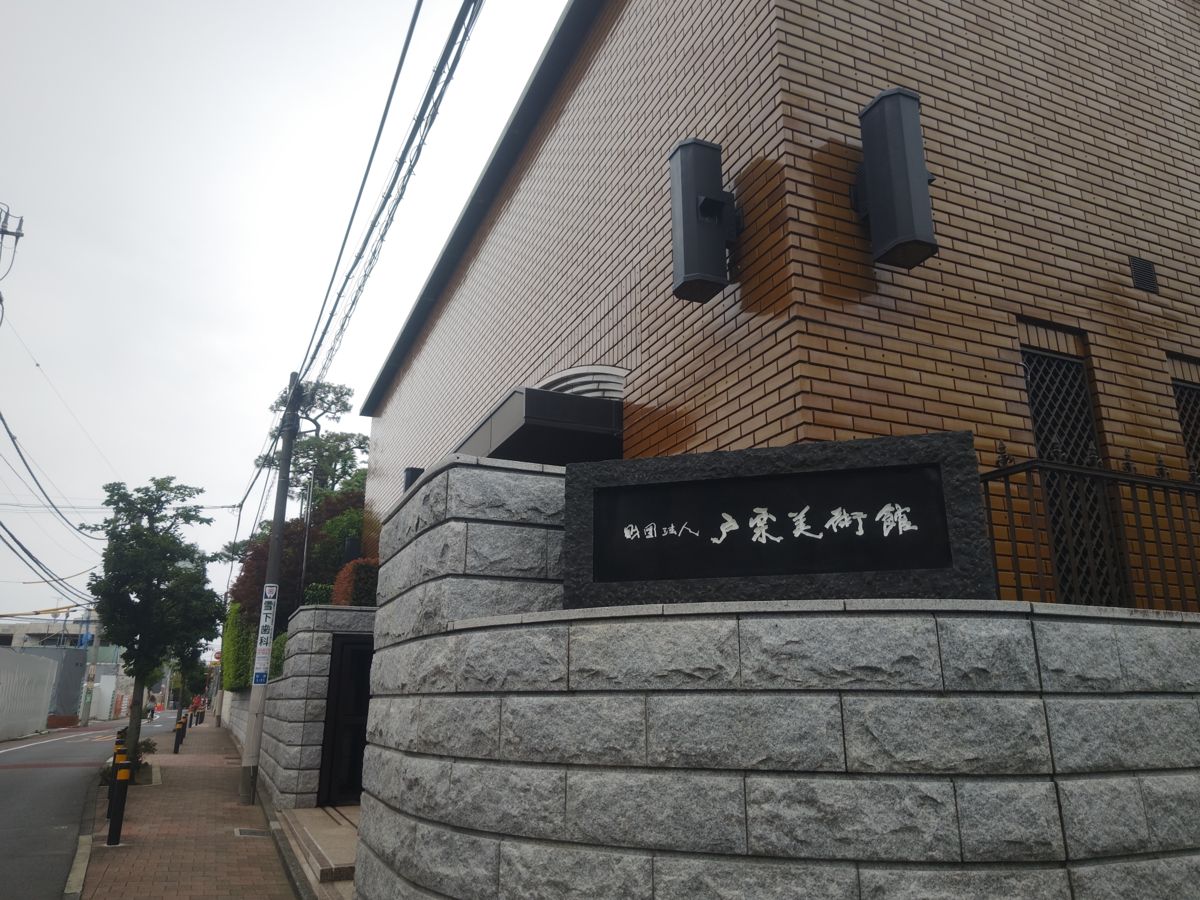
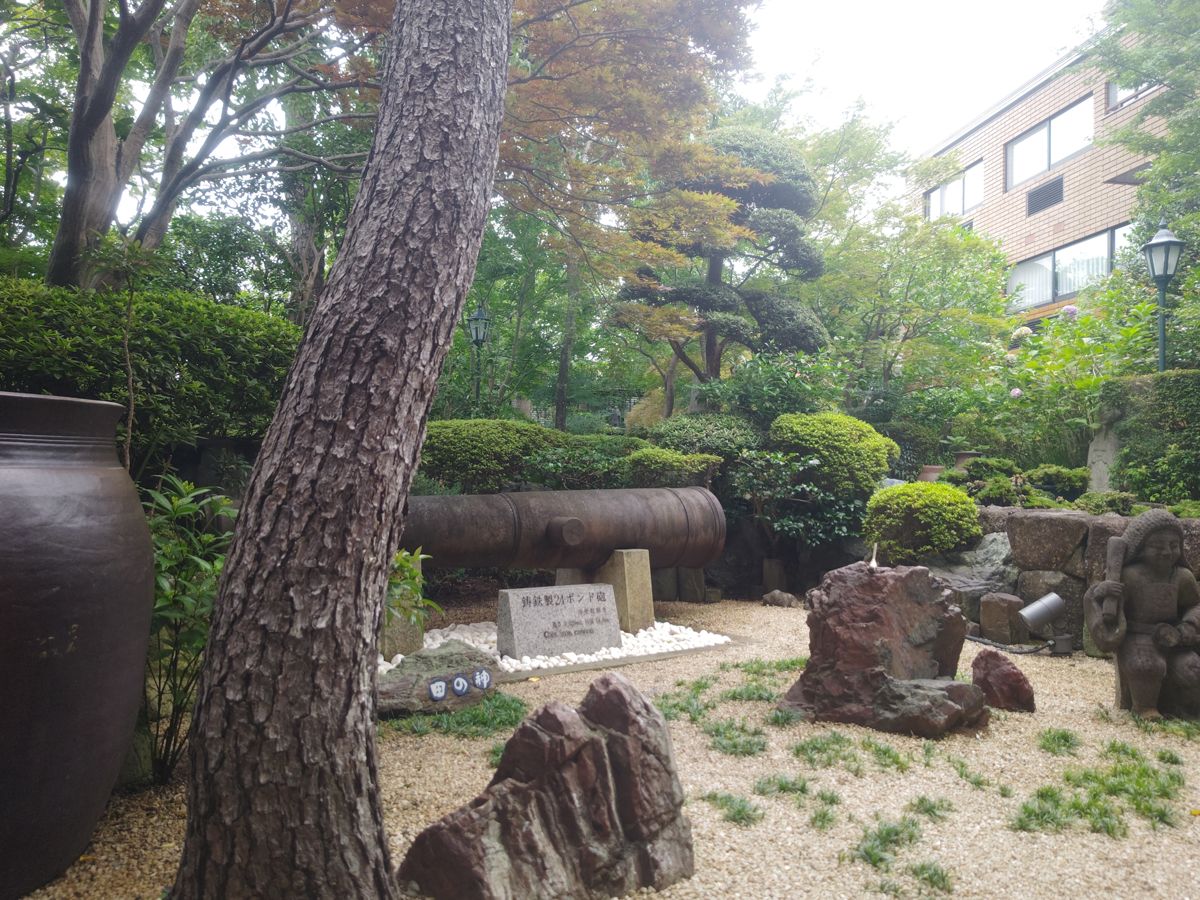
The higher the price of land, the more luxurious the space given over to greenery. The Toguri Museum of Art in Shoto, Shibuya, which collects ceramics such as Imari and Nabeshima ware, opened in 1987.[26] Beside its entrance is a garden of pines and clipped shrubs set with stones. In my view, in an expensive residential area, leaving space unbuilt and presenting it as greenery is itself a form of display.
Tokyo Midtown in Roppongi is a mixed-use complex that opened in March 2007, with SOM and Kengo Kuma and Associates among its designers.[27] Bamboo is planted in its atrium, and wood-colored louvers and handrails and a stepped wooden bench are combined with the greenery seen through the glass.
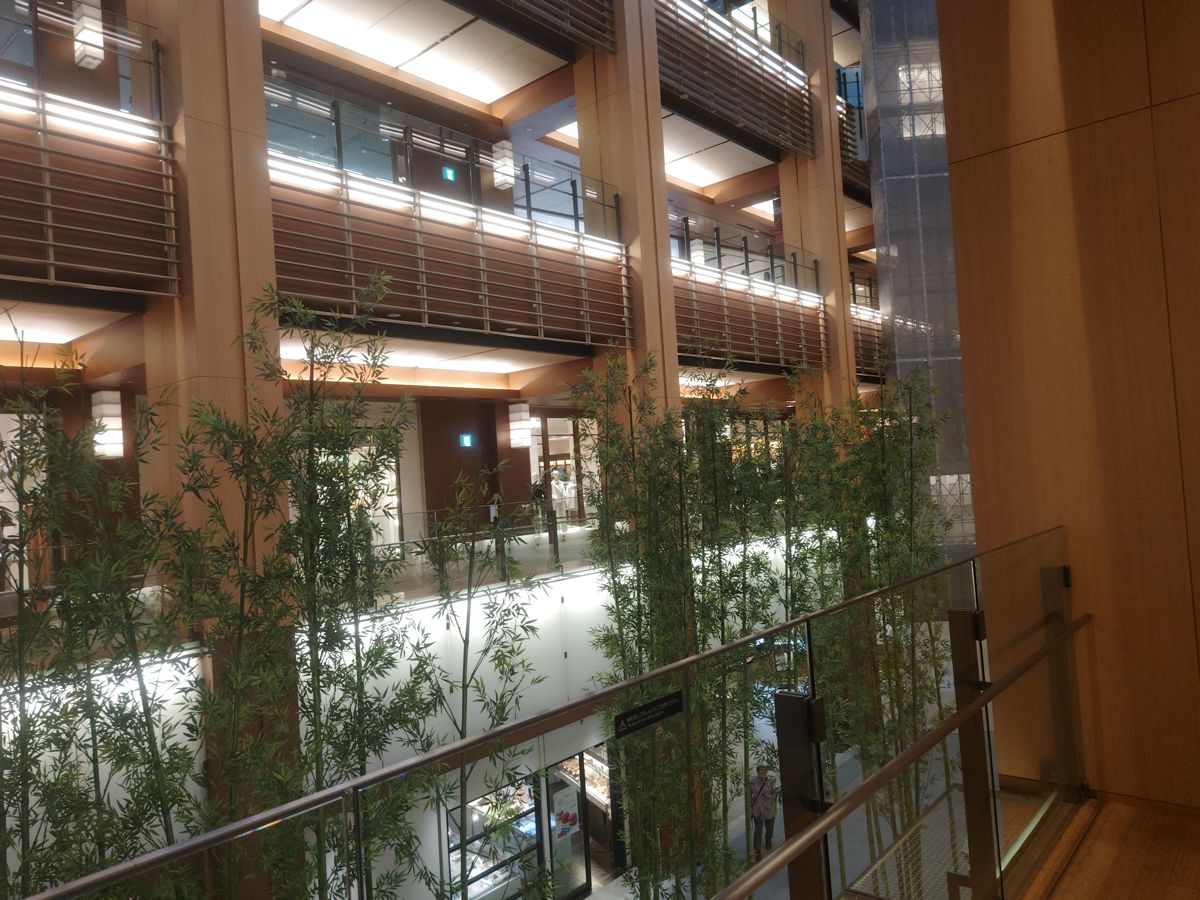
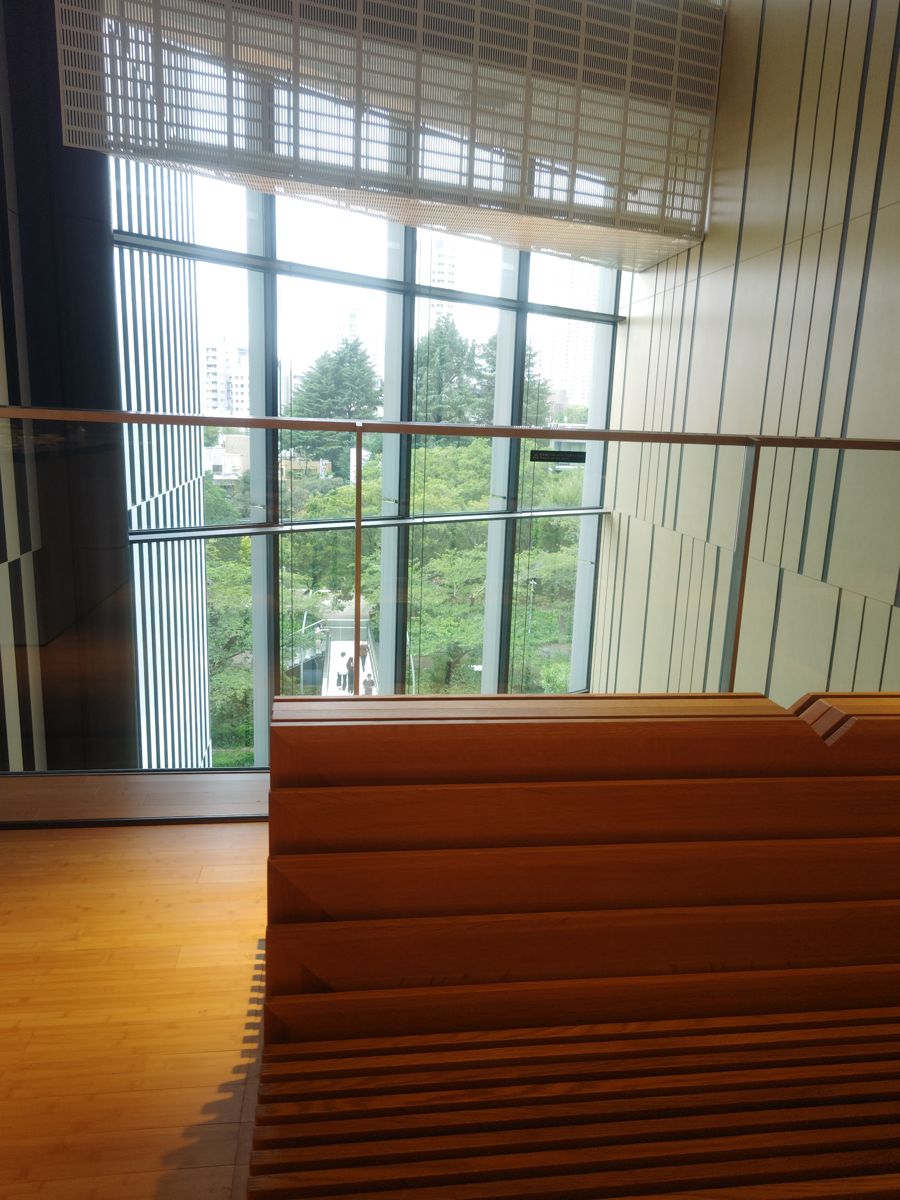
I have not confirmed whether the louvers and bench are solid wood or wood-grain veneer, or whether the bamboo is real.
Avenidas célebres
| Avenida | Especies | Detalles |
|---|---|---|
| Avenida de ginkgos de Jingu Gaien Minato/Shinjuku | Ginkgo | 146 árboles en cuatro filas a 9 m, 300 m de largo. Plantones criados desde 1908; terminada en 1923. Diseño del paisajista Orishimo Yoshinobu[28] |
| Avenida de zelkovas de Omotesando Shibuya/Minato | Zelkova | Unos 900 m desde Aoyama-dori hasta el Santuario Meiji[29] |
| Avenida de zelkovas de Baba Daimon Fuchu | Zelkova | La única avenida de zelkovas de Japón declarada monumento natural nacional[30] |
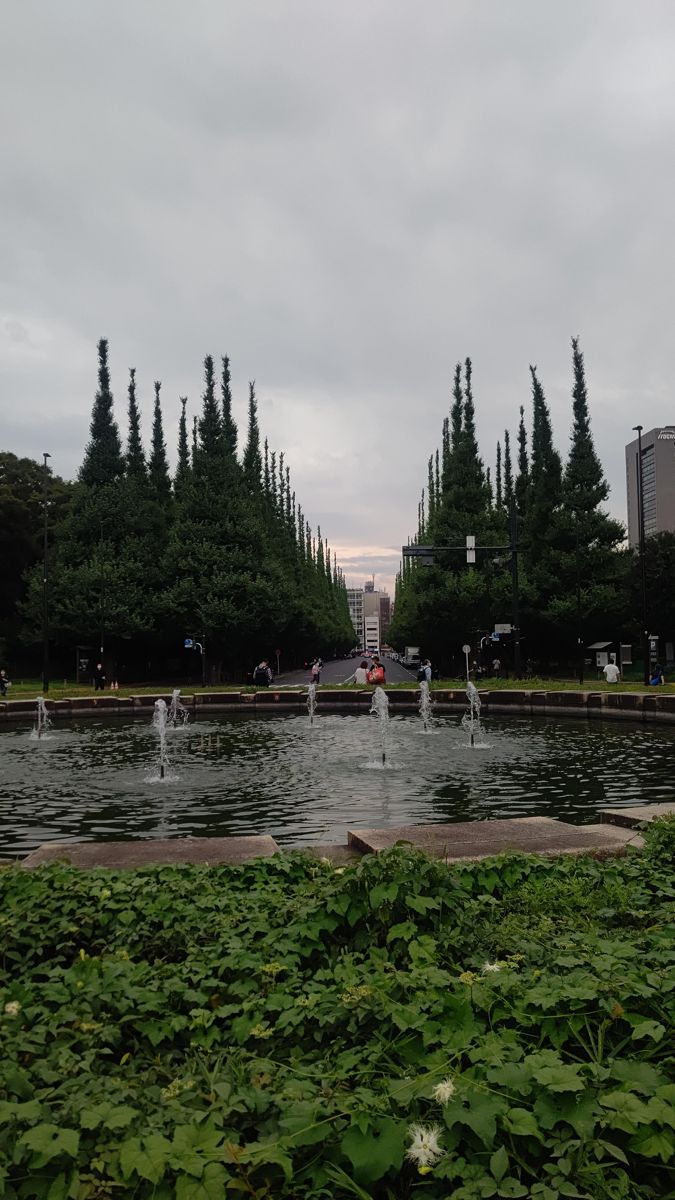
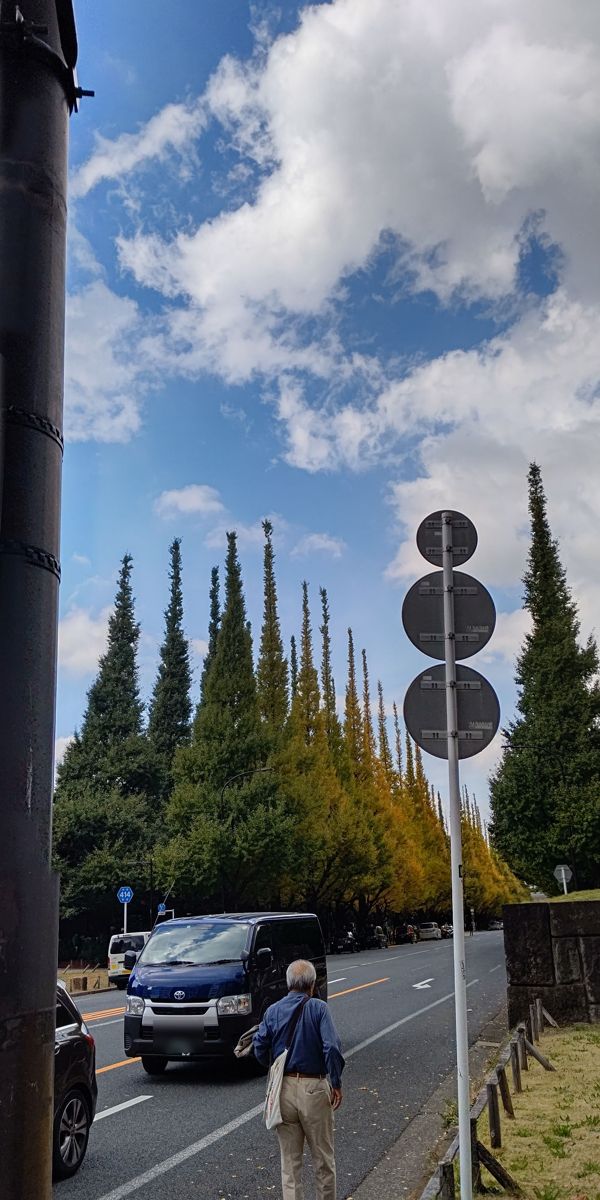
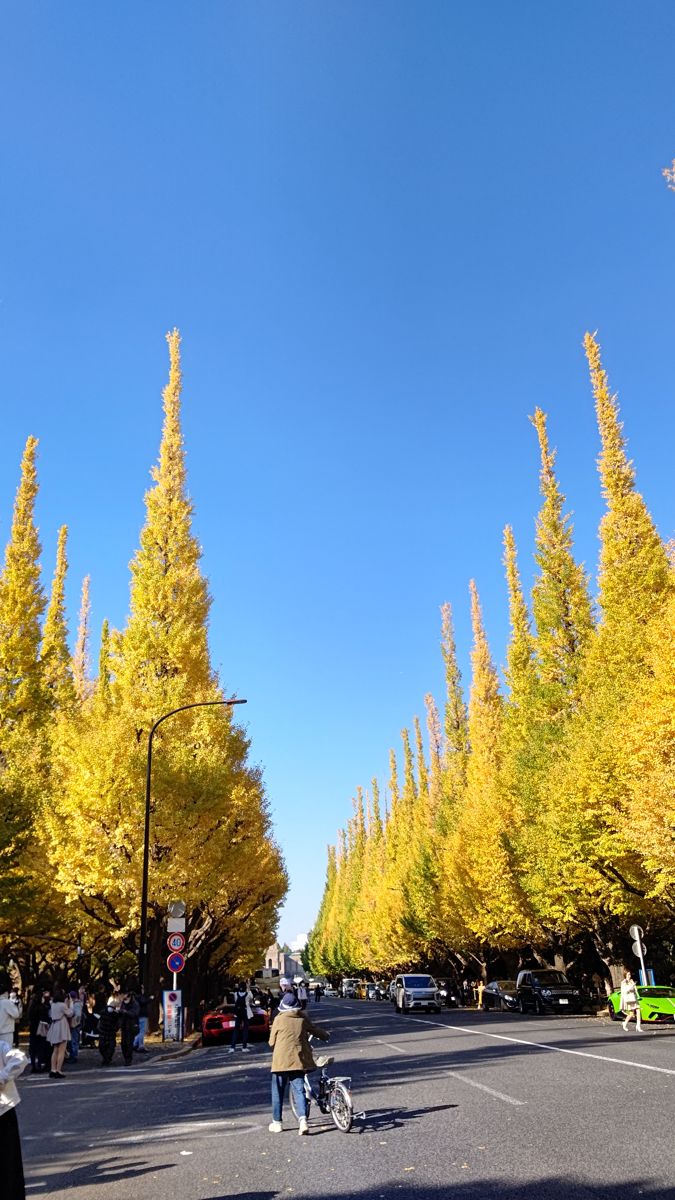
La avenida de ginkgos de Jingu Gaien usa un truco de pintor. Los árboles del lado de Aoyama-dori se mantienen más altos y bajan hacia el fondo, creando una perspectiva para que la Galería Conmemorativa Meiji luzca al final de la avenida.[28] Es un ejemplo de usar la altura de los árboles para componer una vista.
The Jingu Gaien redevelopment and opposition to the tree felling
Jingu Gaien, home of the ginkgo avenue, is undergoing large-scale redevelopment. The developers are four parties—Mitsui Fudosan, Meiji Jingu, the Japan Sport Council and Itochu—and the plan is to rebuild Jingu Stadium and Chichibunomiya Rugby Stadium and put up high-rise buildings. The Tokyo government approved the project on February 17, 2023.[31]
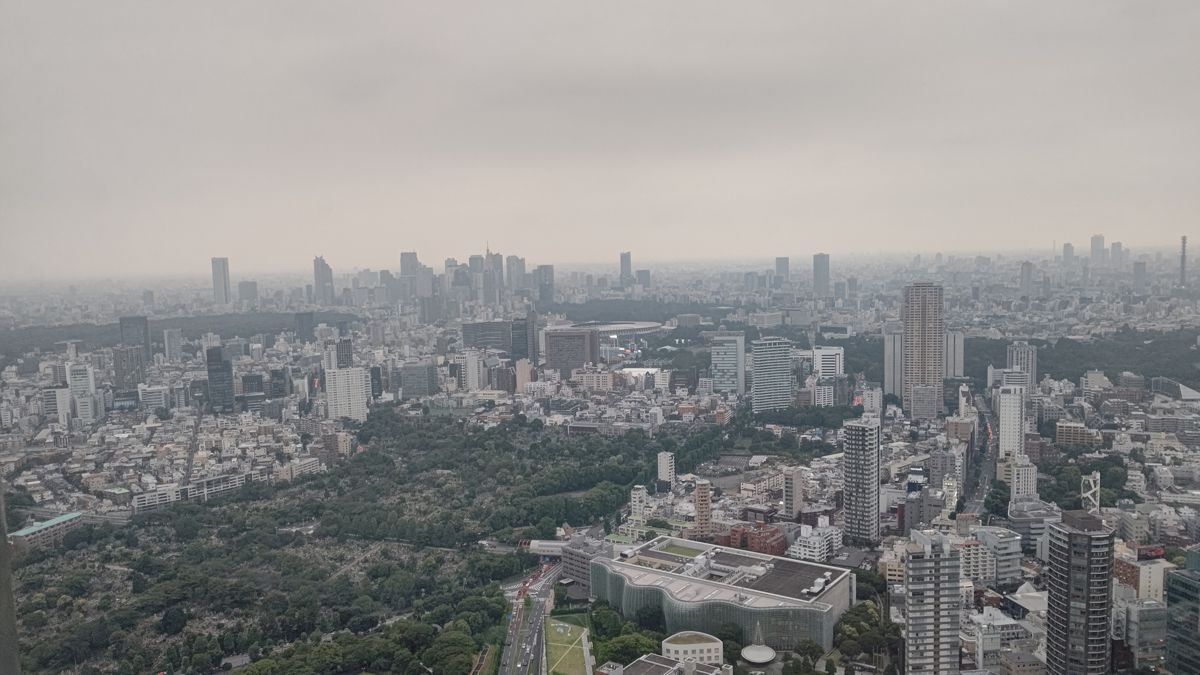
As the plan became known, opposition to the tree felling spread. From February 2023, a petition asking the Tokyo government to withdraw its support for the plan gathered more than 225,000 signatures, and in September that year the International Council on Monuments and Sites (ICOMOS) issued a "Heritage Alert," warning that the plan would lead to irreversible destruction of cultural heritage.[32]
The number of trees to be cut has been revised several times. According to the Tokyo government's fact sheet, the number fell from 971 in the draft environmental assessment of August 2021 to 556 at the time of the August 2022 report, and to 511 with the change of September 30, 2024. The total number of trees is planned to rise from 1,904 before the project to 2,304 after it.[31] In September 2024, Mitsui Fudosan announced a revised plan reducing the felling of tall trees 3 m or higher from 743 to 619. Because it counts differently from the Tokyo documents, the numbers do not match.[33]
All four rows of the ginkgo avenue are to be kept. Based on a root survey, the distance between the new baseball stadium building and the avenue was widened from about 8 m to about 18.3 m.[31] Still, those calling for conservation argue that what matters is not the number of trees cut but "the quality of tree conservation," and that historic trees should be kept where they were planted.[34]
Felling began on October 28, 2024.[35] Court cases also continue. In a suit by 82 plaintiffs, including nearby residents, seeking to revoke the felling permit, the Tokyo District Court rejected the claim in May 2026.[36] A separate suit seeking to revoke the project approval concluded hearings at the Tokyo District Court on September 15, 2026, with a ruling expected on January 28, 2027.[37]
The author's view
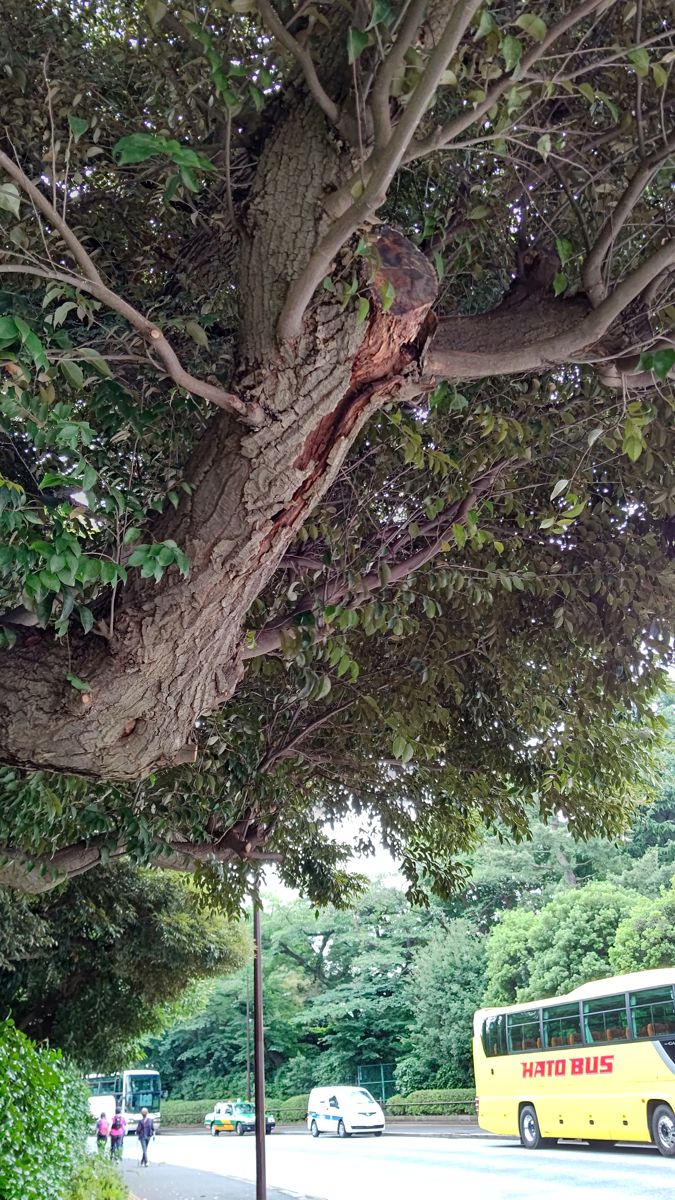
Personally, I am in favor of replanting trees through the redevelopment. When I walked through Gaien in June 2023, I noticed quite a few trees that had been poorly pruned and had wounds or defects. If such trees are to be replaced, I think that is a good thing.
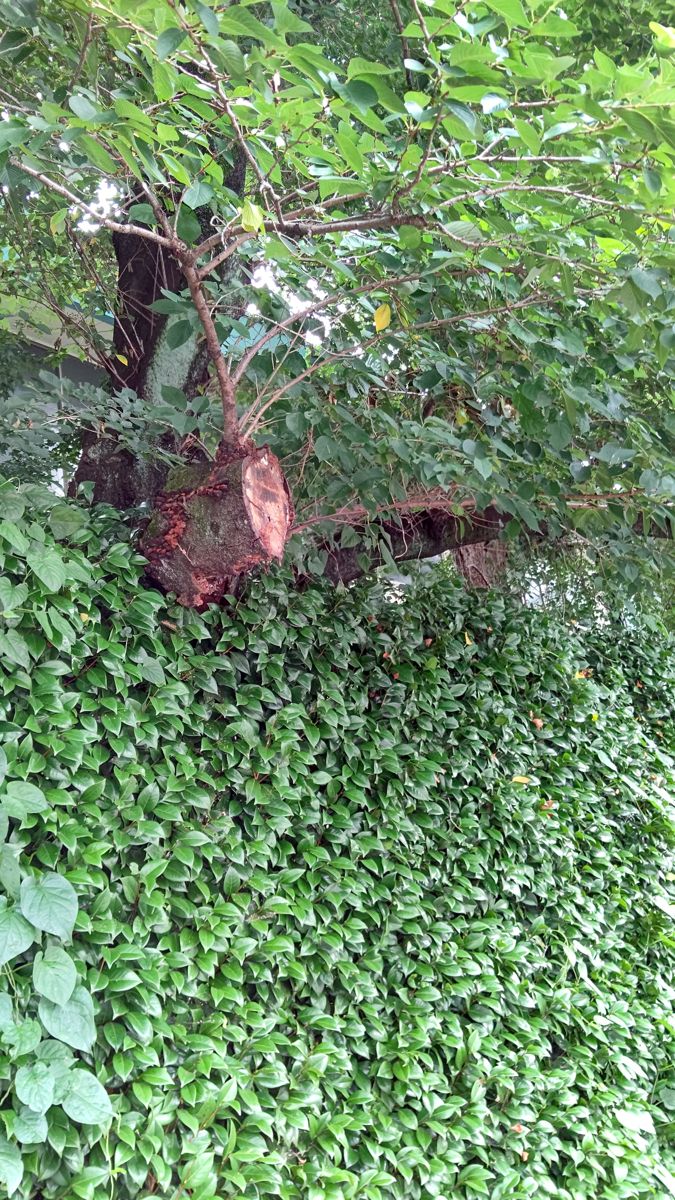
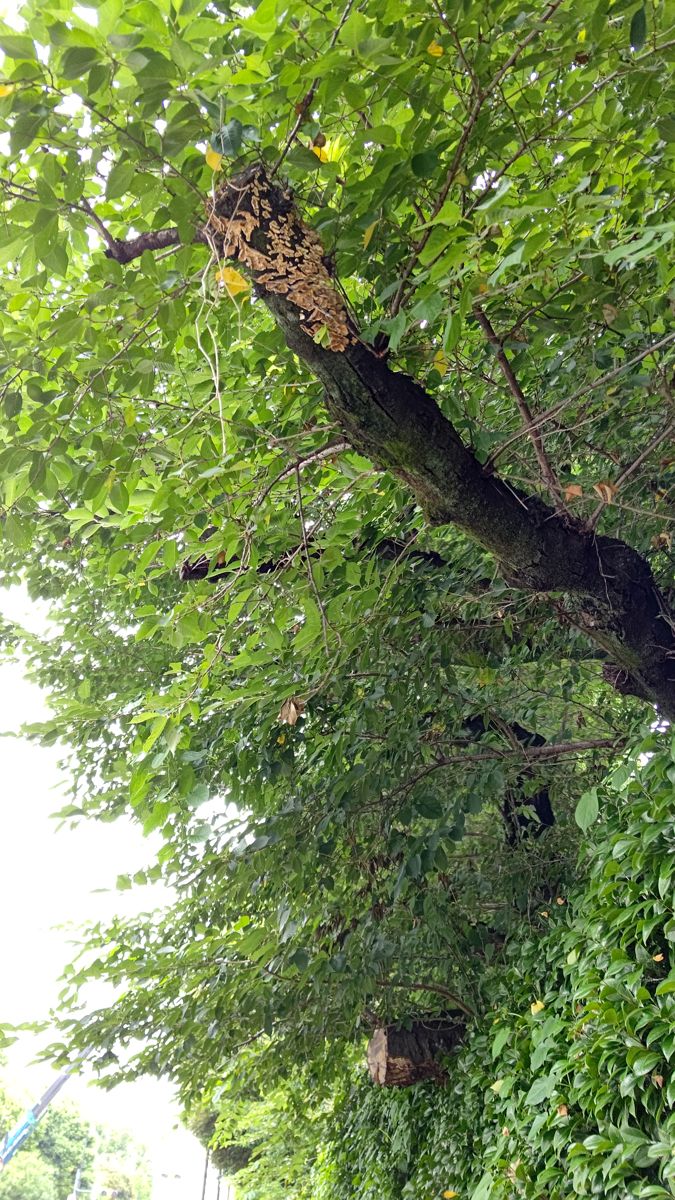
This is, however, my impression from what I saw while walking, not a survey of the condition of all the trees in Gaien. I have also not confirmed whether the trees in the photos are among those to be felled. Damaged trees can also be kept, without replanting, through proper pruning and care. That "quality of conservation" is exactly what the opponents are asking about.
Cerezos del río Meguro
Unos 800 cerezos Somei-yoshino bordean unos 3,8 km del río, desde Ikejiri-Ohashi hasta el puente Kamenoko.[16] El Somei-yoshino fue elegido flor oficial de Tokio en 1984.[38]
Un paseo verde: el acueducto Tamagawa
El acueducto Tamagawa se excavó para llevar agua a la ciudad de Edo. Las obras empezaron en 1653 y unieron la toma de Hamura con Yotsuya-Okido a lo largo de unos 43 km; el agua empezó a llegar al año siguiente.[39]
| Año | Hecho |
|---|---|
| 1653 Jo'o 2 | Comienza la excavación; el suministro empieza al año siguiente[39] |
| 1737 Genbun 2 | Se dice que Kawasaki Heiemon Sadataka, por orden del shogunato, plantó cerezos en ambas orillas en torno al puente Koganei (los cerezos de Koganei)[39] |
| 1924 Taisho 13 | «Koganei (cerezos)» declarado Lugar de Belleza Escénica[39] |
| 1971 Showa 46 | Se aprueba convertir el terraplén en paseo verde[39] |
| 1981 Showa 56 | Abre en parte el paseo verde metropolitano del acueducto Tamagawa (puente Heiwa–puente Mure)[39] |
| 2003 Heisei 15 | El acueducto Tamagawa es declarado sitio histórico nacional[39] |
Una obra hecha para llevar agua se convirtió en lugar de cerezos y, finalmente, en paseo verde. El canal de Edo une hoy Tama con las afueras del centro de Tokio como camino de verdor.
Árboles de la memoria y de las ceremonias
Árboles que sobrevivieron a la guerra
En Tokio quedan árboles que ardieron en los bombardeos y siguen vivos. Un estudio de los 23 distritos encontró que, de 474 candidatos, 200 se confirmaron como «árboles dañados por la guerra» mediante testimonios y otras pruebas, y otros 150 se consideran probables. El parque Ueno tiene 53 confirmados, y la zona del santuario Tomioka Hachimangu, en Koto, es una de las que concentran 93. En algunos lugares, como el santuario Tobiki Inari de Sumida, sobreviven varios en un recinto pequeño.[40]
| Lugar | Especies | Estado actual |
|---|---|---|
| Senso-ji (Taito) | Ginkgo | Una bomba incendiaria alcanzó su base; la mitad superior ardió y el tronco hueco está carbonizado por dentro. Aun así sigue echando ramas y hojas[41] |
| Templo Koenji (Koishikawa, Bunkyo) | Ginkgo | La parte superior ardió en el gran bombardeo de Tokio; tronco hueco y carbonizado. Echa rebrotes y tiene hojas verdes[42] |
| Zenkojizaka (Koishikawa, Bunkyo) | Muku (Aphananthe) | La parte superior ardió en los bombardeos y se cortó la mayor parte del tronco, pero crece bien[42] |
| Santuario Nitta (Ota) | Zelkova | Citado en la investigación como ejemplo de árbol dañado por la guerra[40] |
Aunque el centro del tronco se convierta en carbón, un árbol puede seguir transportando agua y nutrientes mientras sobreviva su capa exterior viva. Los árboles que rebrotaron de troncos quemados y siguen con hojas más de 80 años después son testigos vivos que llevan en su cuerpo la memoria de los bombardeos.
El ginkgo del Senso-ji y el ginkgo del Koenji se describen de forma muy parecida, pero son árboles distintos. El del Senso-ji es un árbol sagrado de más de 800 años que se alza en el lado oeste del recinto; el del Koenji está dentro del jardín de infancia del templo, en Koishikawa (Bunkyo). En ambos, el interior del tronco se quemó en los bombardeos aéreos y quedó hueco.
El jardín de la Dieta: árboles de todas las prefecturas
En el jardín delantero del edificio de la Dieta Nacional hay «árboles prefecturales» regalados por prefecturas de todo Japón. Se ofrecieron para conmemorar el 80.º aniversario de la apertura de la Dieta, el 29 de noviembre de 1970.[17] Están plantados en los lados de la Cámara de Representantes y de la Cámara de Consejeros; según la prefectura de Shiga, cada prefectura tiene dos árboles en cada lado.[43]
Los árboles son seres vivos y se sustituyen cuando mueren. El 18 de noviembre de 2025 se sustituyó un arce japonés muerto de Shiga, en el lado de la Cámara de Representantes, por otro de 4 m cultivado en Shiga.[43] El jardín también tiene un gran ginkgo que está allí desde antes de construirse el edificio.[17]
La Fiesta Nacional de Plantación de Árboles y la de Cuidado de Árboles en Tokio
La Fiesta Nacional de Plantación de Árboles es el acto central del movimiento nacional de reverdecimiento, en el que el emperador y la emperatriz plantan árboles y siembran semillas. Se celebra cada año desde 1950, empezando en Yamanashi, de forma rotatoria entre las prefecturas.[44] La Fiesta Nacional de Cuidado de Árboles es un acto en el que miembros de la familia imperial cuidan después los árboles plantados en una fiesta de plantación.[45] Tokio acogió la fiesta de plantación en 1996 y, en 2018, la de cuidado de esos mismos árboles.
| Año | Acto | Sede | Detalles |
|---|---|---|---|
| 1996 (Heisei 8) 19 de mayo | 47.ª Fiesta Nacional de Plantación de Árboles | Bosque de montaña: Hinohara Tomin-no-Mori (Hinohara) Bosque urbano: parque costero Tatsumi-no-Mori (Koto) Bosque marino: vertedero interior del rompeolas central | Lema: «Los bosques sostienen nuestra vida, las ciudades cultivan el verde: vivir junto al bosque en Tokio». Unos 12.000 participantes. El emperador y la emperatriz plantaron árboles en el bosque marino y sembraron semillas en el bosque urbano[44][46][45] |
| 2018 (Heisei 30) 17 y 18 de noviembre | 42.ª Fiesta Nacional de Cuidado de Árboles | Cuidado de árboles: futuro parque Umi-no-Mori (vertedero interior del rompeolas central) Ceremonia: Musashino Forest Sport Plaza (Chofu) | Lema: «Del cuidado de los árboles a una vida con madera que se transmite». Unas 5.000 personas en la ceremonia. El entonces príncipe heredero podó un ginkgo plantado en 1996 y la entonces princesa heredera lo abonó[47][48] |
El «bosque marino» de 1996 era un terreno ganado al mar con basura y tierra de obras (sobre los rellenos, véase el capítulo 6). En la época de la fiesta de cuidado, unos 20 años después, un documento del Gobierno Metropolitano señalaba que «la sede, entonces un vertedero desnudo, ha renacido como un hermoso bosque de árboles crecidos».[48] Ese bosque es el actual parque Umi-no-Mori (Bosque del Mar). Repartir el acto en tres sedes —montaña (Hinohara), ciudad (Koto) y mar (vertedero)— mostraba de una vez la extensión del verde de Tokio, desde los bosques de Tama hasta la bahía.
Las especies plantadas varían según la fuente: la lista de la Agencia Forestal indica «ginkgo, Castanopsis sieboldii»[44], mientras que el documento de Tokio enumera como árboles de 1996 a cuidar «ginkgo, Castanopsis sieboldii y cerezo de Oshima».[45] En la lista de la Agencia Forestal (hasta la 64.ª fiesta, en 2013), es la única fiesta de plantación celebrada en Tokio.
Fuentes
- 林野庁関東森林管理局 広報資料(高尾山) PDF
- 環境省 新宿御苑 見どころマップ PDF
- 環境省 巨樹・巨木林データベース 観察コースガイド「新宿御苑」 PDF
- 東京都建設局「都立代々木公園の整備計画 答申」 PDF
- GLTJP「代々木公園」 Enlace
- ニッポン旅マガジン「水元公園」 Enlace
- 東京都建設局 浜離宮恩賜庭園 資料 PDF
- ニッポン旅マガジン「林試の森公園」 Enlace
- 東京都建設局 林試の森公園 資料 PDF
- ニッポン旅マガジン「国立科学博物館附属自然教育園」 Enlace
- 目黒区「駒場野公園」 Enlace
- 東京都建設局 井の頭恩賜公園 公式ページ「公園について」 Enlace
- 三井住友トラスト不動産「このまちアーカイブス 吉祥寺」 Enlace
- 新宿区「新宿中央公園」 Enlace
- 三井住友トラスト不動産「このまちアーカイブス 新宿」 Enlace
- ニッポン旅マガジン「目黒川の桜並木」 Enlace
- 参議院「国会議事堂を見る」 Enlace
- 国土交通省関東地方整備局「新宿御苑旧御凉亭」 Enlace
- 国土技術政策総合研究所 緑化生態研究室「道路緑化における効果的・効率的な施工・管理手法に関する研究」(平成22〜24年度) PDF
- GO TOKYO「日比谷公園」 Enlace
- ホテルニューオータニ「日本庭園」 Enlace
- 東京都建設局「東京の街路樹 総括表」(令和5年4月1日現在) PDF
- 衆議院「国会前庭」 Enlace
- GO TOKYO(東京観光公式サイト)「三菱一号館美術館」 Enlace
- Precious.jp「パーク ハイアット 東京 ピーク ラウンジ」 Enlace
- 戸栗美術館 公式サイト Enlace
- All About「東京ミッドタウン」(2007年1月7日) Enlace
- 港区「港区今昔物語」(神宮外苑いちょう並木) Enlace
- 国土交通省「観光社会資本の事例」(表参道) PDF
- 東京都「多摩のまちガイド 府中市」 PDF
- 東京都都市整備局「神宮外苑地区におけるまちづくり ファクトシート」(令和7年12月2日改訂) PDF
- CNN.co.jp 明治神宮外苑の再開発計画をめぐる記事(2023年10月6日) Enlace
- BUILT「神宮外苑再開発で“伐採樹木”124本減らす」(2024年9月11日) Enlace
- RIEF「三井不動産が「伐採を124本減らす」等の見直し案公表」(2024年9月9日) Enlace
- 時事通信「神宮再開発、樹木伐採を開始」(2024年10月28日) Enlace
- 共同通信(秋田魁新報電子版)「樹木伐採、取り消し認めず 神宮外苑再開発、住民敗訴」(2026年5月12日) Enlace
- 日本共産党東京都委員会「外苑再開発 認可取り消し訴訟が結審」(2026年9月28日) Enlace
- 東京都「東京都の紋章・花・木・鳥」 Enlace
- 東京都水道局 玉川上水 年表 PDF
- 菅野博貢・根岸尚代「東京都23区に残存する戦災樹木の分布特性についての一考察」『ランドスケープ研究』83(5)(2020年) PDF
- 乗りものニュース「都内に意外と多い『街かど戦禍遺産』たち」(2025年3月9日) Enlace
- 環境省 巨樹・巨木林データベース 観察コースガイド「本郷・小石川」 PDF
- 滋賀県「国会議事堂前庭の県の木『もみじ』を植え替えました」 Enlace
- 林野庁「(参考)全国植樹祭開催一覧」 PDF
- 東京都産業労働局 第42回全国育樹祭の資料(平成8年第47回全国植樹祭の概要を含む) PDF
- 宮内庁「全国植樹祭へのご臨場」 Enlace
- 東京都 知事の活動「第42回全国育樹祭」(2018年11月17日・18日) Enlace
- 東京都産業労働局 第42回全国育樹祭の概要資料 PDF